Visual reference
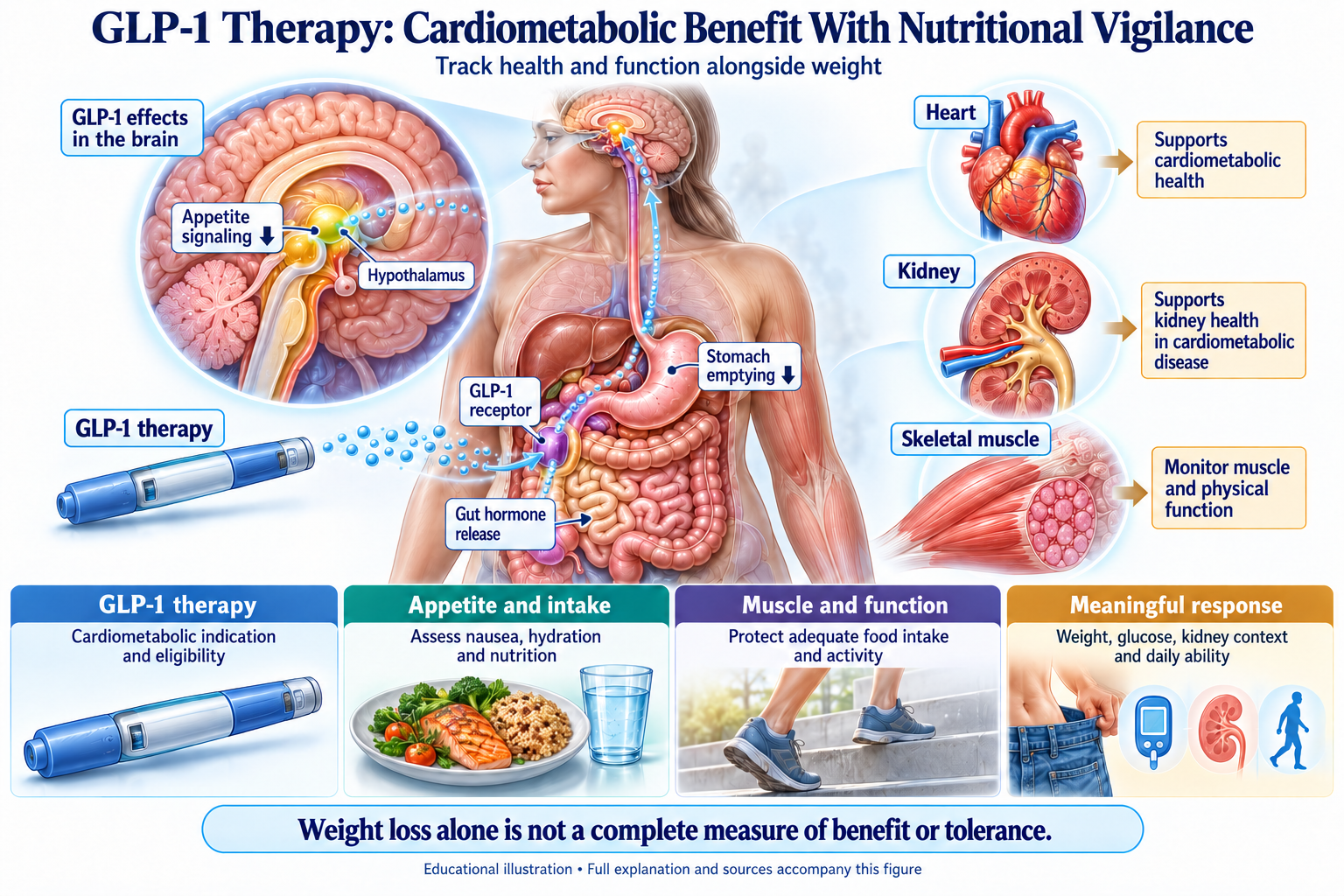
Browse the visual reference library · Download lesson Markdown
Renal Effects and Outcomes
Major Clinical Evidence
FLOW Trial (2024): Halted early due to compelling evidence — semaglutide 1.0 mg weekly significantly reduced kidney failure, sustained eGFR reduction ≥50%, and cardiovascular death in patients with T2D and CKD.
The Badve et al. meta-analysis of randomized trials found that GLP-1 receptor agonists reduced clinically important kidney and cardiovascular outcomes in the studied populations. Outcome definitions, trial populations, and pooled effect measures matter; the results do not establish identical benefit for every agent or every kidney disease. PubMed source
Renal Protection Mechanisms
- Restoration of Tubuloglomerular Feedback: GLP-1RAs induce diuresis and natriuresis by direct inhibition of NHE3 on proximal tubular cells
- Glomerular Hemodynamics: Enhanced sodium delivery to macula densa restores normal TGF and suppresses RAAS overactivation
- Anti-inflammatory Effects: GLP-1 receptors in kidneys dampen RAGE-induced inflammation
Clinical Outcomes Data
- Primary Prevention: 21% reduction in composite renal outcomes
- Acute Kidney Disease: 43% mortality reduction (aHR 0.57) in T2D patients with AKD
- Transplant Recipients: Significantly lower likelihood of sustaining 40% eGFR reduction, with better graft and patient survival
Diuretic Effects and Natriuresis
- GLP-1 promotes natriuresis by inhibiting NHE3: 40–60% increases in sodium excretion and 60% increases in calcium excretion during volume loading
- GLP-1 receptors in pelvic wall activate afferent renal nerves (110% increase in nerve activity)
Cardiovascular Effects and BNP Modulation
BNP Modulation
GLP-1RAs significantly decrease NT-proBNP (−0.14 SD; 95% CI −0.27 to −0.01; p = 0.03), independent of baseline age, body weight, and metabolic control.
Cardiovascular Outcomes Trial Results
| Trial | Agent | Population | MACE HR (95% CI) | ARR | NNT (3 yr) |
|---|---|---|---|---|---|
| LEADER | Liraglutide 1.8 mg | T2DM + CVD/risk | 0.87 (0.78–0.97) | 2.3% | 43 |
| SUSTAIN-6 | Semaglutide SC | T2DM + CVD/risk | 0.74 (0.58–0.95) | 2.9% | 34 |
| REWIND | Dulaglutide 1.5 mg | T2DM (31% 1° prev.) | 0.88 (0.79–0.99) | 1.2% | 83 |
| HARMONY | Albiglutide | T2DM + CVD | 0.78 (0.68–0.90) | 2.1% | 48 |
| AMPLITUDE-O | Efpeglenatide | T2DM + CVD/risk | 0.73 (0.58–0.92) | 3.4% | 29 |
| SELECT | Semaglutide 2.4 mg | Obesity + CVD, no DM | 0.80 (0.72–0.90) | 1.5% | 67 |
Individual MACE Components
- CV Death: 13% relative reduction (HR 0.87; 95% CI 0.81–0.94) — NNT 83–143
- MI: 9% relative reduction (HR 0.91; 95% CI 0.84–0.99) — NNT 125–250
- Stroke: 16% relative reduction (HR 0.84; 95% CI 0.76–0.93) — unique benefit vs. SGLT2i — NNT 111–200
- HF Hospitalization: 11% reduction (HR 0.89; 95% CI 0.82–0.98) — NNT 125–250
GLP-1 RAs provide a unique stroke reduction benefit (16%) that SGLT2 inhibitors do not. For patients with high stroke risk, GLP-1 RAs should be prioritized in the treatment algorithm.
Anti-Inflammatory Properties
Molecular Mechanisms
- NF-kB Pathway Inhibition: Block NF-kB activation and decrease TNF-alpha, IL-6, and IL-1beta
- Central Anti-Inflammatory Action: CNS GLP-1R activation required for systemic effects
- Macrophage Polarization: Shift toward M2 anti-inflammatory phenotype with 35% TNF-alpha reduction after LPS challenge
Tissue-Specific Effects
- Cardiovascular: Reduced atherosclerotic plaque inflammation
- Hepatic: Improved NASH through AMPK/mTOR autophagy pathway
- Renal: Protection against diabetic nephropathy via cAMP-PKA pathway
- Neurological: Neuroprotection in neurodegeneration and stroke models
Protein Requirements During GLP-1 Therapy
In some studies, 40–60% of total weight lost was attributed to muscle mass rather than fat. Proactive protein optimization is essential during GLP-1 therapy.
Evidence-Based Protein Targets
| Category | Target (g/kg/day) | Context |
|---|---|---|
| Minimum Threshold | 1.2 | Muscle preservation baseline |
| Optimal Range | 1.6–2.0 | During active weight loss |
| High-Risk (elderly, rapid loss) | Up to 2.4 | Older adults or rapid weight loss |
Key Evidence
- Protein intake >1.3 g/kg/day associated with increased muscle mass; intake <1.0 g/kg/day associated with higher risk of muscle mass decline (meta-analysis, SMD 0.75; p < 0.001)
- At 2.3 g/kg/day, muscle loss was only 0.3 kg vs. 1.6 kg at 1.0 g/kg/day during caloric restriction (Mettler et al.)
- Military personnel consuming 1.6–2.4 g/kg/day preserved anabolic sensitivity during 40% energy deficit vs. lost sensitivity at 0.8 g/kg/day (RDA)
GLP-1 Direct Effects on Muscle
GLP-1 infusion increased post-meal protein synthetic response by ~62% (vs. ~29% with placebo), potentially due to increased microvascular blood flow (Aging Cell).
Meal Pattern Optimization
- Per-Meal Target: 20–30 g protein per feeding session
- Frequency: 5+ feeding sessions daily for sustained amino acid supply
- 5–6 small meals instead of 3 large meals
- Evening cutoff: Stop eating 2–3 hours before bedtime
- Resistance training: Single most powerful intervention for maintaining lean tissue during weight loss
Available Agents and Clinical Selection
| Agent | Route | Dosing | Half-Life | CV Benefit | Start → Max |
|---|---|---|---|---|---|
| Exenatide IR (Byetta) | SC | BID | 2.4 hr | No | 5 μg → 10 μg BID |
| Liraglutide (Victoza) | SC | Daily | 13 hr | Yes | 0.6 → 1.8 mg |
| Dulaglutide (Trulicity) | SC | Weekly | 5 days | Yes | 0.75 → 4.5 mg |
| Semaglutide SC (Ozempic) | SC | Weekly | 7 days | Yes | 0.25 → 2.0 mg |
| Semaglutide Oral (Rybelsus) | Oral | Daily | 7 days | Under study | 3 → 14 mg |
| Tirzepatide (Mounjaro) | SC | Weekly | 5 days | Under study | 2.5 → 15 mg |
Clinical Selection Guide
- For CV Protection: Semaglutide SC (strongest signal, 26% MACE reduction), liraglutide (22% CV death reduction), dulaglutide (primary prevention benefit)
- For Weight Management: Semaglutide 2.4 mg (Wegovy), tirzepatide (Zepbound, up to 22.5% weight loss)
- For Convenience: Weekly agents preferred; oral semaglutide has complex fasting requirements
Adverse Effects Management
GI Side Effects (40–85% of patients)
- Typically transient (resolving 4–8 weeks), dose-dependent
- Nausea Protocol: Ondansetron 8 mg + metoclopramide 10 mg 30 min before injection reduces nausea from 61.7% to 16.7%
- Avoid strong smells; consume crackers/ginger 30 min post-injection
Stop GLP-1RA 1 week before upper endoscopy requiring sedation due to delayed gastric emptying risk.
Pancreatitis
Real-world study of 161 cases found no increased recurrent pancreatitis risk. Prior pancreatitis is not a contraindication to GLP-1RA therapy.
Hypoglycemia Prevention
- Reduce sulfonylurea dose by 50% when initiating GLP-1RA
- Consider 10–20% basal insulin reduction
Contraindications
- Personal/family history of medullary thyroid carcinoma
- MEN2 syndrome
- Pregnancy/nursing
- Severe gastroparesis
Drug Interactions and Combination Therapy
SGLT2 Inhibitor Combinations
- GLP-1 RAs reduce MACE by 23% (HR 0.77) regardless of baseline SGLT2i use (interaction P = 0.95)
- Combined additive renal protection: 38% vs. 21% individual benefit
- Triple therapy (SGLT2i + GLP-1RA + nonsteroidal MRA): projected 4.4% ARR with NNT of 23 over 3 years
RAAS Inhibitor Interactions
- GLP-1RA BP reduction (2–3 mmHg) is additive to ACEi/ARB effects
- No increased hypotension risk based on CVOT safety data (50–94% of participants on RAAS inhibitors)
Clinical Implementation
Monitoring Parameters
Acute Phase (0–12 weeks)
- Weekly: symptom assessment, weight, glucose patterns
- Biweekly: clinical evaluation during dose escalation
Maintenance Phase (>12 weeks)
- Quarterly: HbA1c (if diabetic), weight, BP
- Semiannually: CMP, lipid profile
- Annually: body composition (DEXA), micronutrient assessment
Special Populations
- CKD: Start lowest dose; benefits demonstrated in CKD stages 3–4; combine with SGLT2i for maximum renal protection
- HFpEF: Benefits established (STEP-HFpEF)
- Elderly (≥75): Increased dehydration risk; enhanced protein needs (1.2–2.0 g/kg/day)
- Pregnancy: Discontinue ≥2 months before conception
Key References
- Perkovic V, et al. Effects of semaglutide on CKD in T2D (FLOW). N Engl J Med. 2024;391(2):109–121. PubMed
- Badve SV, Bilal A, Lee MMY, et al. Effects of GLP-1 receptor agonists on kidney and cardiovascular disease outcomes: a meta-analysis of randomised controlled trials. Lancet Diabetes Endocrinol. 2025;13(1):15-28. PubMed
- Marso SP, et al. Liraglutide and CV outcomes (LEADER). N Engl J Med. 2016;375(4):311–322. PubMed
- Marso SP, et al. Semaglutide and CV outcomes (SUSTAIN-6). N Engl J Med. 2016;375(19):1834–1844. PubMed
- Gerstein HC, et al. Dulaglutide and CV outcomes (REWIND). Lancet. 2019;394:121–130. PubMed
- Lincoff AM, et al. Semaglutide in obesity without diabetes (SELECT). N Engl J Med. 2023;389(24):2221–2232. PubMed
- Kosiborod MN, et al. Semaglutide in HFpEF with obesity (STEP-HFpEF). N Engl J Med. 2023;389(12):1069–1084. PubMed
- Neuen BL, Heerspink HJL, Vart P, et al. Estimated Lifetime Cardiovascular, Kidney, and Mortality Benefits of Combination Treatment With SGLT2 Inhibitors, GLP-1 Receptor Agonists, and Nonsteroidal MRA Compared With Conventional Care in Patients With Type 2 Diabetes and Albuminuria. Circulation. 2024;149(6):450-462. PubMed
Related Mastery Modules
Also on this topic
The same subject at other levels of depth.
- Student handout: GLP-1 Receptor Agonists for PT Students