Visual summary
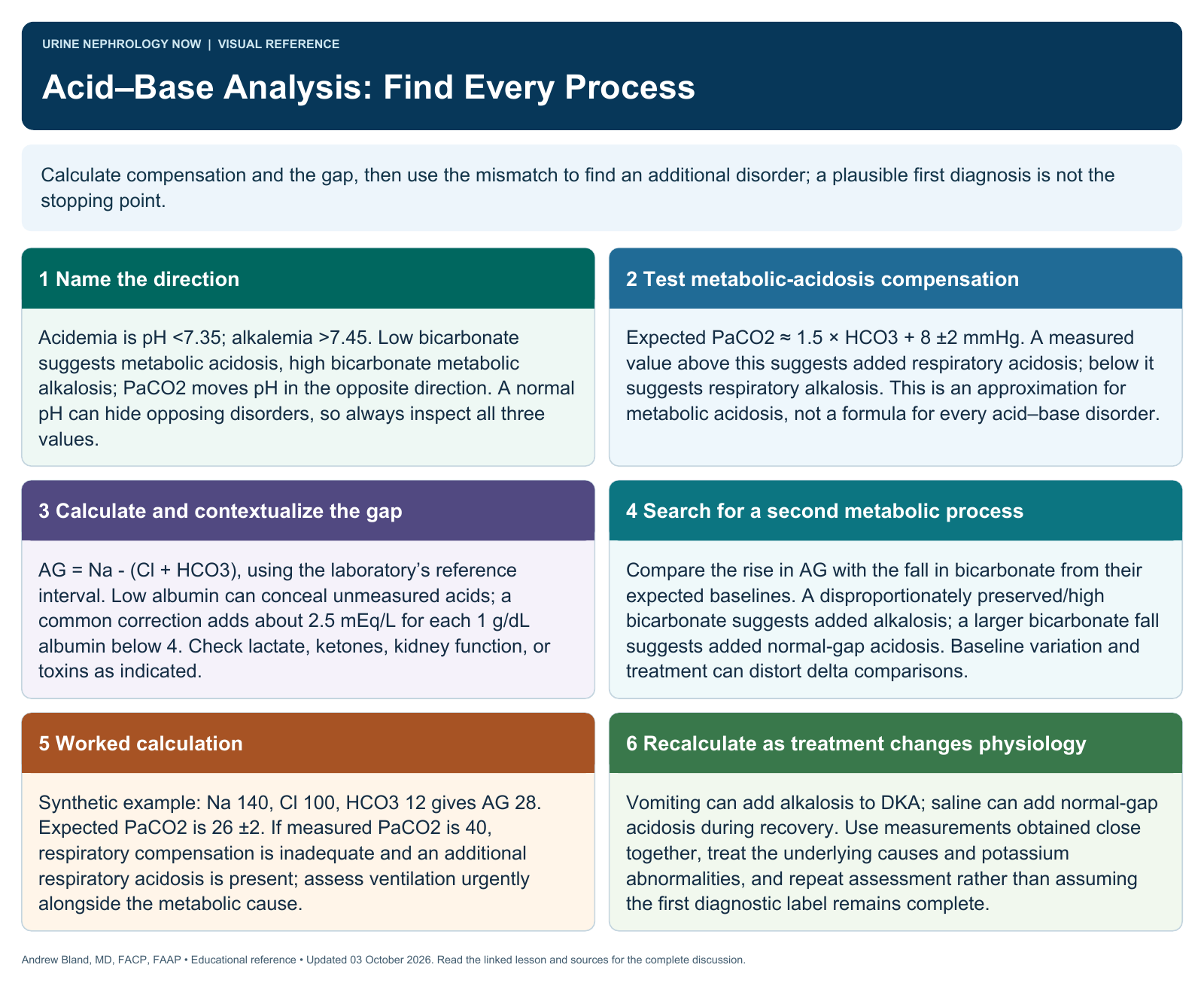
Name the primary disorder, test the expected response, calculate the gap, and look actively for an additional process.
Text version
Three variables, one physiology
pH describes acidemia or alkalemia; bicarbonate and carbon dioxide help identify metabolic and respiratory contributions. A near-normal pH can conceal major opposing disorders, so interpretation should always consider the whole set of measurements.
Start with the primary pattern
Assess pH, identify the dominant direction of bicarbonate and carbon dioxide change, and review the clinical setting. Check whether the blood gas and chemistry were collected at comparable times before combining results.
Test the compensation
Compare the observed response with the expected physiologic compensation for the suspected primary disorder. A mismatch suggests an additional process rather than unusually effective compensation. Acute and chronic respiratory disturbances have different expected responses.
Calculate the anion gap
Use the laboratory’s convention and consider albumin when interpreting the gap. An elevated gap prompts investigation for unmeasured acids; a normal gap does not eliminate clinically significant acidosis or mixed disease.
Applied case: DKA plus more
Case 6 demonstrates that ketoacidosis may coexist with vomiting-related alkalosis and another respiratory process. Compare the gap, bicarbonate change, and expected carbon dioxide rather than stopping at the first plausible diagnosis.
Treat causes, then reassess
Address the underlying illness, potassium and volume abnormalities, and adequate ventilation. Repeat measurements as treatment changes physiology. Compensation formulas and delta-gap comparisons are useful approximations, not substitutes for clinical interpretation.
Continue learning
This graphic summarizes a topic. The full educational pages provide the broader discussion and references.