Comprehensive Acid-Base Review
A Systematic Approach to Diagnosing and Managing Acid-Base Disorders
⏱️ Core Module
🎯 Essential Knowledge
📚 Complete Reference
📚 Module Navigation
1. Introduction & Key Concepts
2. The ABC's of Analysis
Full article: Comprehensive Acid-Base Review
4. Step-by-Step Approach
5. Compensation Rules
6. Anion Gap Analysis
7. Non-Anion Gap Acidosis
8. Mixed Disorders
Full article: Comprehensive Acid-Base Review
Full article: Comprehensive Acid-Base Review
Visual reference
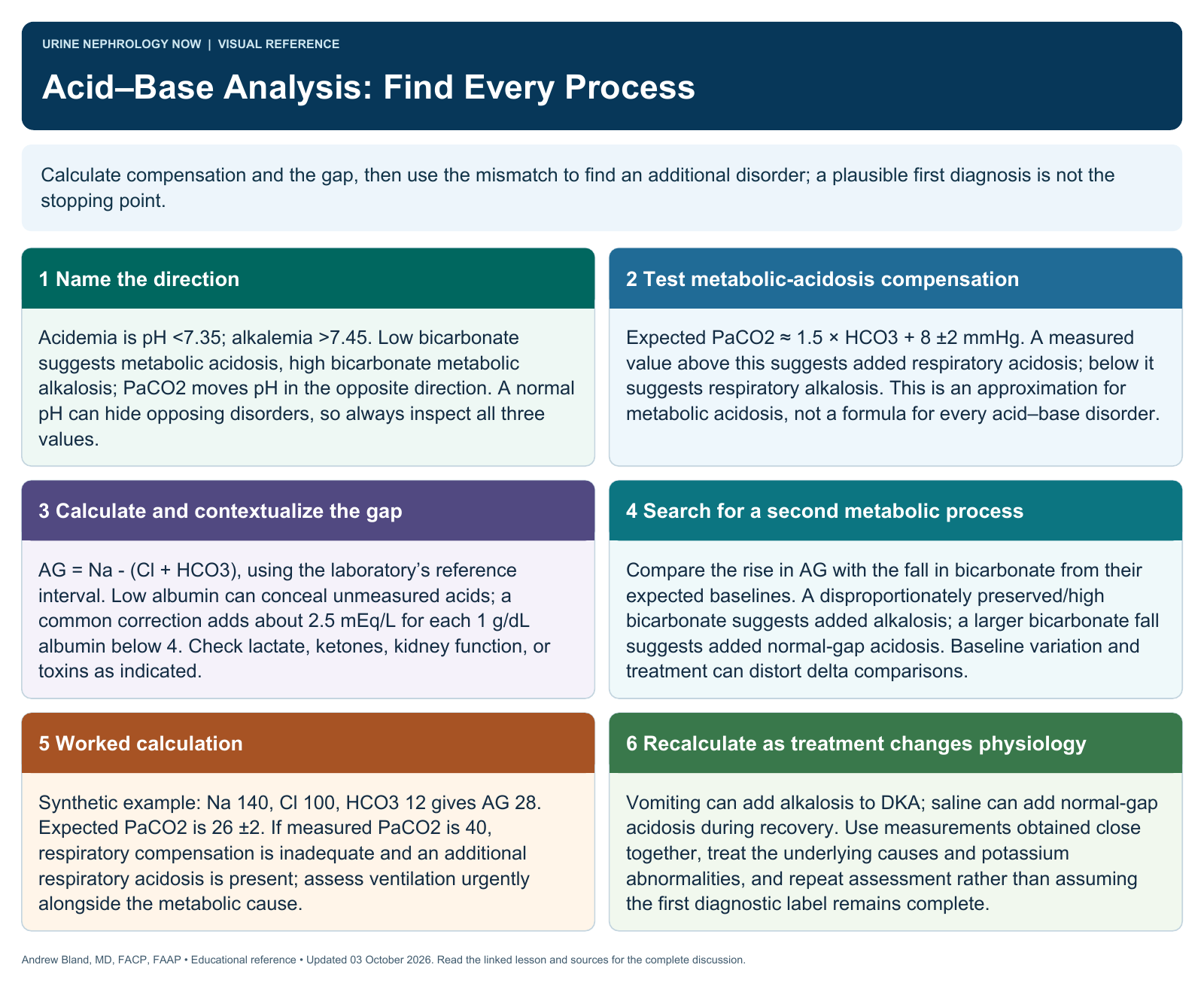
Browse the visual reference library · Download lesson Markdown
1. Introduction to Acid-Base Physiology
🎯 Core Definitions
| Term | Definition | Clinical Significance |
|---|---|---|
| Acidemia | Blood pH < 7.40 | Describes the blood pH state |
| Alkalemia | Blood pH > 7.40 | Describes the blood pH state |
| Acidosis | The underlying pathologic process causing acidemia | Can exist without acidemia if compensated |
| Alkalosis | The underlying pathologic process causing alkalemia | Can exist without alkalemia if compensated |
⚠️ Critical Concept
You can have acidosis without acidemia if another disorder is providing compensation. For example, a patient with chronic metabolic acidosis may have a normal pH due to respiratory compensation, but the underlying acidosis still exists.
2. The ABC's of Acid-Base Analysis
A. Initial Assessment
- Identify acidemia or alkalemia
- pH < 7.40 = Acidemia
- pH > 7.40 = Alkalemia
- Identify primary disorder
- Metabolic: Changes in HCO₃⁻
- ↑ HCO₃⁻ (> 24 mEq/L) = Metabolic alkalosis
- ↓ HCO₃⁻ (< 24 mEq/L) = Metabolic acidosis
- Respiratory: Changes in pCO₂
- ↑ pCO₂ (> 40 mmHg) = Respiratory acidosis
- ↓ pCO₂ (< 40 mmHg) = Respiratory alkalosis
- Metabolic: Changes in HCO₃⁻
B. Assess Compensation
⚠️ Golden Rules of Compensation
- Compensation is ALWAYS incomplete
- Overcompensation NEVER occurs
- If it appears to overcompensate, look for a secondary disorder
C. Calculate Anion Gap
AG = Na⁺ - Cl⁻ - HCO₃⁻
Normal AG ≈ 10 mEq/L (range 8-12)
Normal AG ≈ 10 mEq/L (range 8-12)
D. Evaluate for Multiple Disorders
Use Potential Bicarbonate or Delta/Delta ratio (covered in Mixed Disorders section)
E. For Non-Anion Gap Acidosis
Calculate Urinary Anion Gap (UAG)
🔑 Key Takeaways
- Always approach acid-base systematically using the 5-step method
- Compensation is never complete - if it appears so, look for a mixed disorder
- Check for mixed disorders in complex cases using delta/delta ratio
- UAG differentiates renal from GI causes of non-AG acidosis
- Remember correction factors (especially albumin for AG)
- Winter's formula is your best friend for metabolic acidosis
- Mixed respiratory + metabolic acidosis = "closed system" = severe acidemia