Visual summary
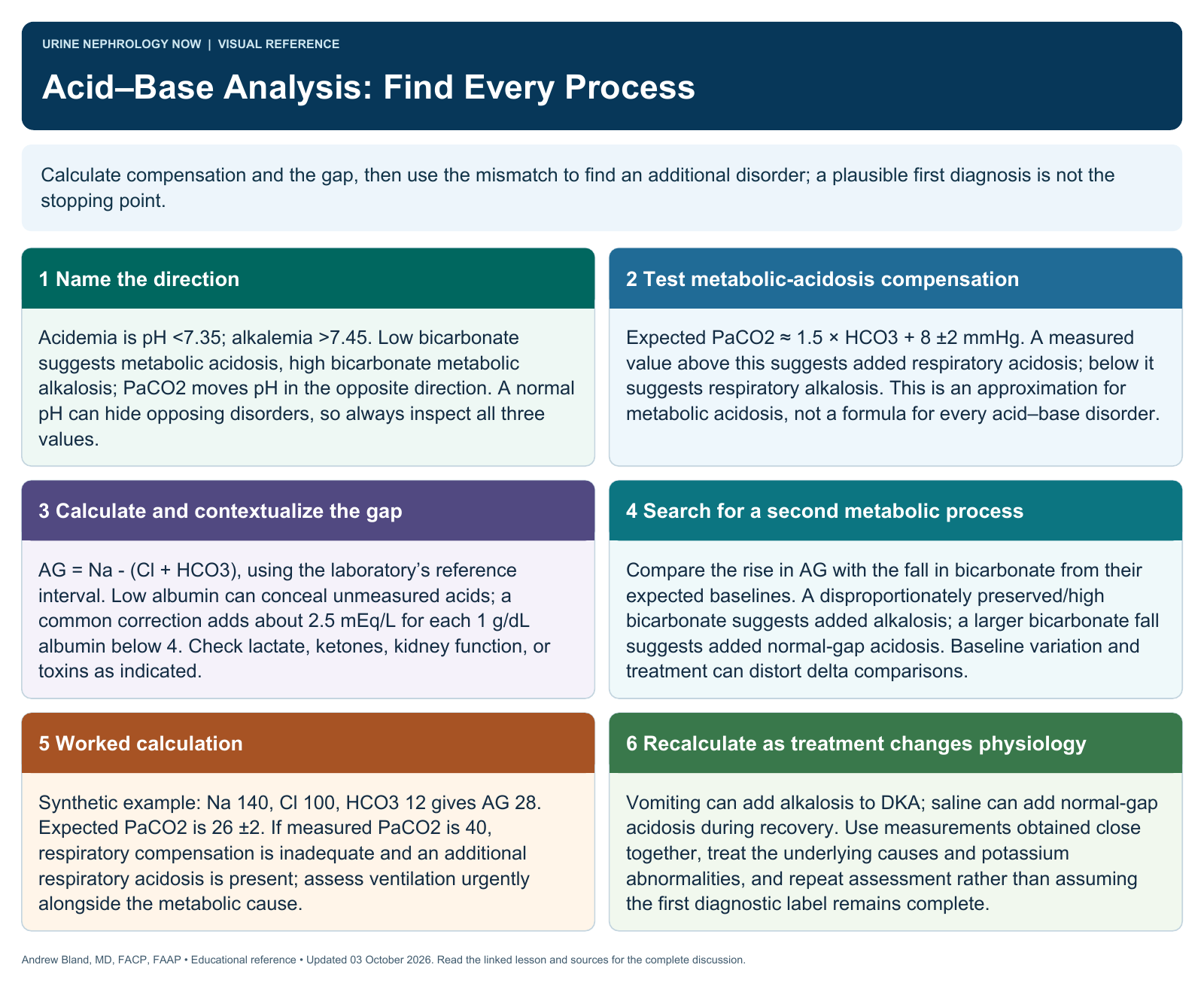
Calculate compensation and the gap, then use the mismatch to find an additional disorder; a plausible first diagnosis is not the stopping point.
Text version
Name the direction
Acidemia is pH <7.35; alkalemia >7.45. Low bicarbonate suggests metabolic acidosis, high bicarbonate metabolic alkalosis; PaCO₂ moves pH in the opposite direction. A normal pH can hide opposing disorders, so always inspect all three values.
Test metabolic-acidosis compensation
Expected PaCO₂ ≈ 1.5 × HCO₃ + 8 ±2 mmHg. A measured value above this suggests added respiratory acidosis; below it suggests respiratory alkalosis. This is an approximation for metabolic acidosis, not a formula for every acid–base disorder.
Calculate and contextualize the gap
AG = Na − (Cl + HCO₃), using the laboratory’s reference interval. Low albumin can conceal unmeasured acids; a common correction adds about 2.5 mEq/L for each 1 g/dL albumin below 4. Check lactate, ketones, kidney function, or toxins as indicated.
Search for a second metabolic process
Compare the rise in AG with the fall in bicarbonate from their expected baselines. A disproportionately preserved/high bicarbonate suggests added alkalosis; a larger bicarbonate fall suggests added normal-gap acidosis. Baseline variation and treatment can distort delta comparisons.
Worked calculation
Synthetic example: Na 140, Cl 100, HCO₃ 12 gives AG 28. Expected PaCO₂ is 26 ±2. If measured PaCO₂ is 40, respiratory compensation is inadequate and an additional respiratory acidosis is present; assess ventilation urgently alongside the metabolic cause.
Recalculate as treatment changes physiology
Vomiting can add alkalosis to DKA; saline can add normal-gap acidosis during recovery. Use measurements obtained close together, treat the underlying causes and potassium abnormalities, and repeat assessment rather than assuming the first diagnostic label remains complete.