Visual summary
Albuminuria adds information about kidney injury and risk that eGFR alone cannot provide. Most albumin remains in the circulation; glomerular pressure, barrier integrity, and proximal tubular handling influence how much appears in urine.
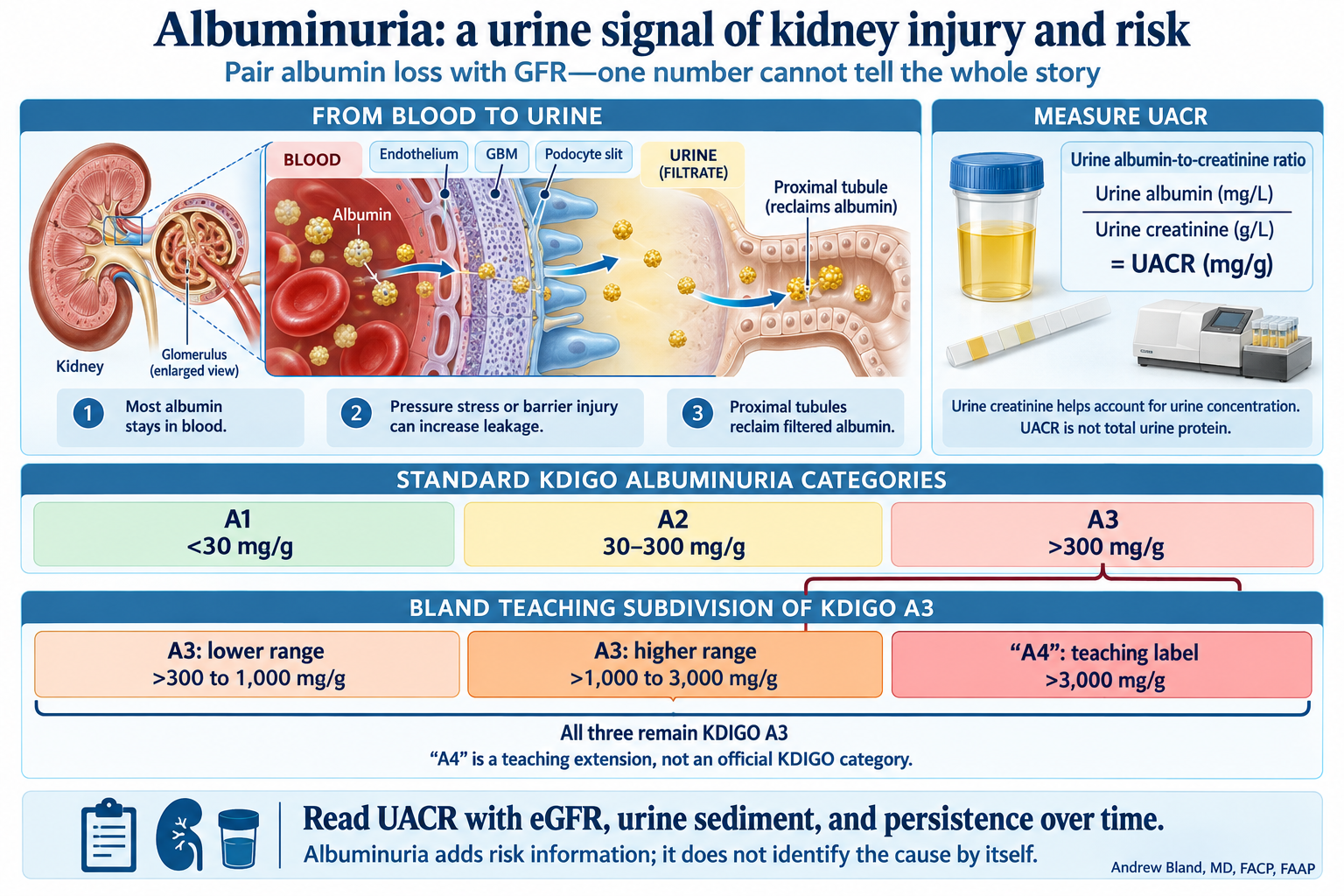
Illustration updated October 19, 2026. Educational schematic. Full teaching text and sources follow.
Diagram description
Albumin moves from blood across the glomerular barrier into filtrate, with proximal tubular reclamation. UACR divides urine albumin by urine creatinine. KDIGO A3 above 300 mg/g is subdivided for teaching into greater than 300 through 1,000, greater than 1,000 through 3,000, and greater than 3,000, called A4 in Bland’s teaching framework. All three remain KDIGO A3.
Text version
Measure urine albumin relative to urine creatinine
Urine albumin (mg/L) ÷ urine creatinine (g/L) = UACR (mg/g). Both measurements come from urine. The denominator helps account for urine concentration; differences in creatinine excretion can still influence the ratio. UACR measures albumin, not every urine protein.
A3 contains a wide range
| Teaching label | UACR | Standard KDIGO category |
|---|---|---|
| A1 | <30 | A1 |
| A2 | 30–300 | A2 |
| A3: lower range | >300 to 1,000 | A3 |
| A3: higher range | >1,000 to 3,000 | A3 |
| “A4”: teaching label | >3,000 | A3 |
The scorecard-inspired teaching extension separates the broad A3 band into three buckets. The upper boundary belongs to the preceding bucket: 1,000 is in the lower A3 range, 3,000 is in the higher A3 range, and values above 3,000 enter the teaching “A4” bucket. “A4” is not an official KDIGO category; all three buckets remain KDIGO A3.
A4 has a published history. The Canadian Society of Nephrology’s 2015 AJKD commentary proposed A4 for nephrotic-range albuminuria (ACR >2,220 mg/g). AJKD is the NKF journal. This lecture uses >3,000 mg/g for its teaching A4; current KDIGO remains A1–A3.
Read both directions in the heat map
GFR and UACR provide complementary risk information. Move down for lower GFR and across for higher UACR. The expanded teaching view preserves the standard KDIGO colors within A3. These are broad categories, not individual risk percentages.
Magnitude does not establish the cause
UACR does not itself prove hyperfiltration, inflammation, or nephrotic syndrome. Interpret it with urine sediment, GFR, clinical findings, and persistence. Transient elevations occur; persistent kidney abnormalities for at least three months support CKD.
Supporting evidence
NIDDK: assessment of urine albumin · KDIGO 2024 CKD guideline · KDIGO digital heat map
The subdivisions at 1,000 and 3,000 mg/g are Andrew Bland’s chosen teaching thresholds, confirmed October 19, 2026. The A4 name has historical precedent; these exact bins are not the standard KDIGO categories.