Visual summary
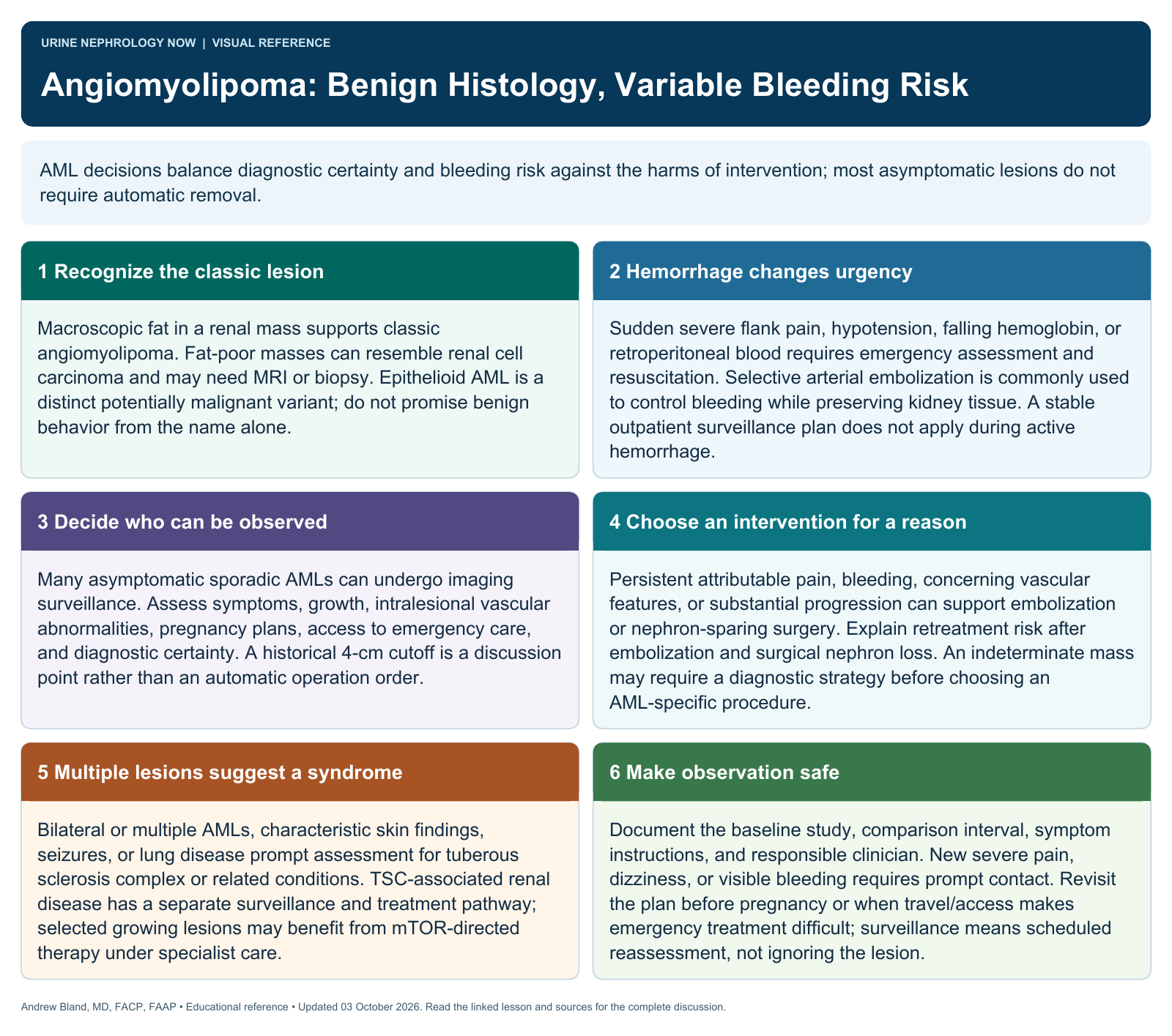
AML decisions balance diagnostic certainty and bleeding risk against the harms of intervention; most asymptomatic lesions do not require automatic removal.
Text version
Recognize the classic lesion
Macroscopic fat in a renal mass supports classic angiomyolipoma. Fat-poor masses can resemble renal cell carcinoma and may need MRI or biopsy. Epithelioid AML is a distinct potentially malignant variant; do not promise benign behavior from the name alone.
Hemorrhage changes urgency
Sudden severe flank pain, hypotension, falling hemoglobin, or retroperitoneal blood requires emergency assessment and resuscitation. Selective arterial embolization is commonly used to control bleeding while preserving kidney tissue. A stable outpatient surveillance plan does not apply during active hemorrhage.
Decide who can be observed
Many asymptomatic sporadic AMLs can undergo imaging surveillance. Assess symptoms, growth, intralesional vascular abnormalities, pregnancy plans, access to emergency care, and diagnostic certainty. A historical 4-cm cutoff is a discussion point rather than an automatic operation order.
Choose an intervention for a reason
Persistent attributable pain, bleeding, concerning vascular features, or substantial progression can support embolization or nephron-sparing surgery. Explain retreatment risk after embolization and surgical nephron loss. An indeterminate mass may require a diagnostic strategy before choosing an AML-specific procedure.
Multiple lesions suggest a syndrome
Bilateral or multiple AMLs, characteristic skin findings, seizures, or lung disease prompt assessment for tuberous sclerosis complex or related conditions. TSC-associated renal disease has a separate surveillance and treatment pathway; selected growing lesions may benefit from mTOR-directed therapy under specialist care.
Make observation safe
Document the baseline study, comparison interval, symptom instructions, and responsible clinician. New severe pain, dizziness, or visible bleeding requires prompt contact. Revisit the plan before pregnancy or when travel/access makes emergency treatment difficult; surveillance means scheduled reassessment, not ignoring the lesion.