Visual summary
A safe ARNI transition is a verified medication schedule with no prohibited overlap and a concrete monitoring plan.
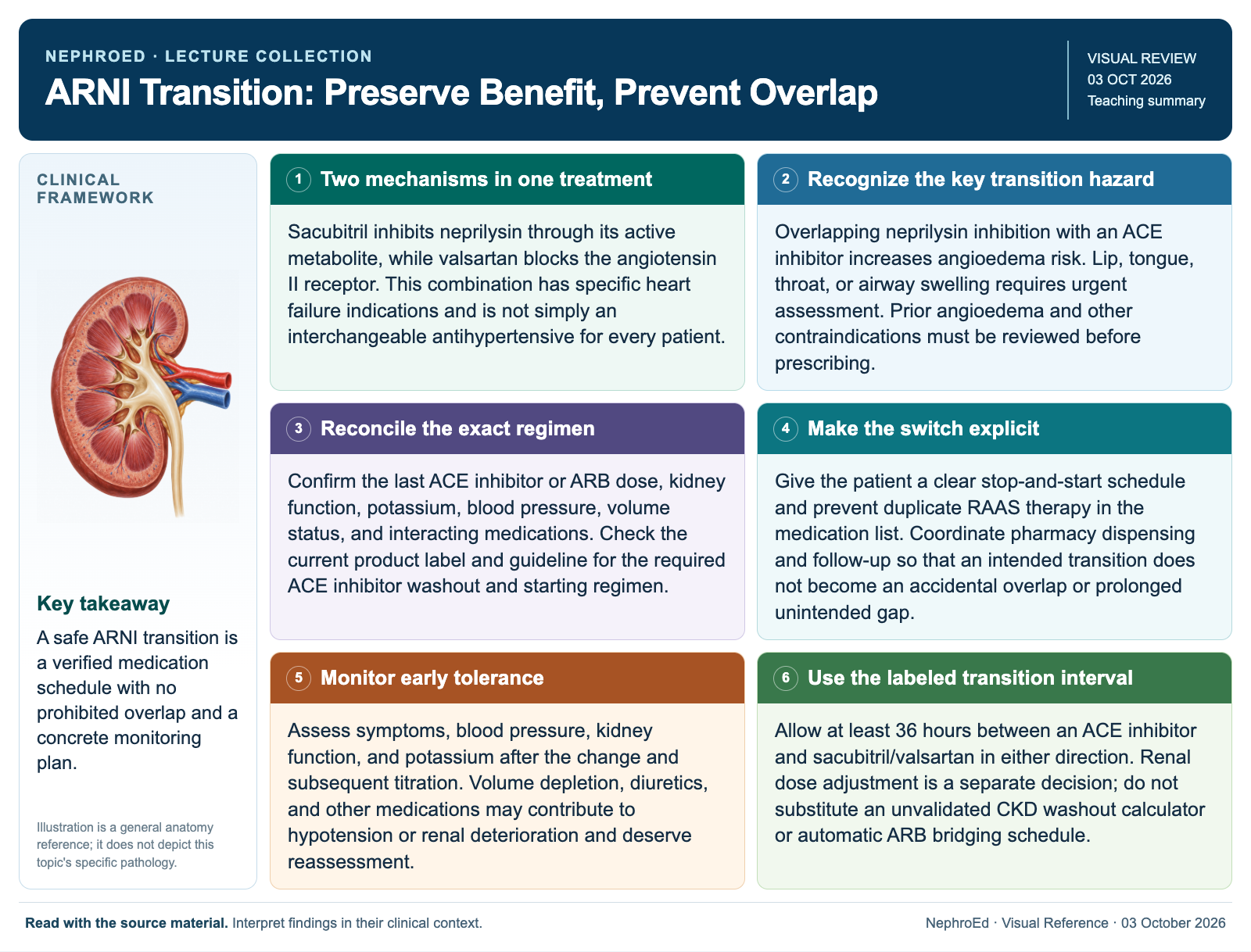
Text version
Two mechanisms in one treatment
Sacubitril inhibits neprilysin through its active metabolite, while valsartan blocks the angiotensin II receptor. This combination has specific heart failure indications and is not simply an interchangeable antihypertensive for every patient.
Recognize the key transition hazard
Overlapping neprilysin inhibition with an ACE inhibitor increases angioedema risk. Lip, tongue, throat, or airway swelling requires urgent assessment. Prior angioedema and other contraindications must be reviewed before prescribing.
Reconcile the exact regimen
Confirm the last ACE inhibitor or ARB dose, kidney function, potassium, blood pressure, volume status, and interacting medications. Check the current product label and guideline for the required ACE inhibitor washout and starting regimen.
Make the switch explicit
Give the patient a clear stop-and-start schedule and prevent duplicate RAAS therapy in the medication list. Coordinate pharmacy dispensing and follow-up so that an intended transition does not become an accidental overlap or prolonged unintended gap.
Monitor early tolerance
Assess symptoms, blood pressure, kidney function, and potassium after the change and subsequent titration. Volume depletion, diuretics, and other medications may contribute to hypotension or renal deterioration and deserve reassessment.
Use the labeled transition interval
Allow at least 36 hours between an ACE inhibitor and sacubitril/valsartan in either direction. Renal dose adjustment is a separate decision; do not substitute an unvalidated CKD washout calculator or automatic ARB bridging schedule.
Continue learning
This graphic summarizes a topic. The full educational pages provide the broader discussion and references.