Visual summary
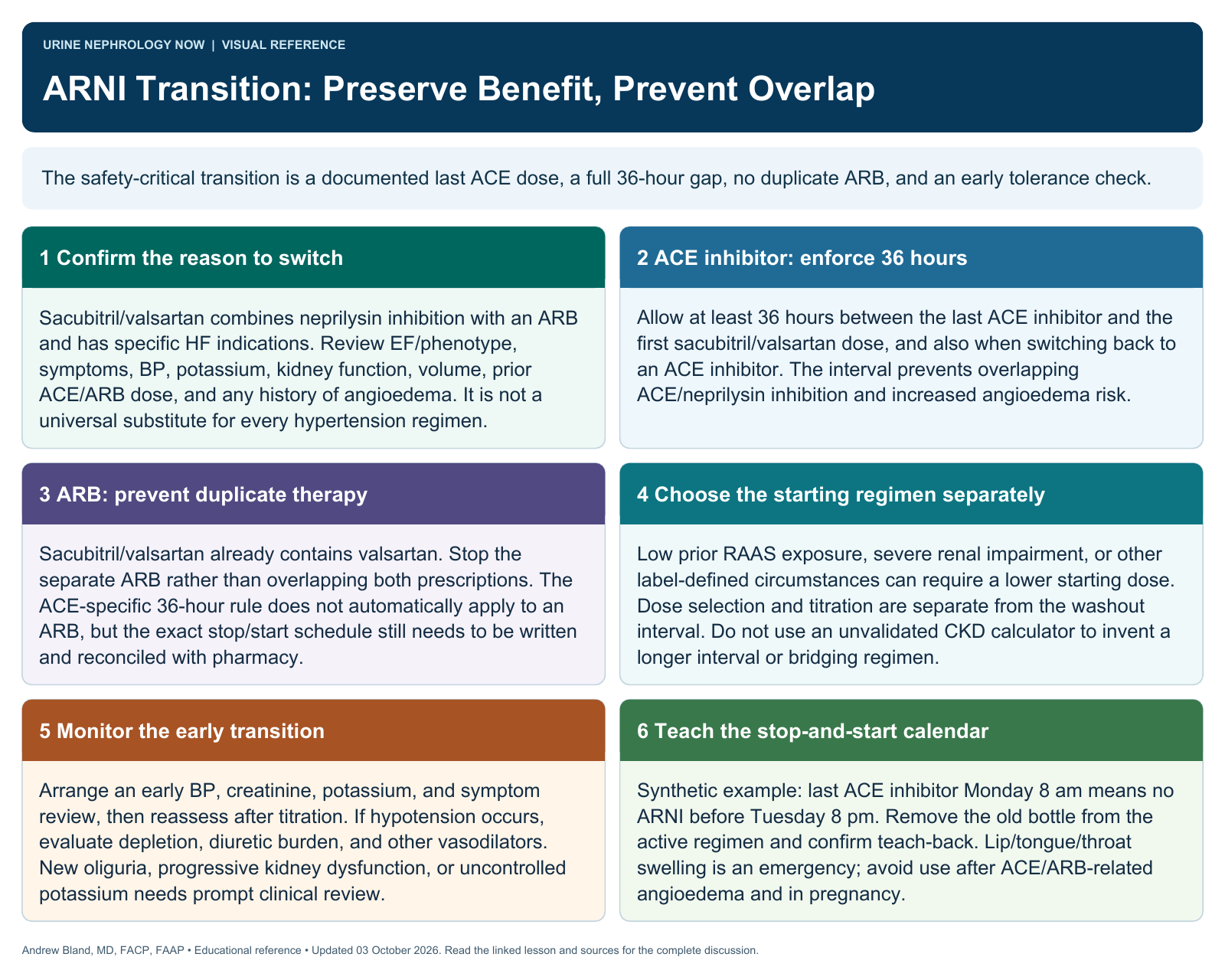
The safety-critical transition is a documented last ACE dose, a full 36-hour gap, no duplicate ARB, and an early tolerance check.
Text version
Confirm the reason to switch
Sacubitril/valsartan combines neprilysin inhibition with an ARB and has specific HF indications. Review EF/phenotype, symptoms, BP, potassium, kidney function, volume, prior ACE/ARB dose, and any history of angioedema. It is not a universal substitute for every hypertension regimen.
ACE inhibitor: enforce 36 hours
Allow at least 36 hours between the last ACE inhibitor and the first sacubitril/valsartan dose, and also when switching back to an ACE inhibitor. The interval prevents overlapping ACE/neprilysin inhibition and increased angioedema risk.
ARB: prevent duplicate therapy
Sacubitril/valsartan already contains valsartan. Stop the separate ARB rather than overlapping both prescriptions. The ACE-specific 36-hour rule does not automatically apply to an ARB, but the exact stop/start schedule still needs to be written and reconciled with pharmacy.
Choose the starting regimen separately
Low prior RAAS exposure, severe renal impairment, or other label-defined circumstances can require a lower starting dose. Dose selection and titration are separate from the washout interval. Do not use an unvalidated CKD calculator to invent a longer interval or bridging regimen.
Monitor the early transition
Arrange an early BP, creatinine, potassium, and symptom review, then reassess after titration. If hypotension occurs, evaluate depletion, diuretic burden, and other vasodilators. New oliguria, progressive kidney dysfunction, or uncontrolled potassium needs prompt clinical review.
Teach the stop-and-start calendar
Synthetic example: last ACE inhibitor Monday 8 am means no ARNI before Tuesday 8 pm. Remove the old bottle from the active regimen and confirm teach-back. Lip/tongue/throat swelling is an emergency; avoid use after ACE/ARB-related angioedema and in pregnancy.