Visual summary
Bosniak is a structured imaging language; the patient’s situation determines how its risk estimate becomes a management plan.
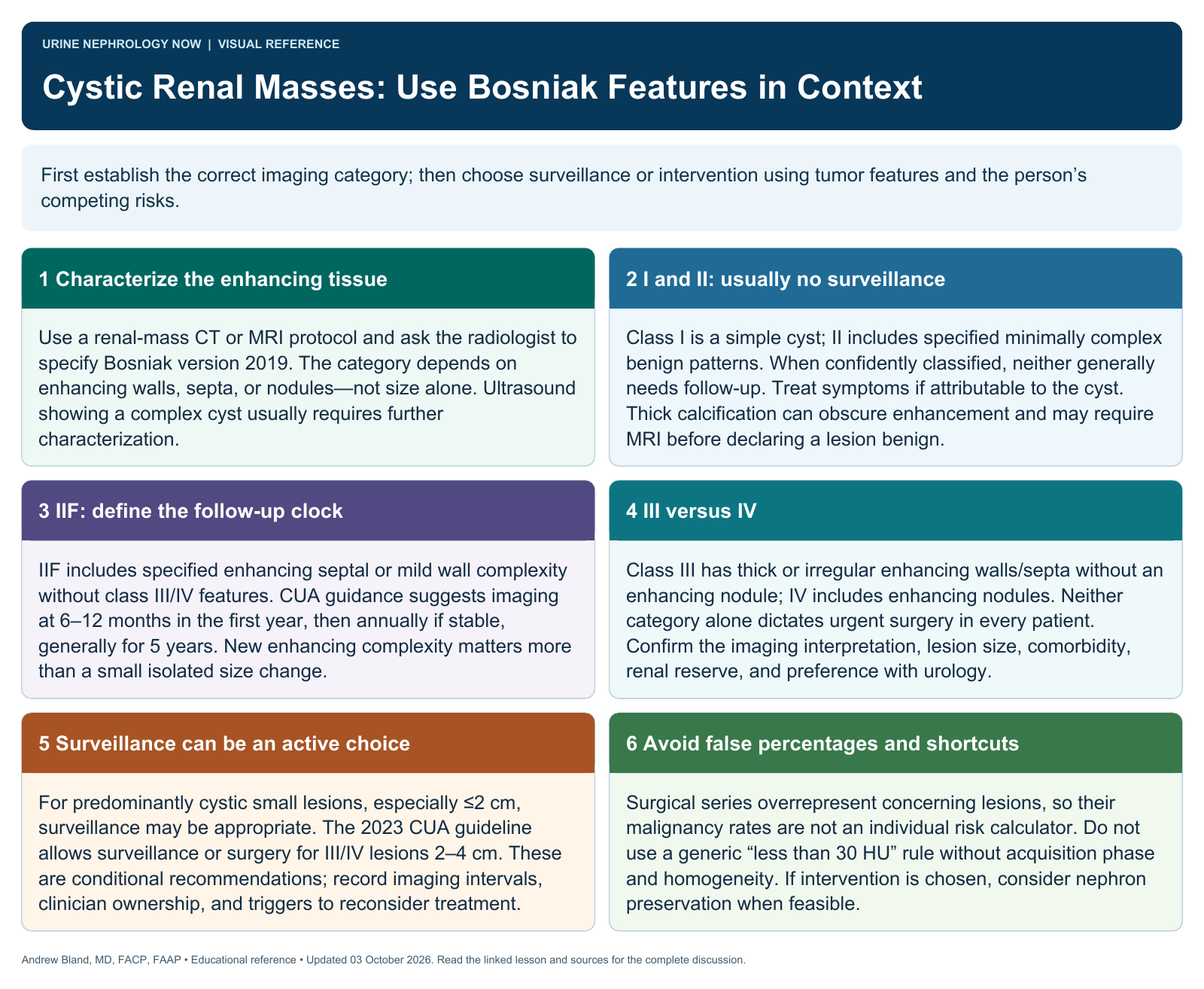
Text version
A classification of imaging appearance
Bosniak classification organizes cystic renal masses by features such as wall and septal complexity, enhancement, and nodules. It estimates concern for malignancy; it does not by itself establish pathology or dictate the same treatment for everyone.
Recognize complexity
A simple cyst differs from a mass with enhancing internal structures or nodularity. Hemorrhage, infection, and technical factors can complicate interpretation, so suspicious findings need appropriate characterization rather than a category guessed from one ultrasound image.
Use the correct imaging framework
The 2019 version incorporates specific CT and MRI criteria. Confirm the modality, protocol quality, and radiologist’s description, and distinguish a cystic renal mass from necrotic tissue within a predominantly solid tumor.
Link category to a discussion
Lower-risk findings may need no additional intervention, while selected lesions require surveillance or urologic assessment. Management considers size, growth, comorbidity, life expectancy, renal function, patient preferences, and current guideline recommendations.
Make surveillance explicit
If observation is chosen, document the imaging method, planned interval, responsible clinician, and triggers for reassessment. A surveillance recommendation without ownership or follow-up can leave an indeterminate lesion unresolved.
Avoid false precision
Reported malignancy proportions depend on how cohorts were selected and which lesions underwent surgery. Do not present a category’s historical percentage as the exact risk for an individual or imply that every complex cyst requires immediate surgery.
Continue learning
This graphic summarizes a topic. The full educational pages provide the broader discussion and references.