Visual summary
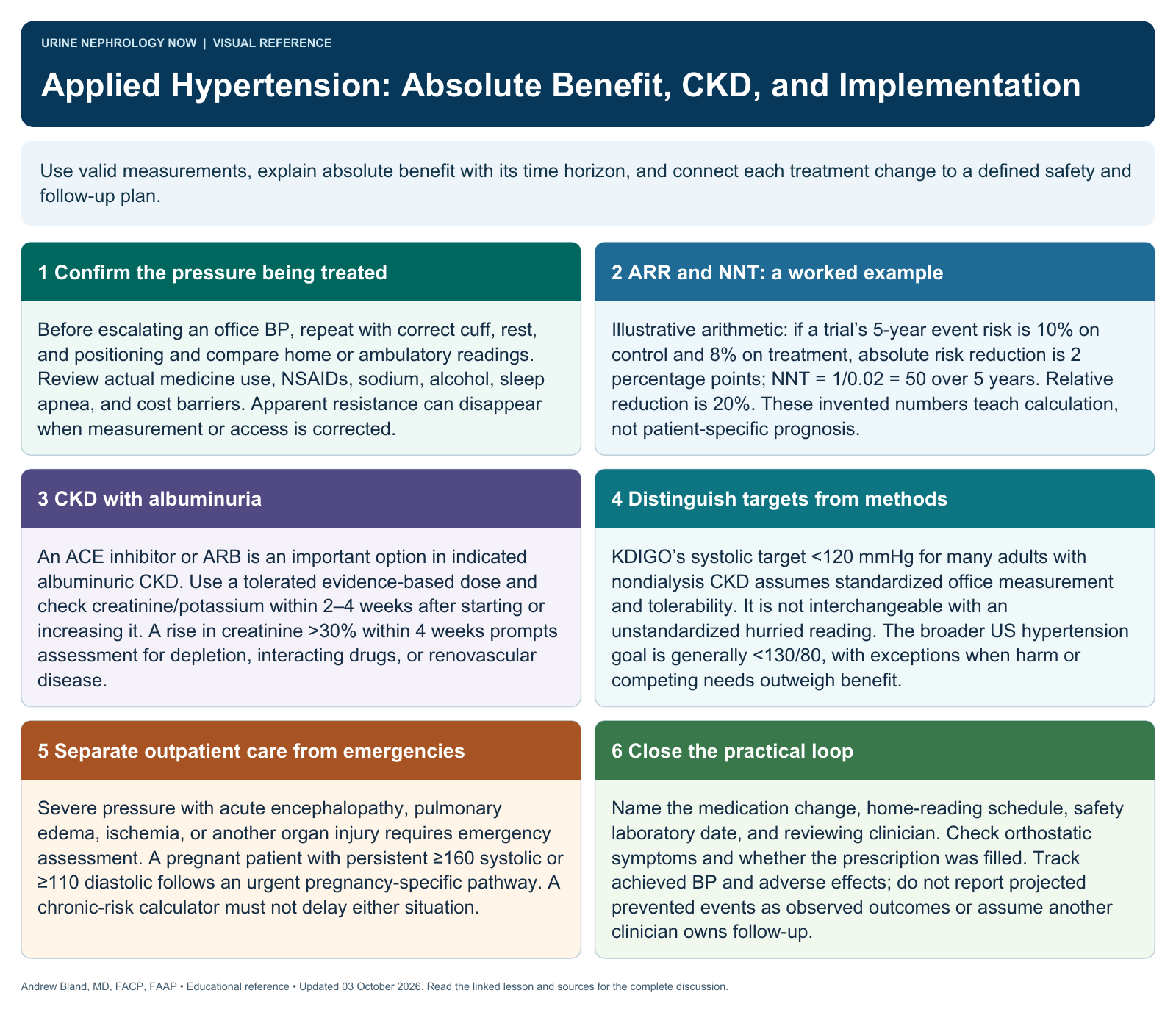
Use valid measurements, explain absolute benefit with its time horizon, and connect each treatment change to a defined safety and follow-up plan.
Text version
Confirm the pressure being treated
Before escalating an office BP, repeat with correct cuff, rest, and positioning and compare home or ambulatory readings. Review actual medicine use, NSAIDs, sodium, alcohol, sleep apnea, and cost barriers. Apparent resistance can disappear when measurement or access is corrected.
ARR and NNT: a worked example
Illustrative arithmetic: if a trial’s 5-year event risk is 10% on control and 8% on treatment, absolute risk reduction is 2 percentage points; NNT = 1/0.02 = 50 over 5 years. Relative reduction is 20%. These invented numbers teach calculation, not patient-specific prognosis.
CKD with albuminuria
An ACE inhibitor or ARB is an important option in indicated albuminuric CKD. Use a tolerated evidence-based dose and check creatinine/potassium within 2–4 weeks after starting or increasing it. A rise in creatinine >30% within 4 weeks prompts assessment for depletion, interacting drugs, or renovascular disease.
Distinguish targets from methods
KDIGO’s systolic target <120 mmHg for many adults with nondialysis CKD assumes standardized office measurement and tolerability. It is not interchangeable with an unstandardized hurried reading. The broader US hypertension goal is generally <130/80, with exceptions when harm or competing needs outweigh benefit.
Separate outpatient care from emergencies
Severe pressure with acute encephalopathy, pulmonary edema, ischemia, or another organ injury requires emergency assessment. A pregnant patient with persistent ≥160 systolic or ≥110 diastolic follows an urgent pregnancy-specific pathway. A chronic-risk calculator must not delay either situation.
Close the practical loop
Name the medication change, home-reading schedule, safety laboratory date, and reviewing clinician. Check orthostatic symptoms and whether the prescription was filled. Track achieved BP and adverse effects; do not report projected prevented events as observed outcomes or assume another clinician owns follow-up.