Visual summary
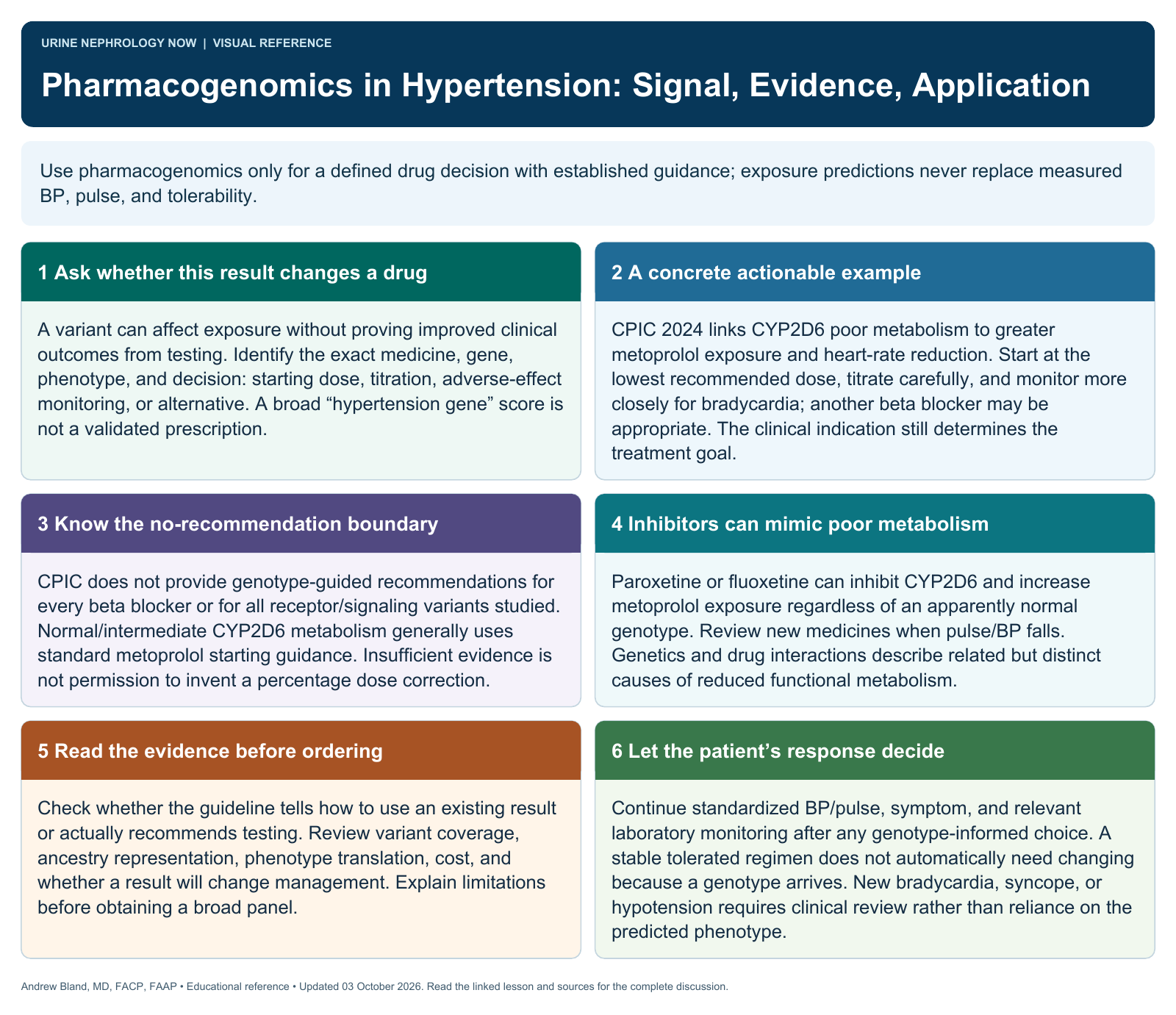
Use pharmacogenomics only for a defined drug decision with established guidance; exposure predictions never replace measured BP, pulse, and tolerability.
Text version
Ask whether this result changes a drug
A variant can affect exposure without proving improved clinical outcomes from testing. Identify the exact medicine, gene, phenotype, and decision: starting dose, titration, adverse-effect monitoring, or alternative. A broad “hypertension gene” score is not a validated prescription.
A concrete actionable example
CPIC 2024 links CYP2D6 poor metabolism to greater metoprolol exposure and heart-rate reduction. Start at the lowest recommended dose, titrate carefully, and monitor more closely for bradycardia; another beta blocker may be appropriate. The clinical indication still determines the treatment goal.
Know the no-recommendation boundary
CPIC does not provide genotype-guided recommendations for every beta blocker or for all receptor/signaling variants studied. Normal/intermediate CYP2D6 metabolism generally uses standard metoprolol starting guidance. Insufficient evidence is not permission to invent a percentage dose correction.
Inhibitors can mimic poor metabolism
Paroxetine or fluoxetine can inhibit CYP2D6 and increase metoprolol exposure regardless of an apparently normal genotype. Review new medicines when pulse/BP falls. Genetics and drug interactions describe related but distinct causes of reduced functional metabolism.
Read the evidence before ordering
Check whether the guideline tells how to use an existing result or actually recommends testing. Review variant coverage, ancestry representation, phenotype translation, cost, and whether a result will change management. Explain limitations before obtaining a broad panel.
Let the patient’s response decide
Continue standardized BP/pulse, symptom, and relevant laboratory monitoring after any genotype-informed choice. A stable tolerated regimen does not automatically need changing because a genotype arrives. New bradycardia, syncope, or hypotension requires clinical review rather than reliance on the predicted phenotype.