Visual summary
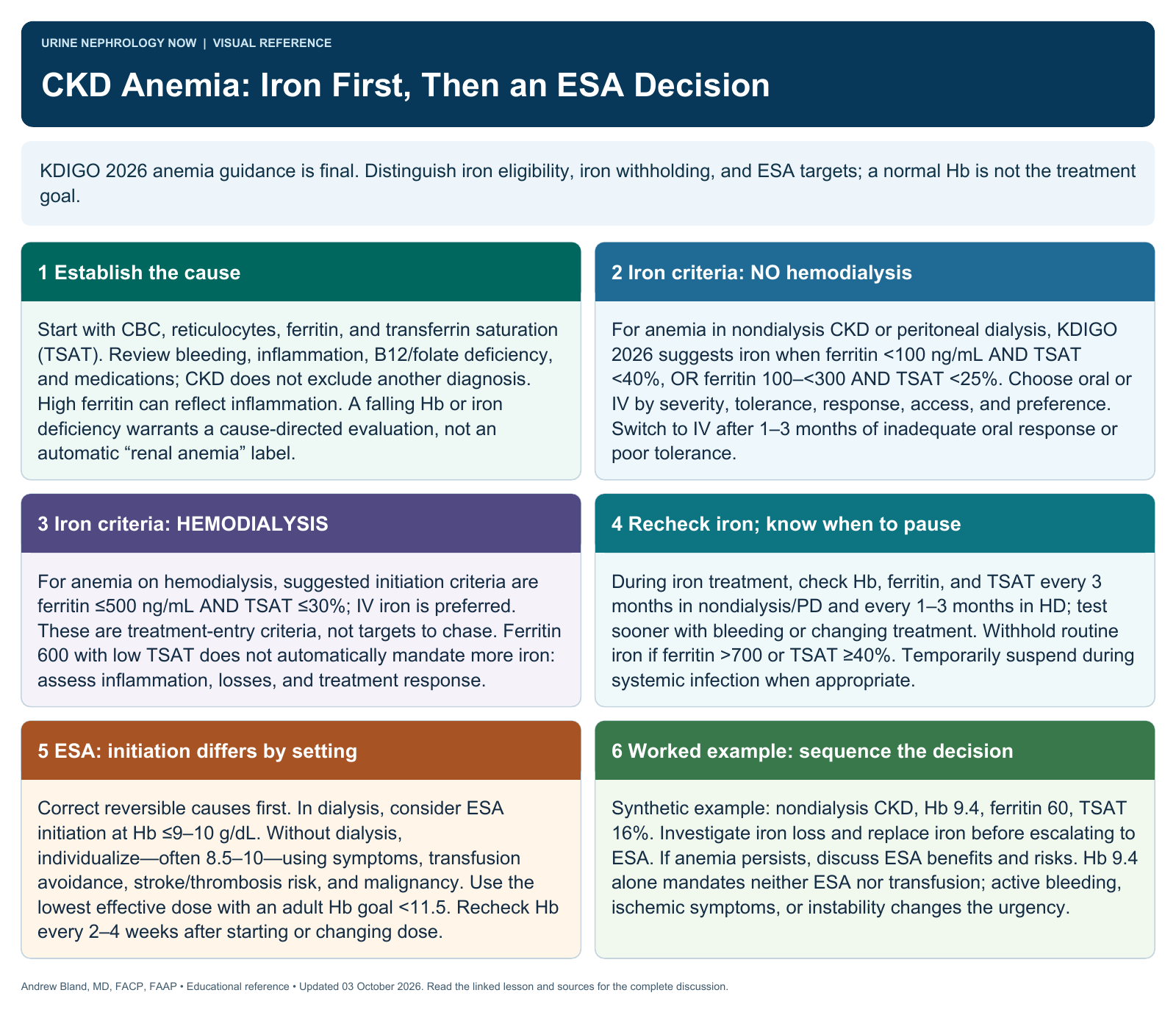
KDIGO 2026 anemia guidance is final. Distinguish iron eligibility, iron withholding, and ESA targets; a normal Hb is not the treatment goal.
Text version
Establish the cause
Start with CBC, reticulocytes, ferritin, and transferrin saturation (TSAT). Review bleeding, inflammation, B12/folate deficiency, and medications; CKD does not exclude another diagnosis. High ferritin can reflect inflammation. A falling Hb or iron deficiency warrants a cause-directed evaluation, not an automatic “renal anemia” label.
Iron criteria: NO hemodialysis
For anemia in nondialysis CKD or peritoneal dialysis, KDIGO 2026 suggests iron when ferritin <100 ng/mL AND TSAT <40%, OR ferritin 100–<300 AND TSAT <25%. Choose oral or IV by severity, tolerance, response, access, and preference. Switch to IV after 1–3 months of inadequate oral response or poor tolerance.
Iron criteria: HEMODIALYSIS
For anemia on hemodialysis, suggested initiation criteria are ferritin ≤500 ng/mL AND TSAT ≤30%; IV iron is preferred. These are treatment-entry criteria, not targets to chase. Ferritin 600 with low TSAT does not automatically mandate more iron: assess inflammation, losses, and treatment response.
Recheck iron; know when to pause
During iron treatment, check Hb, ferritin, and TSAT every 3 months in nondialysis/PD and every 1–3 months in HD; test sooner with bleeding or changing treatment. Withhold routine iron if ferritin >700 or TSAT ≥40%. Temporarily suspend during systemic infection when appropriate.
ESA: initiation differs by setting
Correct reversible causes first. In dialysis, consider ESA initiation at Hb ≤9–10 g/dL. Without dialysis, individualize—often 8.5–10—using symptoms, transfusion avoidance, stroke/thrombosis risk, and malignancy. Use the lowest effective dose with an adult Hb goal <11.5. Recheck Hb every 2–4 weeks after starting or changing dose.
Worked example: sequence the decision
Synthetic example: nondialysis CKD, Hb 9.4, ferritin 60, TSAT 16%. Investigate iron loss and replace iron before escalating to ESA. If anemia persists, discuss ESA benefits and risks. Hb 9.4 alone mandates neither ESA nor transfusion; active bleeding, ischemic symptoms, or instability changes the urgency.
Supporting evidence
- KDIGO 2026 anemia guideline: recommendations2.1–2.4,3.2.1–3.3.1 and practice points2.2,2.5,2.7,2.8,3.4.3.2
- Supporting guideline or source
- KDIGO 2026 Clinical Practice Guideline for the Management of Anemia in Chronic Kidney Disease.
- Intravenous Iron in Patients Undergoing Maintenance Hemodialysis.
- A Trial of Darbepoetin Alfa in Type 2 Diabetes and Chronic Kidney Disease.