Visual summary
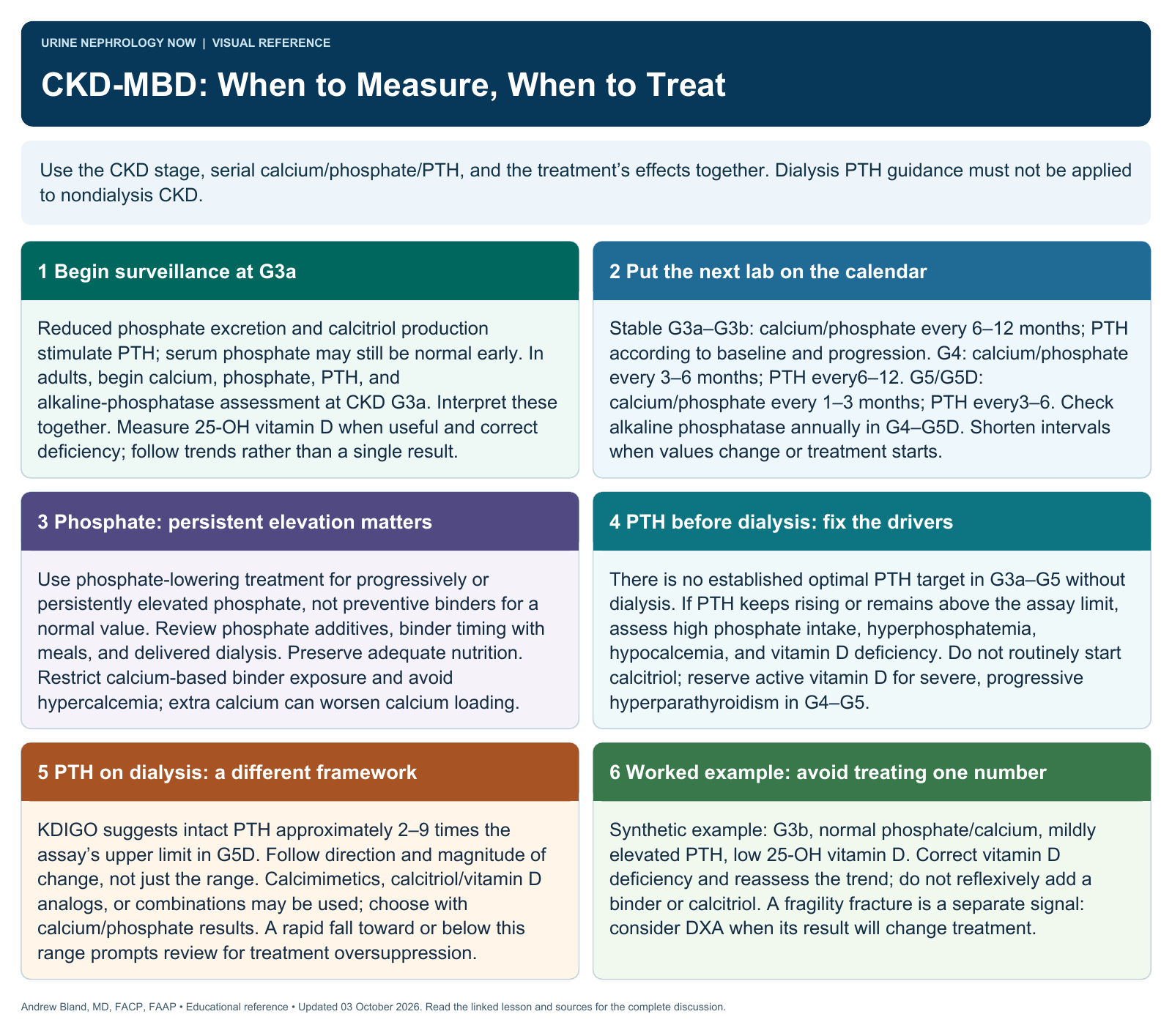
Use the CKD stage, serial calcium/phosphate/PTH, and the treatment’s effects together. Dialysis PTH guidance must not be applied to nondialysis CKD.
Text version
Begin surveillance at G3a
Reduced phosphate excretion and calcitriol production stimulate PTH; serum phosphate may still be normal early. In adults, begin calcium, phosphate, PTH, and alkaline-phosphatase assessment at CKD G3a. Interpret these together. Measure 25-OH vitamin D when useful and correct deficiency; follow trends rather than a single result.
Put the next lab on the calendar
Stable G3a–G3b: calcium/phosphate every 6–12 months; PTH according to baseline and progression. G4: calcium/phosphate every 3–6 months; PTH every6–12. G5/G5D: calcium/phosphate every 1–3 months; PTH every3–6. Check alkaline phosphatase annually in G4–G5D. Shorten intervals when values change or treatment starts.
Phosphate: persistent elevation matters
Use phosphate-lowering treatment for progressively or persistently elevated phosphate, not preventive binders for a normal value. Review phosphate additives, binder timing with meals, and delivered dialysis. Preserve adequate nutrition. Restrict calcium-based binder exposure and avoid hypercalcemia; extra calcium can worsen calcium loading.
PTH before dialysis: fix the drivers
There is no established optimal PTH target in G3a–G5 without dialysis. If PTH keeps rising or remains above the assay limit, assess high phosphate intake, hyperphosphatemia, hypocalcemia, and vitamin D deficiency. Do not routinely start calcitriol; reserve active vitamin D for severe, progressive hyperparathyroidism in G4–G5.
PTH on dialysis: a different framework
KDIGO suggests intact PTH approximately 2–9 times the assay’s upper limit in G5D. Follow direction and magnitude of change, not just the range. Calcimimetics, calcitriol/vitamin D analogs, or combinations may be used; choose with calcium/phosphate results. A rapid fall toward or below this range prompts review for treatment oversuppression.
Worked example: avoid treating one number
Synthetic example: G3b, normal phosphate/calcium, mildly elevated PTH, low 25-OH vitamin D. Correct vitamin D deficiency and reassess the trend; do not reflexively add a binder or calcitriol. A fragility fracture is a separate signal: consider DXA when its result will change treatment.