Visual summary
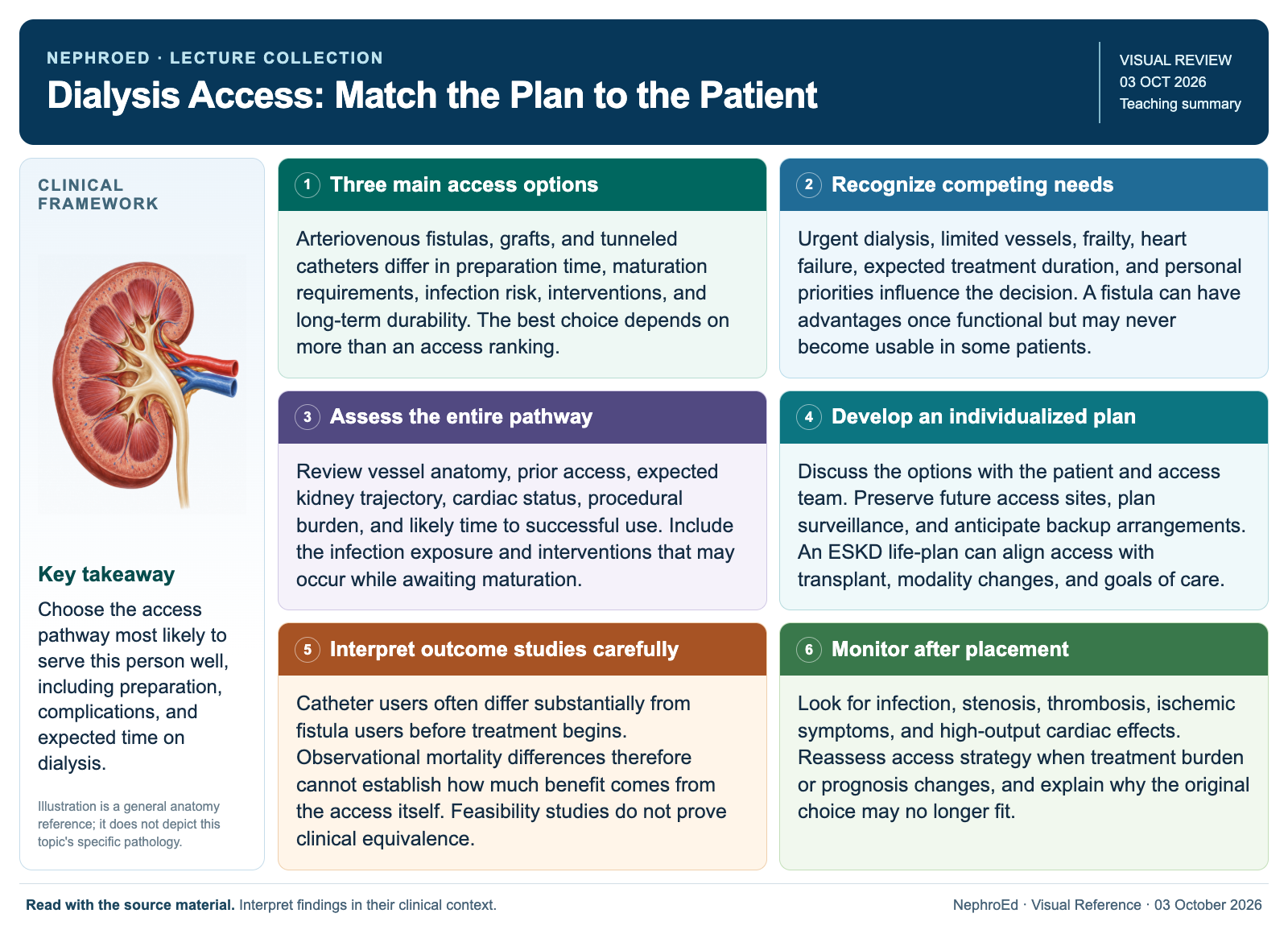
Choose the access pathway most likely to serve this person well, including preparation, complications, and expected time on dialysis.
Text version
Three main access options
Arteriovenous fistulas, grafts, and tunneled catheters differ in preparation time, maturation requirements, infection risk, interventions, and long-term durability. The best choice depends on more than an access ranking.
Recognize competing needs
Urgent dialysis, limited vessels, frailty, heart failure, expected treatment duration, and personal priorities influence the decision. A fistula can have advantages once functional but may never become usable in some patients.
Assess the entire pathway
Review vessel anatomy, prior access, expected kidney trajectory, cardiac status, procedural burden, and likely time to successful use. Include the infection exposure and interventions that may occur while awaiting maturation.
Develop an individualized plan
Discuss the options with the patient and access team. Preserve future access sites, plan surveillance, and anticipate backup arrangements. An ESKD life-plan can align access with transplant, modality changes, and goals of care.
Interpret outcome studies carefully
Catheter users often differ substantially from fistula users before treatment begins. Observational mortality differences therefore cannot establish how much benefit comes from the access itself. Feasibility studies do not prove clinical equivalence.
Monitor after placement
Look for infection, stenosis, thrombosis, ischemic symptoms, and high-output cardiac effects. Reassess access strategy when treatment burden or prognosis changes, and explain why the original choice may no longer fit.
Continue learning
This graphic summarizes a topic. The full educational pages provide the broader discussion and references.