Visual summary
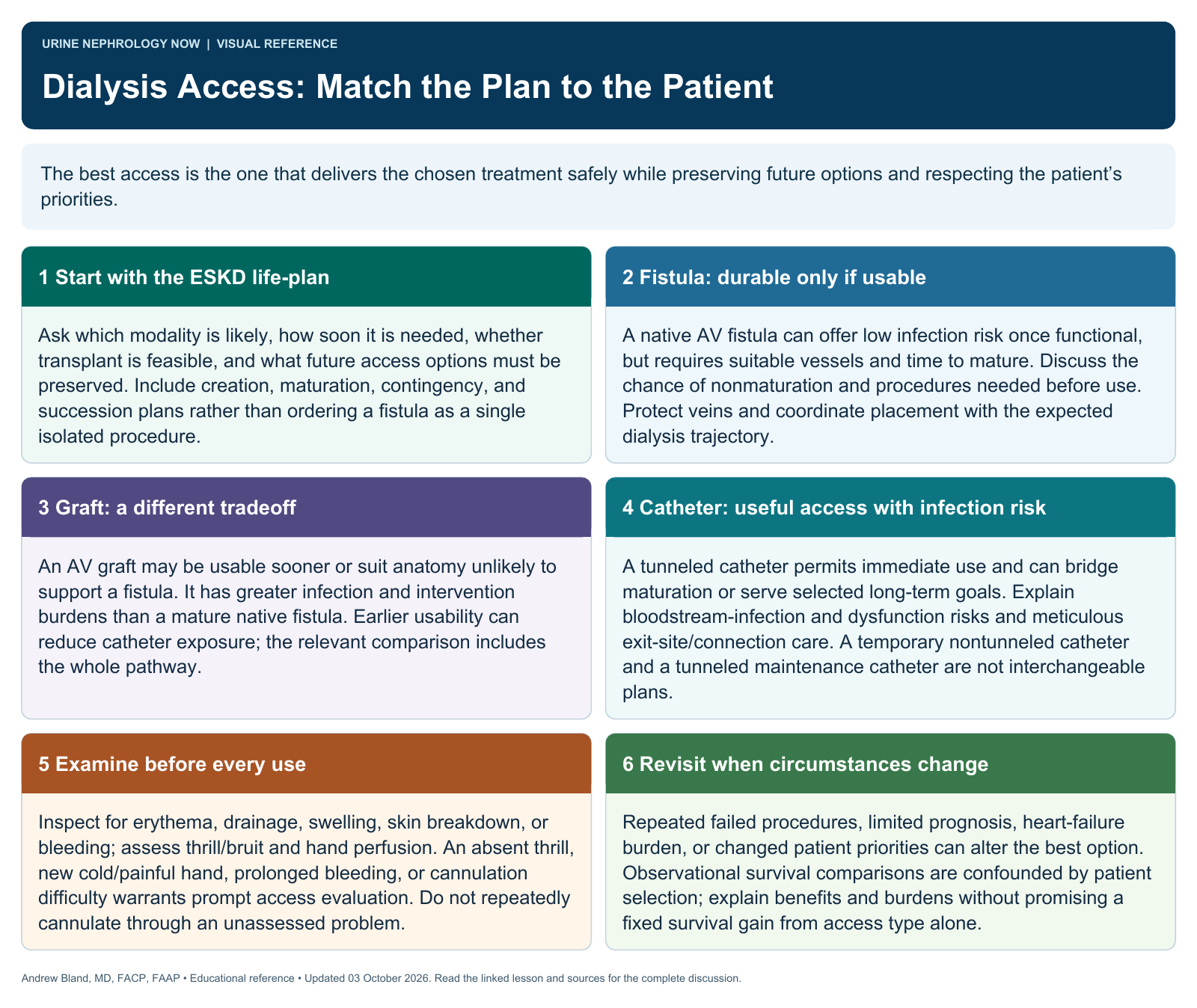
The best access is the one that delivers the chosen treatment safely while preserving future options and respecting the patient’s priorities.
Text version
Start with the ESKD life-plan
Ask which modality is likely, how soon it is needed, whether transplant is feasible, and what future access options must be preserved. Include creation, maturation, contingency, and succession plans rather than ordering a fistula as a single isolated procedure.
Fistula: durable only if usable
A native AV fistula can offer low infection risk once functional, but requires suitable vessels and time to mature. Discuss the chance of nonmaturation and procedures needed before use. Protect veins and coordinate placement with the expected dialysis trajectory.
Graft: a different tradeoff
An AV graft may be usable sooner or suit anatomy unlikely to support a fistula. It has greater infection and intervention burdens than a mature native fistula. Earlier usability can reduce catheter exposure; the relevant comparison includes the whole pathway.
Catheter: useful access with infection risk
A tunneled catheter permits immediate use and can bridge maturation or serve selected long-term goals. Explain bloodstream-infection and dysfunction risks and meticulous exit-site/connection care. A temporary nontunneled catheter and a tunneled maintenance catheter are not interchangeable plans.
Examine before every use
Inspect for erythema, drainage, swelling, skin breakdown, or bleeding; assess thrill/bruit and hand perfusion. An absent thrill, new cold/painful hand, prolonged bleeding, or cannulation difficulty warrants prompt access evaluation. Do not repeatedly cannulate through an unassessed problem.
Revisit when circumstances change
Repeated failed procedures, limited prognosis, heart-failure burden, or changed patient priorities can alter the best option. Observational survival comparisons are confounded by patient selection; explain benefits and burdens without promising a fixed survival gain from access type alone.