Visual summary
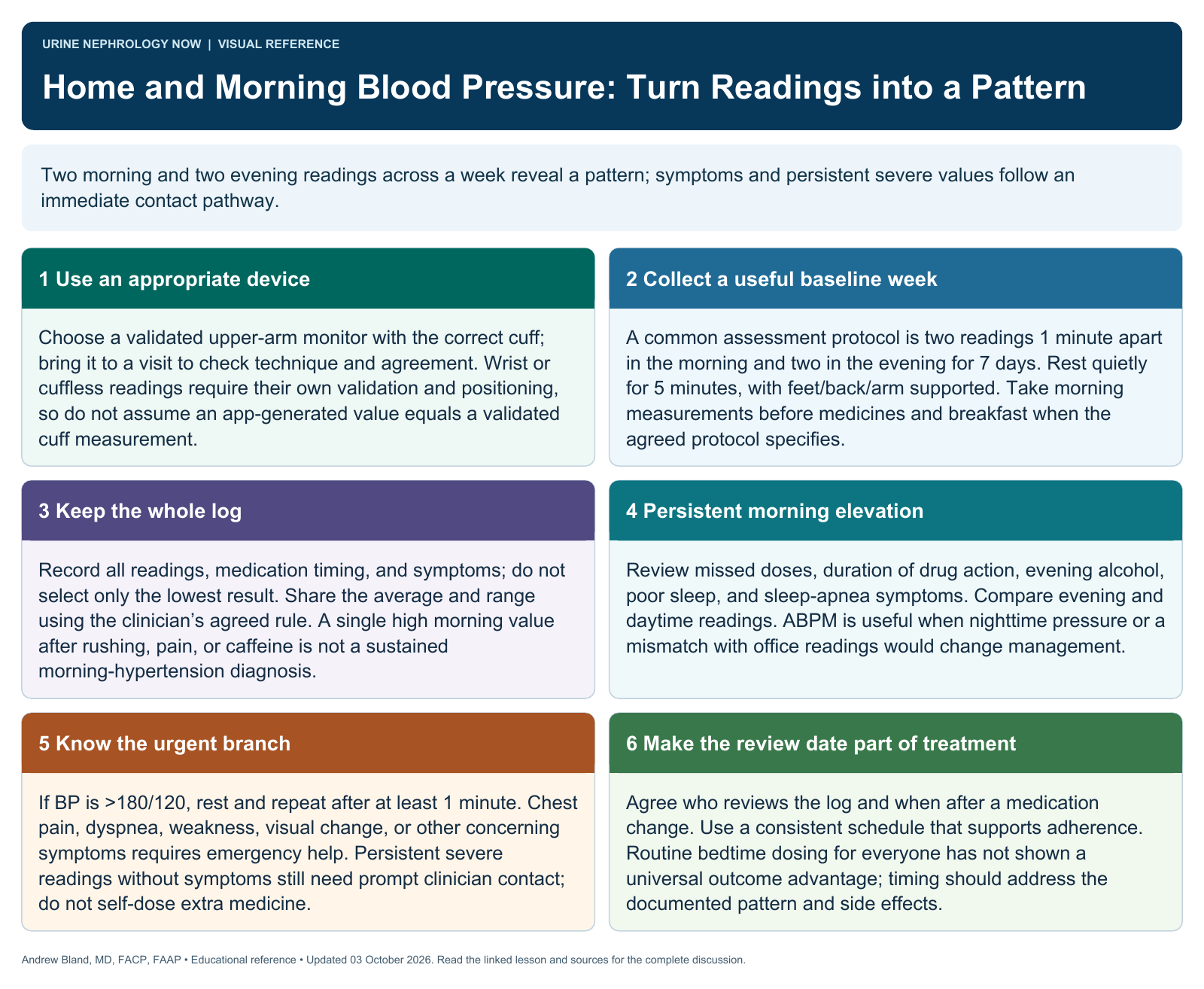
A consistent home log is useful because it reveals patterns that can guide a deliberate treatment plan.
Text version
Home monitoring adds context
Repeated measurements outside the clinic can reveal usual pressure, morning patterns, and treatment response. The value comes from a consistent protocol and clinically interpreted averages rather than reacting to every isolated fluctuation.
Recognize misleading data
Pain, anxiety, recent exercise, incorrect positioning, device problems, or selective recording can produce an alarming log. A very high value with concerning symptoms still warrants urgent assessment rather than routine averaging.
Build a reproducible routine
Use a validated upper-arm monitor with the correct cuff, supported positioning, quiet rest, and repeated readings as advised. Record timing relative to waking, medications, meals, symptoms, and sleep when those details are relevant.
Interpret morning elevation
Persistent morning hypertension may reflect inadequate overall control, medication duration, sleep apnea, autonomic physiology, or adherence problems. Compare with daytime and nighttime information, using ABPM when the diagnostic question requires it.
Connect monitoring to action
Agree on when to send the log, what symptoms require contact, and how medication changes will be assessed. Simplify regimens and address practical barriers before assuming an additional medication is the only solution.
Avoid timing dogma
The goal is sustained control and good adherence. Taking every medicine at bedtime or using a single morning target for all patients is not automatically supported; timing decisions should consider symptoms, regimen, and current evidence.
Continue learning
This graphic summarizes a topic. The full educational pages provide the broader discussion and references.