Visual summary
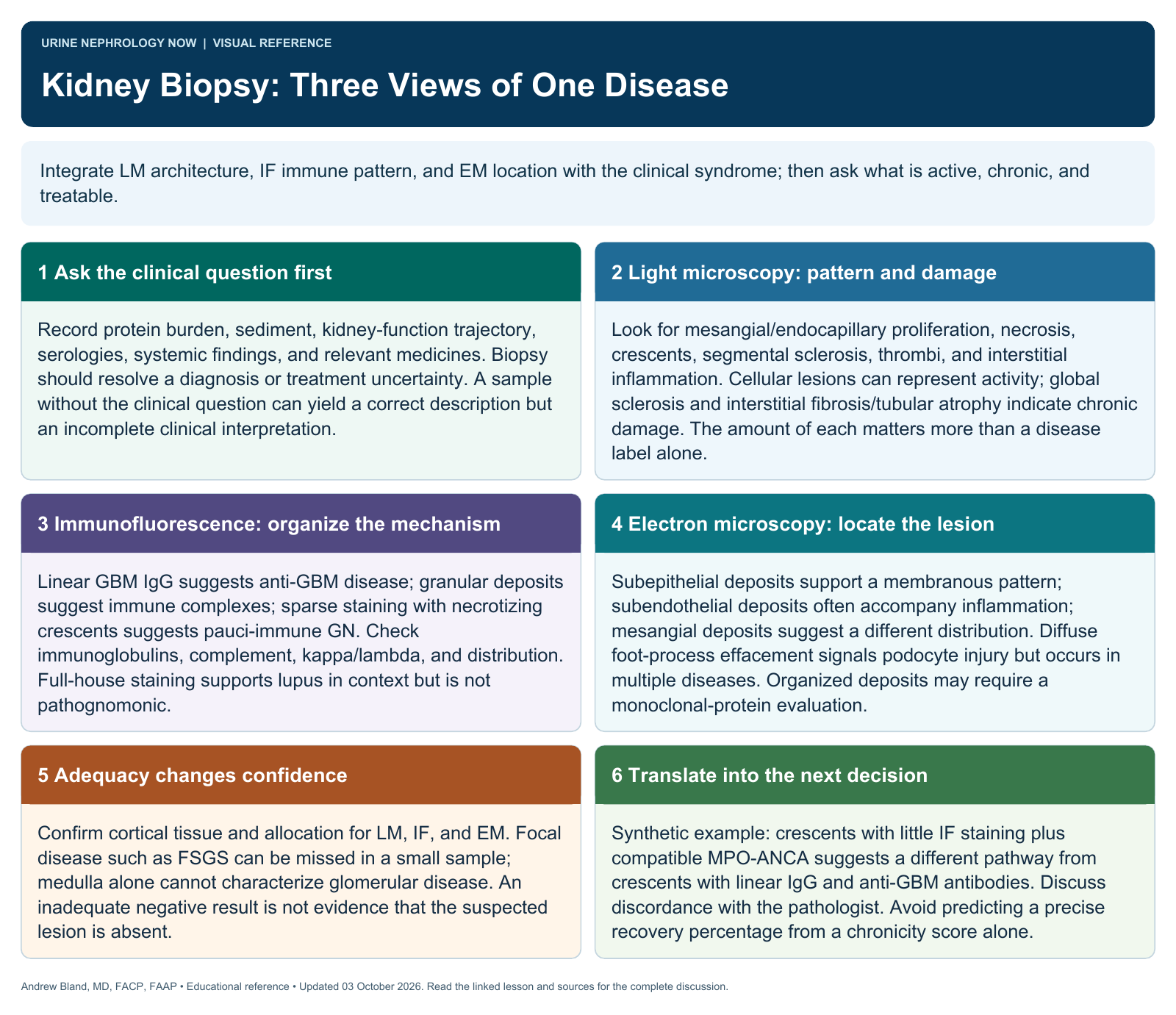
Integrate LM architecture, IF immune pattern, and EM location with the clinical syndrome; then ask what is active, chronic, and treatable.
Text version
Ask the clinical question first
Record protein burden, sediment, kidney-function trajectory, serologies, systemic findings, and relevant medicines. Biopsy should resolve a diagnosis or treatment uncertainty. A sample without the clinical question can yield a correct description but an incomplete clinical interpretation.
Light microscopy: pattern and damage
Look for mesangial/endocapillary proliferation, necrosis, crescents, segmental sclerosis, thrombi, and interstitial inflammation. Cellular lesions can represent activity; global sclerosis and interstitial fibrosis/tubular atrophy indicate chronic damage. The amount of each matters more than a disease label alone.
Immunofluorescence: organize the mechanism
Linear GBM IgG suggests anti-GBM disease; granular deposits suggest immune complexes; sparse staining with necrotizing crescents suggests pauci-immune GN. Check immunoglobulins, complement, kappa/lambda, and distribution. Full-house staining supports lupus in context but is not pathognomonic.
Electron microscopy: locate the lesion
Subepithelial deposits support a membranous pattern; subendothelial deposits often accompany inflammation; mesangial deposits suggest a different distribution. Diffuse foot-process effacement signals podocyte injury but occurs in multiple diseases. Organized deposits may require a monoclonal-protein evaluation.
Adequacy changes confidence
Confirm cortical tissue and allocation for LM, IF, and EM. Focal disease such as FSGS can be missed in a small sample; medulla alone cannot characterize glomerular disease. An inadequate negative result is not evidence that the suspected lesion is absent.
Translate into the next decision
Synthetic example: crescents with little IF staining plus compatible MPO-ANCA suggests a different pathway from crescents with linear IgG and anti-GBM antibodies. Discuss discordance with the pathologist. Avoid predicting a precise recovery percentage from a chronicity score alone.