Quick Navigation
Visual reference
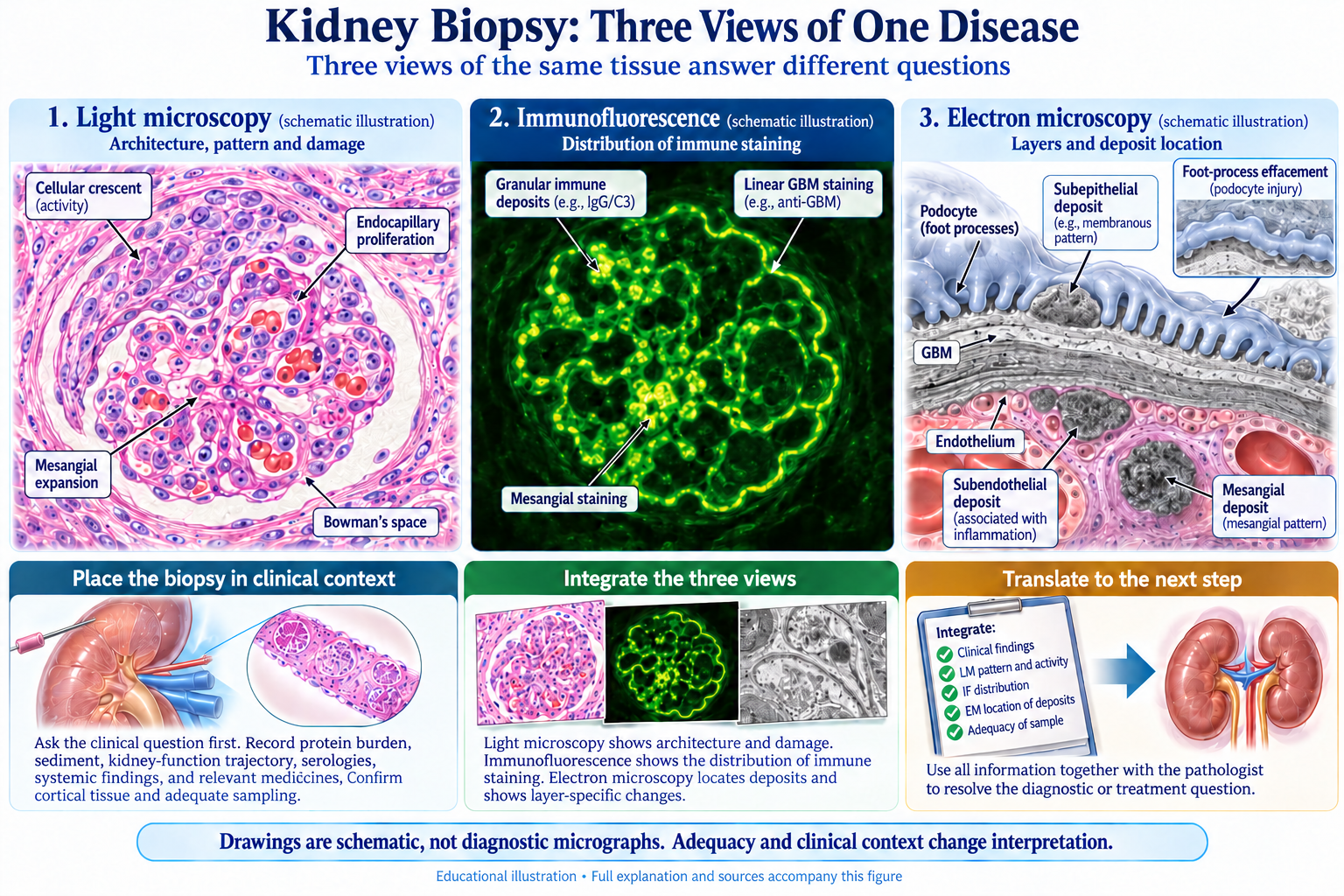
Browse the visual reference library · Download lesson Markdown
Specimen Adequacy
A kidney biopsy must contain sufficient cortical tissue to allow confident diagnosis. Inadequate samples may lead to missed focal diseases (e.g., FSGS) or underestimate disease severity.
Minimum for Diagnosis
8–10 glomeruli
Minimum glomerular count for reliable histologic diagnosis
Ideal Sample
20+ glomeruli
Especially important for focal diseases like FSGS
Cores Required
2–3 cores
Each core 1–2 cm length; 16-gauge needle standard
Tissue Distribution Across Studies
| Study | Fixative/Medium | Purpose |
|---|---|---|
| Light Microscopy | Formalin-fixed, paraffin-embedded | Structural patterns, cellularity, sclerosis, fibrosis |
| Immunofluorescence | Snap-frozen (OCT medium) | Immune deposits (IgG, IgA, IgM, C3, C1q, kappa, lambda) |
| Electron Microscopy | Glutaraldehyde-fixed | Deposit location, foot process effacement, basement membrane |
Light Microscopy Patterns
Proliferative Patterns
Mesangial Proliferation
Definition: Increased mesangial cells (>3 per mesangial area) and/or matrix expansion
Key diseases:
- IgA nephropathy
- Early lupus nephritis (Class II)
- Diabetic nephropathy
Endocapillary Proliferation
Definition: Increased cellularity within glomerular capillary lumina (endothelial cells, monocytes, neutrophils)
Key diseases:
- Post-infectious GN (diffuse)
- Lupus nephritis Class III/IV
- MPGN
- IgA nephropathy (with activity)
Extracapillary Proliferation (Crescents)
Definition: Proliferation in Bowman’s space forming crescents; indicates severe injury with capsule rupture
Key diseases:
- ANCA vasculitis (pauci-immune)
- Anti-GBM disease (Goodpasture)
- Lupus nephritis Class IV with crescents
- Severe IgA nephropathy
Crescent Classification — Prognostic Significance
Cellular Crescent
Predominantly cells (epithelial cells, macrophages)
Prognosis: Potentially reversible with immunosuppression
Fibrocellular Crescent
Mix of cells and fibrosis
Prognosis: Partially reversible; intermediate prognosis
Fibrous Crescent
Predominantly collagen/fibrosis
Prognosis: Irreversible; represents end-stage glomerular scarring
Sclerosis Patterns
| Pattern | Definition | Clinical Significance |
|---|---|---|
| Segmental Sclerosis | Sclerosis involving part of the glomerular tuft | FSGS (primary or secondary); perihilar variant suggests adaptive FSGS |
| Global Sclerosis | Entire glomerulus replaced by scar tissue | End-stage of any glomerular injury; >50% globally sclerosed = poor prognosis for recovery |
| Nodular Sclerosis | Kimmelstiel-Wilson nodules (mesangial nodular expansion) | Pathognomonic for diabetic nephropathy; also seen in LCDD and amyloid |
Necrosis
Fibrinoid necrosis of capillary loops indicates severe, active injury. Characteristic of:
- ANCA vasculitis (segmental necrosis)
- Anti-GBM disease
- Thrombotic microangiopathy (TMA)
- Malignant hypertension
Interstitial Fibrosis & Tubular Atrophy (IFTA) — Chronicity Index
| Grade | % Cortex Affected | Significance |
|---|---|---|
| Mild (Grade 1) | <25% | Early chronic changes; may still respond to therapy |
| Moderate (Grade 2) | 25–50% | Significant chronic damage; partial response expected |
| Severe (Grade 3) | >50% | Advanced chronicity; unlikely to recover; may be futile to treat with immunosuppression |
Immunofluorescence (IF) Patterns
IF identifies the type and distribution of immune deposits. The staining pattern is the single most important diagnostic clue for classifying glomerulonephritis.
Key IF Patterns
LINEAR IgG Staining
Pattern: Smooth, continuous IgG along the GBM
Disease: Anti-GBM disease (Goodpasture syndrome)
Mechanism: Antibodies directed against the alpha-3 chain of type IV collagen in the GBM
Also seen: Diabetic nephropathy (non-specific trapping; no clinical significance)
GRANULAR Staining
Pattern: Lumpy-bumpy, discontinuous deposits along capillary walls and/or mesangium
Diseases:
- Membranous nephropathy (granular IgG, C3 along capillary walls)
- Post-infectious GN (granular IgG, C3 — "starry sky")
- MPGN
- Lupus nephritis
FULL HOUSE Staining
Pattern: IgG, IgA, IgM, C3, and C1q all positive
Disease: Lupus nephritis (virtually pathognomonic)
Significance: C1q positivity is particularly characteristic of SLE; helps distinguish from other immune complex diseases
PAUCI-IMMUNE (Negative IF)
Pattern: Little or no immunoglobulin or complement staining
Diseases:
- ANCA-associated vasculitis (GPA, MPA, EGPA)
Significance: Crescentic GN with negative IF strongly suggests ANCA vasculitis; check serum ANCA (MPO, PR3)
IgA DOMINANT Staining
Pattern: IgA as the dominant or co-dominant immunoglobulin, primarily mesangial
Diseases:
- IgA nephropathy (Berger disease)
- IgA vasculitis (Henoch-Schönlein purpura) nephritis
Note: May also have C3 and IgG co-staining; C1q is typically absent (classical pathway not activated)
Light Chain Restriction
Pattern: Monoclonal kappa OR lambda staining (not both)
Diseases:
- Light chain deposition disease (LCDD)
- AL amyloidosis
- Proliferative GN with monoclonal Ig deposits (PGNMID)
Significance: Monoclonal restriction = paraprotein-related disease; search for underlying hematologic malignancy
Electron Microscopy: Deposit Location
EM localizes immune deposits relative to the glomerular basement membrane (GBM) and evaluates podocyte foot processes. Deposit location is the single most specific finding for disease classification.
Deposit Locations and Disease Correlation
Between GBM and podocytes
- Membranous nephropathy (diffuse)
- Post-infectious GN ("humps")
- Lupus Class V
Between GBM and endothelium
- Lupus nephritis Class III/IV
- MPGN Type I
- Wire-loop lesions (massive subendothelial deposits in lupus)
Within the mesangium
- IgA nephropathy
- Lupus Class I/II
- Early diabetic nephropathy
Within the GBM itself
- Dense deposit disease (C3 GN / MPGN Type II)
- Ribbon-like dense transformation of the GBM
Foot Process Effacement
Diffuse Effacement (>80%)
Indicates podocytopathy with massive proteinuria
- Minimal Change Disease: Diffuse effacement with NO deposits, NO proliferation, NO sclerosis
- Primary FSGS: Diffuse effacement with segmental sclerosis
Focal/Segmental Effacement
Seen overlying areas of immune deposits or sclerosis
- Secondary FSGS (adaptive): effacement 30–60%
- Membranous nephropathy: effacement over deposits
- Immune complex GN: focal effacement near deposits
Wire-Loop Lesions (Lupus Nephritis)
Wire-loop lesions represent massive subendothelial immune complex deposits that thicken the capillary wall, making it appear rigid and refractile on LM (resembling a wire loop).
- Virtually pathognomonic for: Lupus nephritis Class IV (diffuse proliferative)
- On EM: Massive electron-dense subendothelial deposits
- Clinical significance: Indicates severe, active disease requiring aggressive immunosuppression
Comprehensive Pattern-to-Disease Correlation
| Disease | Light Microscopy | Immunofluorescence | Electron Microscopy | Key Diagnostic Feature |
|---|---|---|---|---|
| Minimal Change Disease | Normal glomeruli | Negative | Diffuse foot process effacement; no deposits | Normal LM + diffuse FPE on EM |
| FSGS (Primary) | Segmental sclerosis (may be focal) | Nonspecific IgM/C3 trapping in sclerotic areas | Diffuse FPE (>80%) | Segmental sclerosis + diffuse FPE |
| Membranous Nephropathy | GBM thickening, spikes on silver stain | Granular IgG, C3 along capillary walls | Subepithelial deposits with GBM reaction (stages I–IV) | Subepithelial deposits; anti-PLA2R antibody |
| IgA Nephropathy | Mesangial proliferation (variable) | Dominant IgA in mesangium (±C3, IgG) | Mesangial electron-dense deposits | Dominant mesangial IgA on IF |
| Post-Infectious GN | Diffuse endocapillary proliferation; neutrophil infiltration | Granular IgG, C3 ("starry sky") | Subepithelial "humps" | Subepithelial humps + starry sky IF |
| Lupus Nephritis III/IV | Endocapillary proliferation, crescents, wire-loop lesions | "Full house" (IgG, IgA, IgM, C3, C1q) | Subendothelial deposits (tubuloreticular inclusions) | Full house IF + subendothelial deposits |
| Lupus Nephritis V | GBM thickening (mimics membranous) | Full house | Subepithelial deposits | Membranous pattern + full house IF |
| Anti-GBM Disease | Crescentic GN, fibrinoid necrosis | Linear IgG along GBM | No electron-dense deposits | Linear IgG + crescents |
| ANCA Vasculitis | Focal segmental necrosis, crescents | Pauci-immune (negative or scant) | No or scant immune deposits | Crescentic GN + pauci-immune IF |
| MPGN Type I | Mesangial interposition, "tram-tracking" of GBM | Granular C3, IgG; variable | Subendothelial deposits, mesangial interposition | Tram-tracking + subendothelial deposits |
| Dense Deposit Disease | MPGN pattern or mesangial proliferative | C3 dominant (C3 glomerulopathy) | Intramembranous dense osmiophilic transformation | Ribbon-like intramembranous dense deposits |
| Diabetic Nephropathy | Kimmelstiel-Wilson nodules, GBM thickening, mesangial expansion | Linear IgG (non-specific trapping), albumin | GBM thickening, mesangial expansion | Nodular mesangial sclerosis (clinical context) |
| Amyloidosis (AL/AA) | Amorphous eosinophilic deposits; Congo red positive with apple-green birefringence | Lambda or kappa restriction (AL) or negative (AA) | Non-branching fibrils 8–12 nm | Congo red birefringence + 8–12 nm fibrils |
| Fibrillary GN | MPGN or mesangial pattern | Polyclonal IgG, C3; DNAJB9 positive | Randomly arranged fibrils 16–24 nm | Fibrils larger than amyloid (16–24 nm); Congo red negative |
Special Stains and Techniques
| Stain | Highlights | Clinical Use |
|---|---|---|
| Congo Red | Amyloid fibrils; apple-green birefringence under polarized light | Diagnosis of amyloidosis (AL, AA, ALECT2). Must examine under polarized light to confirm birefringence. |
| Jones Methenamine Silver (JMS) | Basement membranes; GBM spikes and double contours | Membranous nephropathy (spikes), MPGN (tram-tracking), GBM abnormalities |
| PAS (Periodic Acid-Schiff) | Glycoproteins, basement membranes, mesangial matrix | GBM thickening (diabetic, membranous), mesangial expansion, tubular basement membranes |
| Trichrome (Masson) | Collagen (blue/green), immune deposits (red/fuchsinophilic) | Quantify interstitial fibrosis; identify fuchsinophilic deposits (immune complex, fibrin) |
| H&E | General architecture, cellularity | Initial assessment of glomerular, tubular, interstitial, and vascular compartments |
| Thioflavin T | Amyloid (fluorescent) | More sensitive than Congo red for small amyloid deposits |
References
- Sethi S, Haas M, Markowitz GS, et al. Mayo Clinic/Renal Pathology Society Consensus Report on Pathologic Classification, Diagnosis, and Reporting of GN. J Am Soc Nephrol. 2016;27(5):1278-1287. PubMed
- Bajema IM, Wilhelmus S, Alpers CE, et al. Revision of the ISN/RPS classification for lupus nephritis: clarification of definitions, and modified National Institutes of Health activity and chronicity indices. Kidney Int. 2018;93(4):789-796. PubMed
- Trimarchi H, Barratt J, Cattran DC, et al. Oxford Classification of IgA nephropathy 2016: an update from the IgA Nephropathy Classification Working Group. Kidney Int. 2017;91(5):1014-1021. PubMed: 28341274
- D'Agati VD, Fogo AB, Bruijn JA, et al. Pathologic classification of focal segmental glomerulosclerosis: a working proposal. Am J Kidney Dis. 2004;43(2):368-382. PubMed
- KDIGO 2021 Clinical Practice Guideline for the Management of Glomerular Diseases. Kidney Int. 2021;100(4S):S1-S276. PubMed
- Whittier WL, Korbet SM. Timing of complications in percutaneous renal biopsy. J Am Soc Nephrol. 2004;15(1):142-147. PubMed
- Nasr SH, Satoskar A, Markowitz GS, et al. Proliferative glomerulonephritis with monoclonal IgG deposits. J Am Soc Nephrol. 2009;20(9):2055-2064. PubMed
- Nasr SH, Valeri AM, Cornell LD, et al. Fibrillary glomerulonephritis: a report of 66 cases from a single institution. Clin J Am Soc Nephrol. 2011;6(4):775-784. PubMed
- Corapi KM, Chen JLT, Balk EM, Gordon CE. Bleeding complications of native kidney biopsy: a systematic review and meta-analysis. Am J Kidney Dis. 2012;60(1):62-73. PubMed
Andrew Bland, MD, FACP, FAAP | University of Dubuque PA Program | Urine Nephrology Now
© 2025 | For educational purposes only