Visual summary
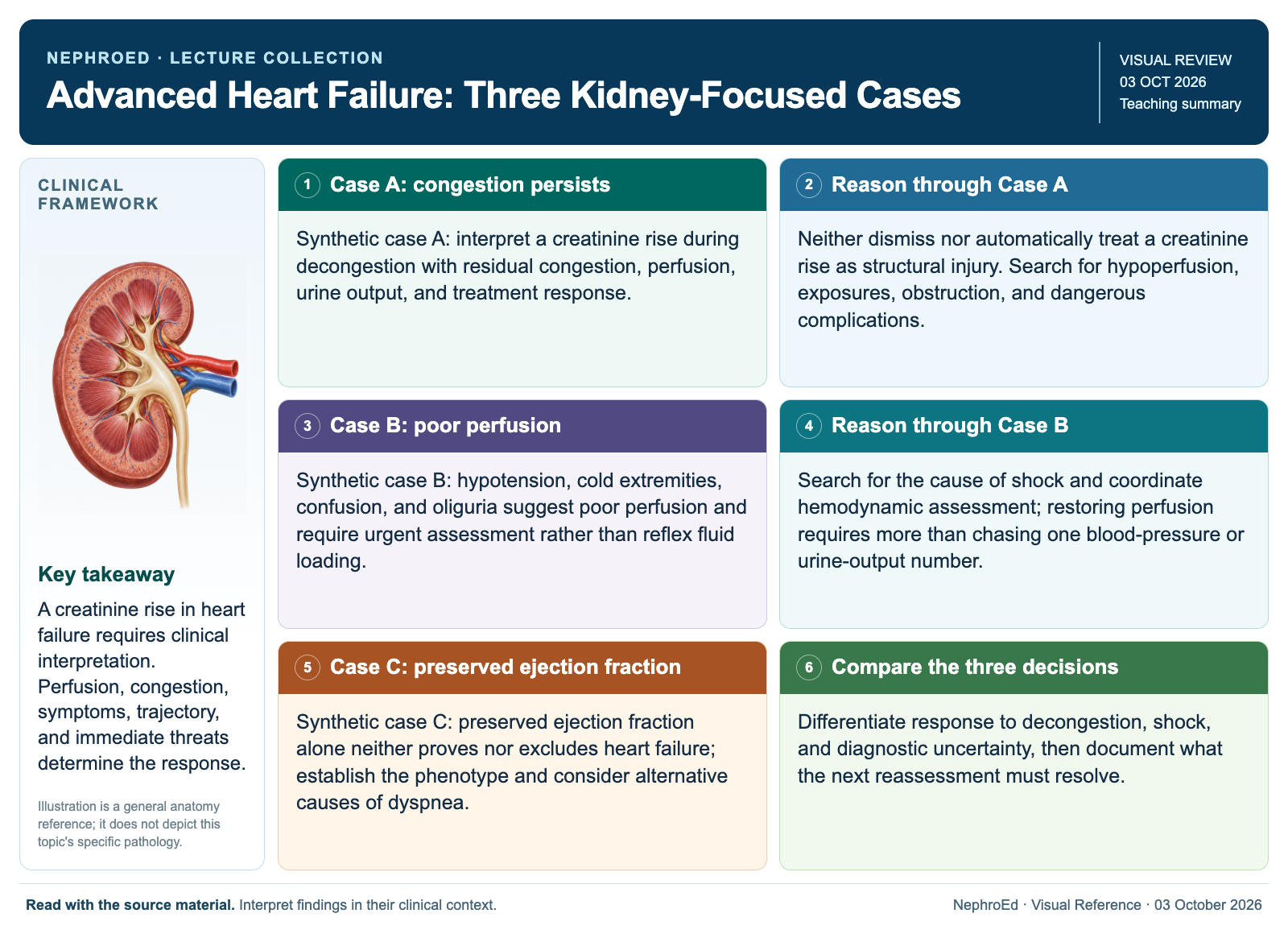
A creatinine rise in heart failure requires clinical interpretation. Perfusion, congestion, symptoms, trajectory, and immediate threats determine the response.
Text version
Case A: congestion persists
Synthetic case A: interpret a creatinine rise during decongestion with residual congestion, perfusion, urine output, and treatment response.
Reason through Case A
Neither dismiss nor automatically treat a creatinine rise as structural injury. Search for hypoperfusion, exposures, obstruction, and dangerous complications.
Case B: poor perfusion
Synthetic case B: hypotension, cold extremities, confusion, and oliguria suggest poor perfusion and require urgent assessment rather than reflex fluid loading.
Reason through Case B
Search for the cause of shock and coordinate hemodynamic assessment; restoring perfusion requires more than chasing one blood-pressure or urine-output number.
Case C: preserved ejection fraction
Synthetic case C: preserved ejection fraction alone neither proves nor excludes heart failure; establish the phenotype and consider alternative causes of dyspnea.
Compare the three decisions
Differentiate response to decongestion, shock, and diagnostic uncertainty, then document what the next reassessment must resolve.
Continue learning
This graphic summarizes a topic. The full educational pages provide the broader discussion and references.