These are synthetic teaching scenarios, not reports about real patients. They explore how congestion, perfusion, treatment response, and uncertainty shape the interpretation of changing kidney function. Treatment decisions require bedside reassessment and an individualized plan.
Learning goal: Connect assessment, evidence, and a clear next clinical decision. Educational use; individual care requires the treating team’s assessment and applicable protocols.
Visual reference
Browse the visual reference library · Download lesson Markdown
Case A: congestion persists
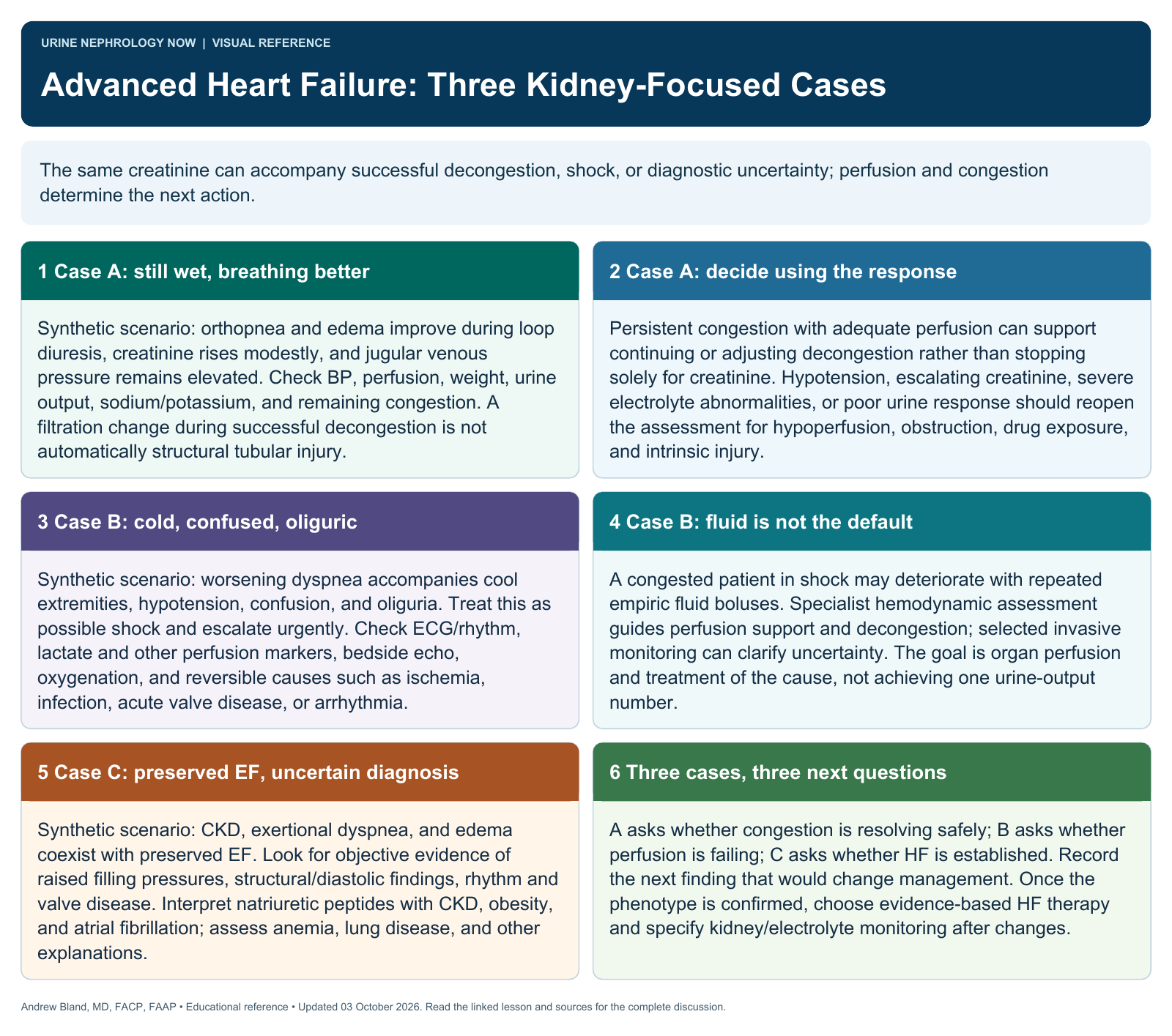
An adult with known heart failure has edema, orthopnea, and elevated venous pressure. During diuresis, creatinine increases modestly while breathing improves but congestion remains. The teaching task is to review perfusion, volume findings, drug exposure, urine output, and the trajectory rather than stopping all treatment because creatinine changed.
Reason through Case A
A filtration change during effective decongestion is not automatically equivalent to progressive structural kidney injury. Conversely, every rise cannot be declared harmless. Look for hypotension, severe electrolyte change, obstruction, nephrotoxins, or worsening injury, and adjust the plan to the complete pattern and the patient’s symptoms.
Case B: poor perfusion
A second adult becomes cool, confused, hypotensive, and oliguric with increasing respiratory distress. This pattern requires urgent assessment for shock and its cause. Repeated empiric fluid loading may worsen congestion; assessment, monitoring, and specialist support must guide the hemodynamic strategy.
Reason through Case B
Consider acute ischemia, arrhythmia, infection, valve disease, medication effects, and right-ventricular dysfunction. Echocardiography and selected invasive assessment can clarify difficult cases. The goal is restoration of adequate perfusion while addressing congestion and the cause, not achieving an isolated urine-output or blood-pressure number.
Case C: preserved ejection fraction
A third adult has exertional dyspnea, edema, CKD, and a preserved ejection fraction. A normal ejection fraction does not establish or exclude heart failure. Assess congestion, filling-pressure evidence, rhythm, valve disease, anemia, lung disease, and other explanations, then choose treatment appropriate to the confirmed phenotype.
Compare the three decisions
Case A asks whether congestion is improving safely; Case B asks whether perfusion is failing; Case C asks whether the diagnosis is established. For each, document the leading mechanism, missing information, next reassessment, medicine plan, and escalation criteria. Similar creatinine values can accompany very different treatment needs.
Apply the framework
Should the same creatinine value lead to the same treatment in all three scenarios?
Show the reasoning
No. The mechanism, perfusion, congestion, symptoms, trajectory, and immediate threats determine the response. A kidney number is interpreted within the clinical picture.
References and evidence
These sources support the teaching framework. Trial populations, endpoints, and limitations should be checked before applying a result to an individual patient.
- Heidenreich PA, Bozkurt B, Aguilar D et al.. 2022 AHA/ACC/HFSA Guideline for the Management of Heart Failure: A Report of the American College of Cardiology/American Heart Association Joint Committee on Clinical Practice Guidelines. Circulation. 2022;145(18):e895-e1032. PubMed 35363499
- Flythe JE, Chang TI, Gallagher MP et al.. Blood pressure and volume management in dialysis: conclusions from a Kidney Disease: Improving Global Outcomes (KDIGO) Controversies Conference. Kidney Int. 2020;97(5):861. PubMed 32278617