Visual summary
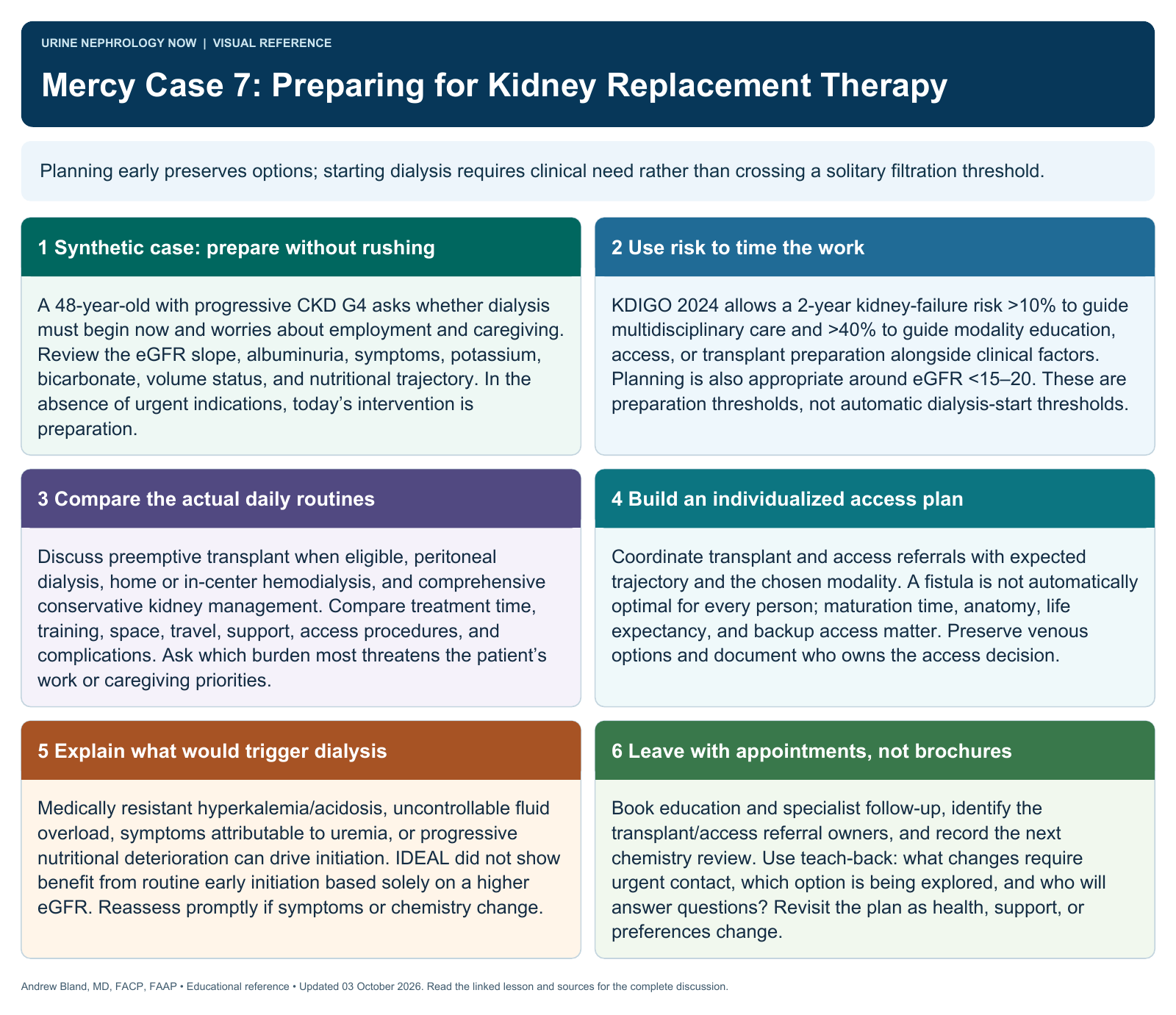
Planning early preserves options; starting dialysis requires clinical need rather than crossing a solitary filtration threshold.
Text version
Synthetic case: prepare without rushing
A 48-year-old with progressive CKD G4 asks whether dialysis must begin now and worries about employment and caregiving. Review the eGFR slope, albuminuria, symptoms, potassium, bicarbonate, volume status, and nutritional trajectory. In the absence of urgent indications, today’s intervention is preparation.
Use risk to time the work
KDIGO 2024 allows a 2-year kidney-failure risk >10% to guide multidisciplinary care and >40% to guide modality education, access, or transplant preparation alongside clinical factors. Planning is also appropriate around eGFR <15–20. These are preparation thresholds, not automatic dialysis-start thresholds.
Compare the actual daily routines
Discuss preemptive transplant when eligible, peritoneal dialysis, home or in-center hemodialysis, and comprehensive conservative kidney management. Compare treatment time, training, space, travel, support, access procedures, and complications. Ask which burden most threatens the patient’s work or caregiving priorities.
Build an individualized access plan
Coordinate transplant and access referrals with expected trajectory and the chosen modality. A fistula is not automatically optimal for every person; maturation time, anatomy, life expectancy, and backup access matter. Preserve venous options and document who owns the access decision.
Explain what would trigger dialysis
Medically resistant hyperkalemia/acidosis, uncontrollable fluid overload, symptoms attributable to uremia, or progressive nutritional deterioration can drive initiation. IDEAL did not show benefit from routine early initiation based solely on a higher eGFR. Reassess promptly if symptoms or chemistry change.
Leave with appointments, not brochures
Book education and specialist follow-up, identify the transplant/access referral owners, and record the next chemistry review. Use teach-back: what changes require urgent contact, which option is being explored, and who will answer questions? Revisit the plan as health, support, or preferences change.