Visual summary
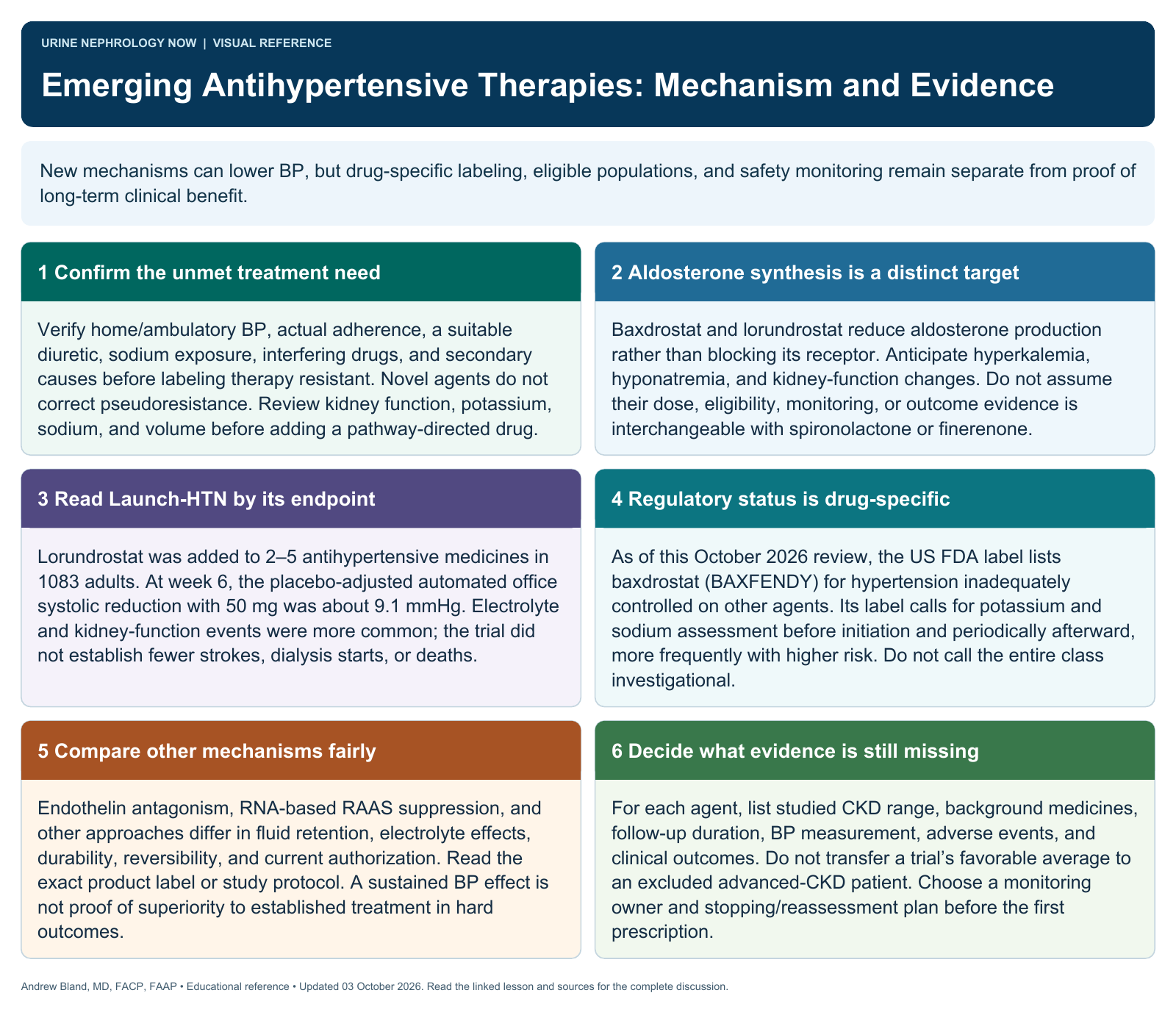
New mechanisms can lower BP, but drug-specific labeling, eligible populations, and safety monitoring remain separate from proof of long-term clinical benefit.
Text version
Confirm the unmet treatment need
Verify home/ambulatory BP, actual adherence, a suitable diuretic, sodium exposure, interfering drugs, and secondary causes before labeling therapy resistant. Novel agents do not correct pseudoresistance. Review kidney function, potassium, sodium, and volume before adding a pathway-directed drug.
Aldosterone synthesis is a distinct target
Baxdrostat and lorundrostat reduce aldosterone production rather than blocking its receptor. Anticipate hyperkalemia, hyponatremia, and kidney-function changes. Do not assume their dose, eligibility, monitoring, or outcome evidence is interchangeable with spironolactone or finerenone.
Read Launch-HTN by its endpoint
Lorundrostat was added to 2–5 antihypertensive medicines in 1083 adults. At week 6, the placebo-adjusted automated office systolic reduction with 50 mg was about 9.1 mmHg. Electrolyte and kidney-function events were more common; the trial did not establish fewer strokes, dialysis starts, or deaths.
Regulatory status is drug-specific
As of this October 2026 review, the US FDA label lists baxdrostat (BAXFENDY) for hypertension inadequately controlled on other agents. Its label calls for potassium and sodium assessment before initiation and periodically afterward, more frequently with higher risk. Do not call the entire class investigational.
Compare other mechanisms fairly
Endothelin antagonism, RNA-based RAAS suppression, and other approaches differ in fluid retention, electrolyte effects, durability, reversibility, and current authorization. Read the exact product label or study protocol. A sustained BP effect is not proof of superiority to established treatment in hard outcomes.
Decide what evidence is still missing
For each agent, list studied CKD range, background medicines, follow-up duration, BP measurement, adverse events, and clinical outcomes. Do not transfer a trial’s favorable average to an excluded advanced-CKD patient. Choose a monitoring owner and stopping/reassessment plan before the first prescription.