Visual summary
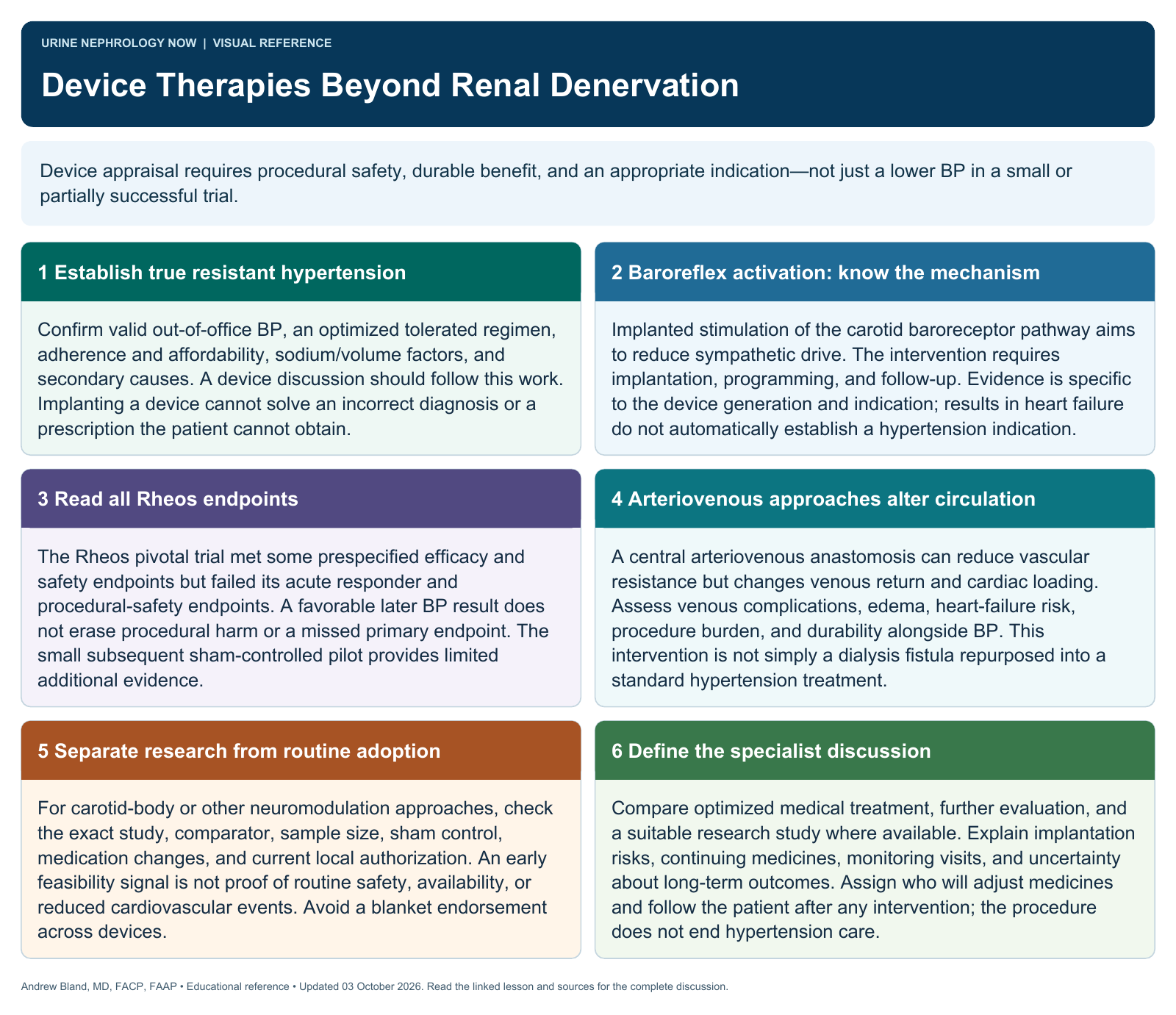
Device appraisal requires procedural safety, durable benefit, and an appropriate indication—not just a lower BP in a small or partially successful trial.
Text version
Establish true resistant hypertension
Confirm valid out-of-office BP, an optimized tolerated regimen, adherence and affordability, sodium/volume factors, and secondary causes. A device discussion should follow this work. Implanting a device cannot solve an incorrect diagnosis or a prescription the patient cannot obtain.
Baroreflex activation: know the mechanism
Implanted stimulation of the carotid baroreceptor pathway aims to reduce sympathetic drive. The intervention requires implantation, programming, and follow-up. Evidence is specific to the device generation and indication; results in heart failure do not automatically establish a hypertension indication.
Read all Rheos endpoints
The Rheos pivotal trial met some prespecified efficacy and safety endpoints but failed its acute responder and procedural-safety endpoints. A favorable later BP result does not erase procedural harm or a missed primary endpoint. The small subsequent sham-controlled pilot provides limited additional evidence.
Arteriovenous approaches alter circulation
A central arteriovenous anastomosis can reduce vascular resistance but changes venous return and cardiac loading. Assess venous complications, edema, heart-failure risk, procedure burden, and durability alongside BP. This intervention is not simply a dialysis fistula repurposed into a standard hypertension treatment.
Separate research from routine adoption
For carotid-body or other neuromodulation approaches, check the exact study, comparator, sample size, sham control, medication changes, and current local authorization. An early feasibility signal is not proof of routine safety, availability, or reduced cardiovascular events. Avoid a blanket endorsement across devices.
Define the specialist discussion
Compare optimized medical treatment, further evaluation, and a suitable research study where available. Explain implantation risks, continuing medicines, monitoring visits, and uncertainty about long-term outcomes. Assign who will adjust medicines and follow the patient after any intervention; the procedure does not end hypertension care.
Supporting evidence
- Baroreflex activation therapy lowers blood pressure in patients with resistant hypertension: results from the double-blind, randomized, placebo-controlled rheos pivotal trial.
- Sham-Controlled Randomized Pilot Trial on Baroreflex Activation Therapy in Resistant Hypertension.
- Central arteriovenous anastomosis for the treatment of patients with uncontrolled hypertension (the ROX CONTROL HTN study): a randomised controlled trial.