Visual summary
Different medicines and indications carry different risks. The plan must account for the procedure, hemodynamics, kidney function, and reasons for therapy, with an explicit restart strategy.
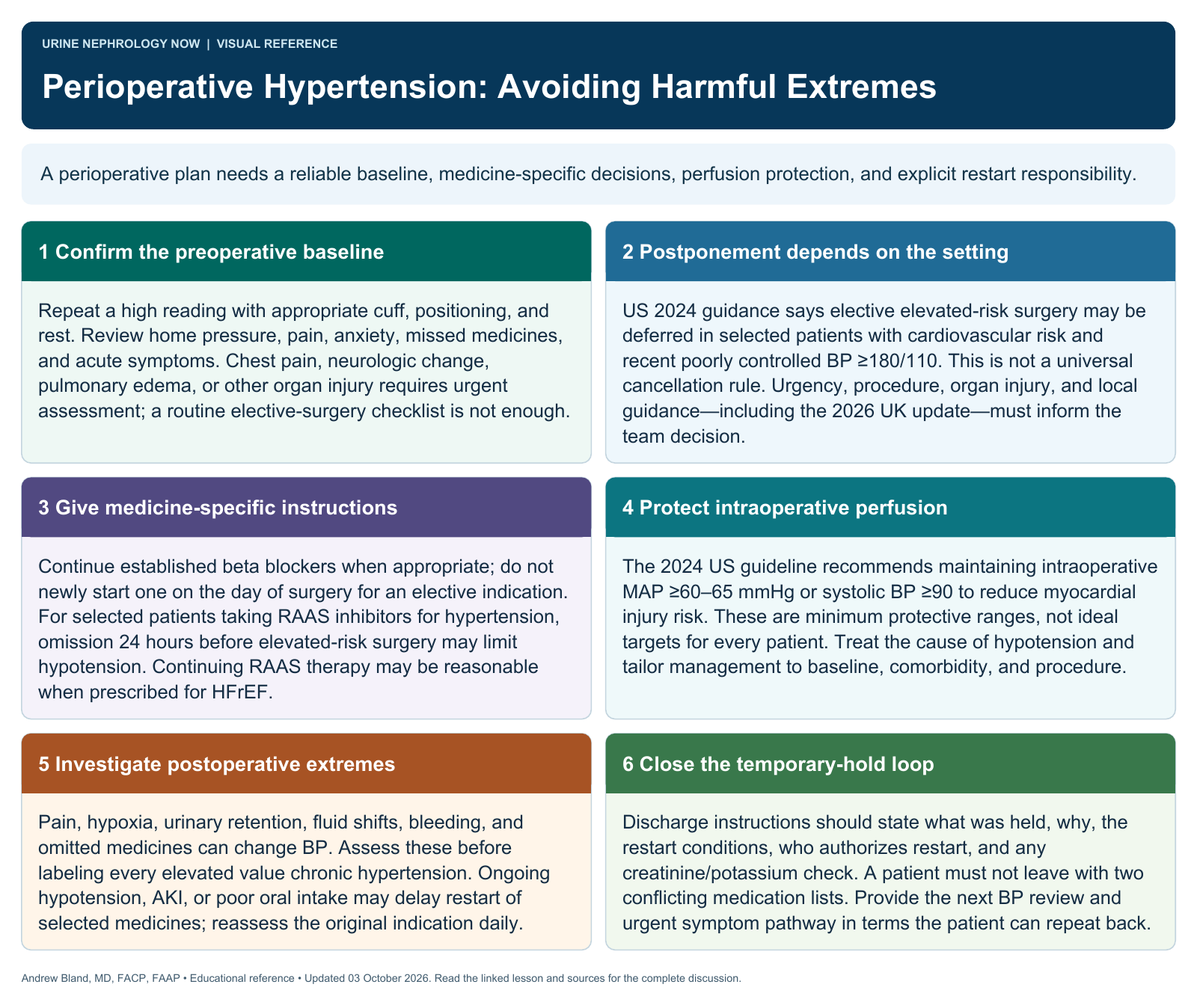
Text version
Measure before making a decision
Confirm measurement technique and usual pressure before acting on a single preoperative value; communicate the baseline to anesthesia.
Assess urgency and the procedure
Separate acute target-organ injury from chronic hypertension and apply the procedure-specific guidance rather than a universal cancellation threshold.
Agree on medicines
Create a medication-specific continuation, hold, and restart plan with the surgical team; avoid blanket instructions for all antihypertensives.
Protect perfusion during surgery
Monitor for both extremes and treat the cause of hemodynamic change. Lowering high pressure too aggressively can compromise perfusion.
Watch the recovery period
Investigate postoperative pain, hypoxia, bleeding, fluid shifts, and missed medicines, and reassess stability before restarting held treatment.
Close the transition
Document restart responsibility, monitoring, follow-up, and urgent symptoms so a temporary hold does not become unintended long-term discontinuation.
Continue learning
This graphic summarizes a topic. The full educational pages provide the broader discussion and references.