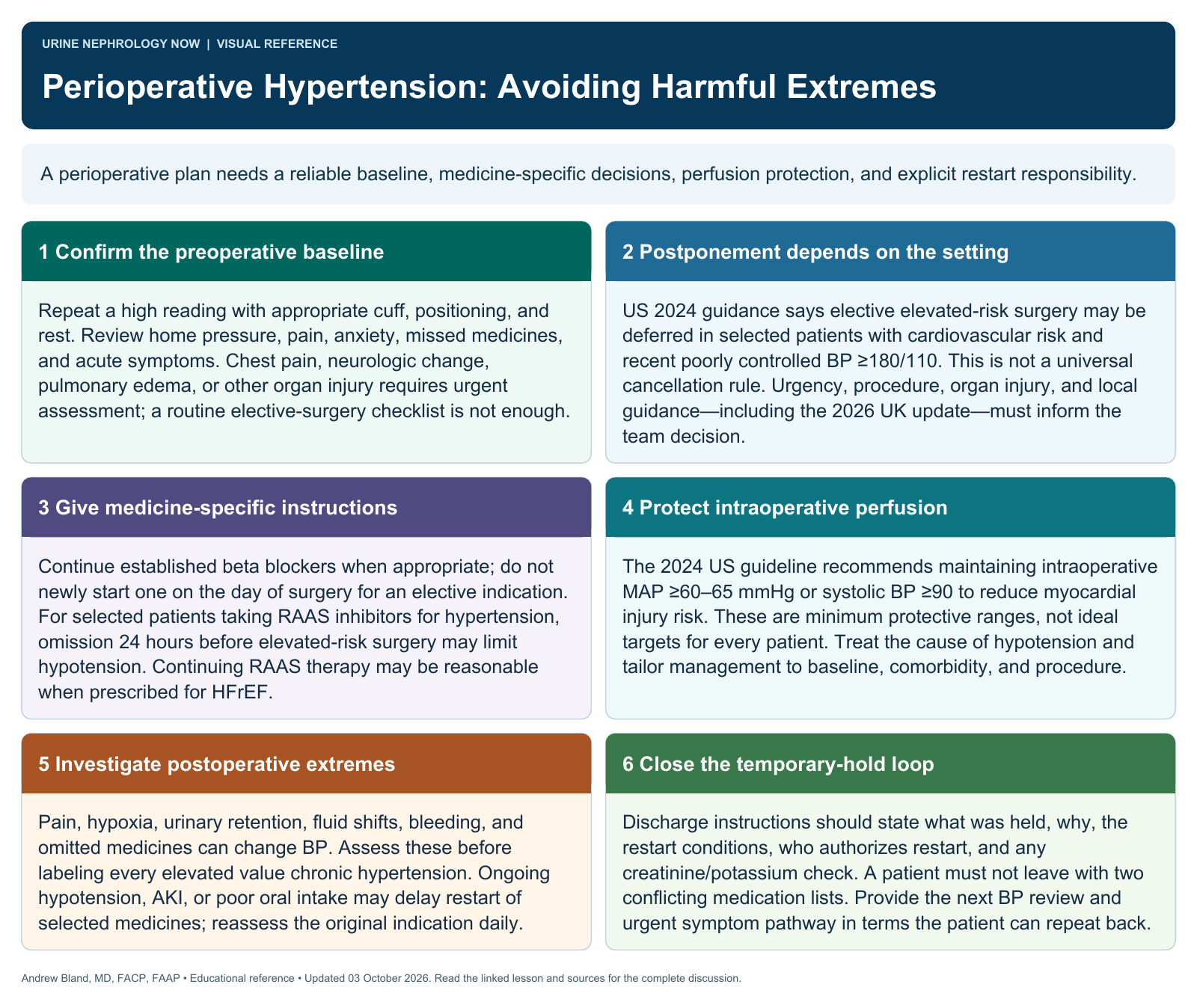
Perioperative blood-pressure care spans preoperative assessment, anesthesia, recovery, and the return home. The objective is safe perfusion and a clear medication plan, with long-term hypertension management connected to the surgical team rather than treated as a separate issue.
Learning goal: Connect assessment, evidence, and a clear next clinical decision. Educational use; individual care requires the treating team’s assessment and applicable protocols.
Visual reference
Browse the visual reference library · Download lesson Markdown
Measure before making a decision
Confirm technique, cuff size, rest, pain, anxiety, recent medicines, and prior home or ambulatory readings. A single high preoperative reading may not represent usual pressure. Document the baseline and communicate it to the anesthesia team; do not create a new chronic diagnosis from an isolated stressful encounter.
Assess urgency and the procedure
Evaluate symptoms or findings of acute target-organ injury, the urgency and type of surgery, and overall cardiovascular risk. Elective postponement thresholds vary by guideline and context. The 2026 Association of Anaesthetists guidance covers planned adult surgery with specified exclusions; it is not a universal emergency-surgery rule.
Agree on medicines
Reconcile antihypertensives, heart-failure therapy, diabetes medicines, and nonprescription products. Continue, omit, and restart instructions must be medication-specific and agreed by the responsible team. Avoid abrupt changes or contradictory instructions; RAAS-inhibitor decisions can differ by indication, patient risk, and anesthetic circumstances.
Protect perfusion during surgery
Anesthesia and surgery can cause hypotension as well as hypertension. Monitor according to procedural and patient risk, and address the cause of pressure changes. POQI emphasizes avoiding important hypotension and tailoring management to physiology; aggressive correction of hypertension can itself produce harmful low pressure.
Watch the recovery period
Pain, hypoxia, bladder distension, fluid shifts, bleeding, and missed medicines can alter postoperative pressure. Reassess before assigning every abnormal value to baseline hypertension. Postoperative hypotension may be prolonged and overlooked, so medication reintroduction requires a review of stability, intake, kidney function, and the actual indication.
Close the transition
The discharge plan should specify each medicine, the reason for any change, who will restart it, monitoring needs, and the follow-up date. Explain urgent symptoms and reconcile the plan with primary care. A temporary perioperative hold should not become an unintentional permanent discontinuation.
Apply the framework
Why is “hold all blood-pressure medicines before surgery” inadequate?
Show the reasoning
Different medicines and indications carry different risks. The plan must account for the procedure, hemodynamics, kidney function, and reasons for therapy, with an explicit restart strategy.
References and evidence
These sources support the teaching framework. Trial populations, endpoints, and limitations should be checked before applying a result to an individual patient.
- McCormack T, Wickham A, McDonagh STJ et al.. Measurement and management of adult blood pressure in the peri-operative period: updated guidelines from the Association of Anaesthetists and the British and Irish Hypertension Society. Anaesthesia. 2026;81(3):402-414. PubMed 41532177
- Bhave NM, Cibotti-Sun M, Moore MM. 2024 Perioperative Cardiovascular Management for Noncardiac Surgery Guideline-at-a-Glance. J Am Coll Cardiol. 2024;84(19):1970-1975. PubMed 39320290
- Saugel B, Fletcher N, Gan TJ et al.. PeriOperative Quality Initiative (POQI) international consensus statement on perioperative arterial pressure management. Br J Anaesth. 2024;133(2):264-276. PubMed 38839472