Visual summary
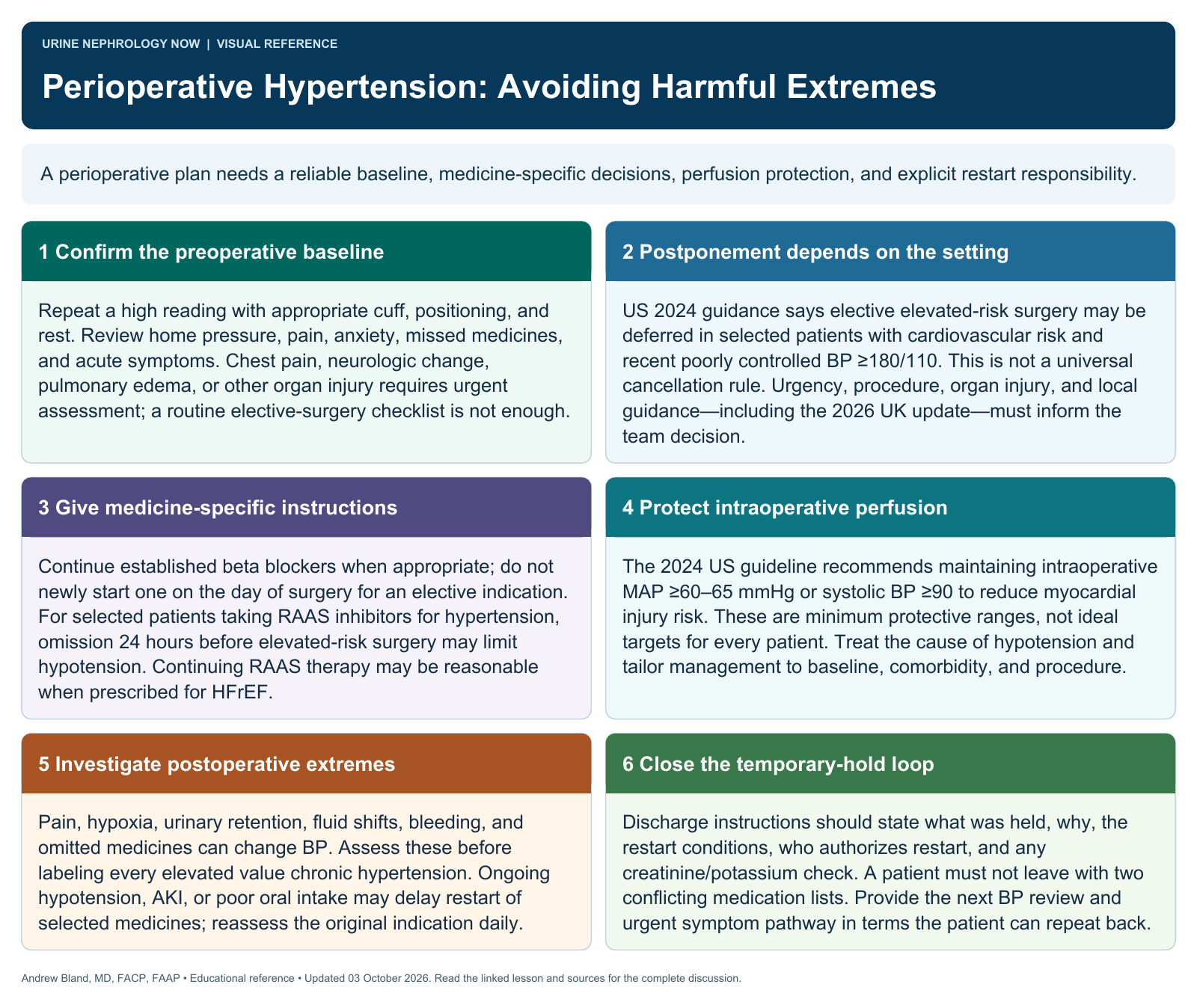
A perioperative plan needs a reliable baseline, medicine-specific decisions, perfusion protection, and explicit restart responsibility.
Text version
Confirm the preoperative baseline
Repeat a high reading with appropriate cuff, positioning, and rest. Review home pressure, pain, anxiety, missed medicines, and acute symptoms. Chest pain, neurologic change, pulmonary edema, or other organ injury requires urgent assessment; a routine elective-surgery checklist is not enough.
Postponement depends on the setting
US 2024 guidance says elective elevated-risk surgery may be deferred in selected patients with cardiovascular risk and recent poorly controlled BP ≥180/110. This is not a universal cancellation rule. Urgency, procedure, organ injury, and local guidance—including the 2026 UK update—must inform the team decision.
Give medicine-specific instructions
Continue established beta blockers when appropriate; do not newly start one on the day of surgery for an elective indication. For selected patients taking RAAS inhibitors for hypertension, omission 24 hours before elevated-risk surgery may limit hypotension. Continuing RAAS therapy may be reasonable when prescribed for HFrEF.
Protect intraoperative perfusion
The 2024 US guideline recommends maintaining intraoperative MAP ≥60–65 mmHg or systolic BP ≥90 to reduce myocardial injury risk. These are minimum protective ranges, not ideal targets for every patient. Treat the cause of hypotension and tailor management to baseline, comorbidity, and procedure.
Investigate postoperative extremes
Pain, hypoxia, urinary retention, fluid shifts, bleeding, and omitted medicines can change BP. Assess these before labeling every elevated value chronic hypertension. Ongoing hypotension, AKI, or poor oral intake may delay restart of selected medicines; reassess the original indication daily.
Close the temporary-hold loop
Discharge instructions should state what was held, why, the restart conditions, who authorizes restart, and any creatinine/potassium check. A patient must not leave with two conflicting medication lists. Provide the next BP review and urgent symptom pathway in terms the patient can repeat back.
Supporting evidence
- Official clinical guidance
- Measurement and management of adult blood pressure in the peri-operative period: updated guidelines from the Association of Anaesthetists and the British and Irish Hypertension Society.
- PeriOperative Quality Initiative (POQI) international consensus statement on perioperative arterial pressure management.