Visual summary
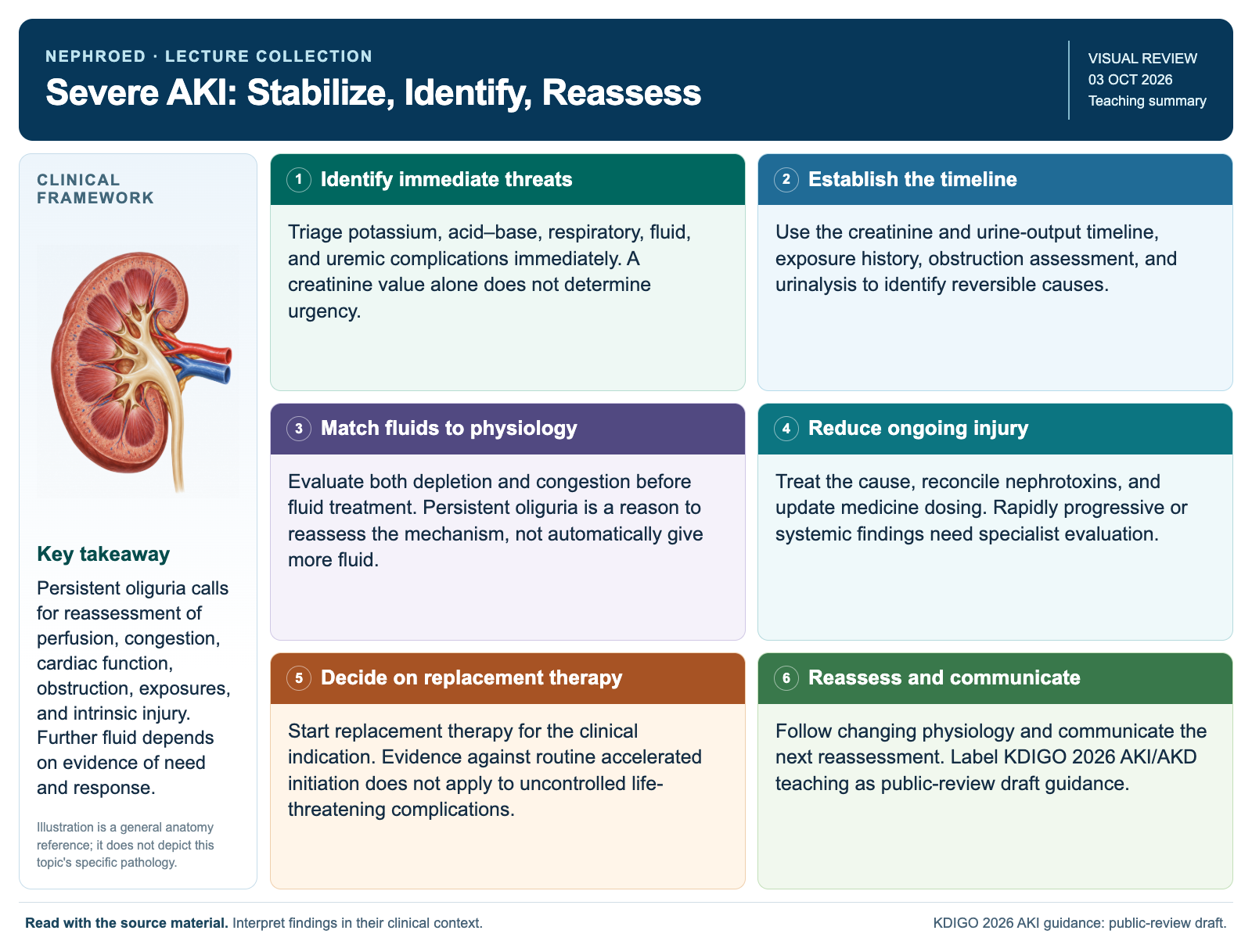
Persistent oliguria calls for reassessment of perfusion, congestion, cardiac function, obstruction, exposures, and intrinsic injury. Further fluid depends on evidence of need and response.
Text version
Identify immediate threats
Triage potassium, acid–base, respiratory, fluid, and uremic complications immediately. A creatinine value alone does not determine urgency.
Establish the timeline
Use the creatinine and urine-output timeline, exposure history, obstruction assessment, and urinalysis to identify reversible causes.
Match fluids to physiology
Evaluate both depletion and congestion before fluid treatment. Persistent oliguria is a reason to reassess the mechanism, not automatically give more fluid.
Reduce ongoing injury
Treat the cause, reconcile nephrotoxins, and update medicine dosing. Rapidly progressive or systemic findings need specialist evaluation.
Decide on replacement therapy
Start replacement therapy for the clinical indication. Evidence against routine accelerated initiation does not apply to uncontrolled life-threatening complications.
Reassess and communicate
Follow changing physiology and communicate the next reassessment. Label KDIGO 2026 AKI/AKD teaching as public-review draft guidance.
Continue learning
This graphic summarizes a topic. The full educational pages provide the broader discussion and references.