Severe acute kidney injury is a clinical emergency when it causes dangerous electrolyte, acid–base, fluid, or uremic complications. The initial question is what threatens the patient now, followed by why kidney function changed and what is reversible.
Learning goal: Connect assessment, evidence, and a clear next clinical decision. Educational use; individual care requires the treating team’s assessment and applicable protocols.
Visual reference
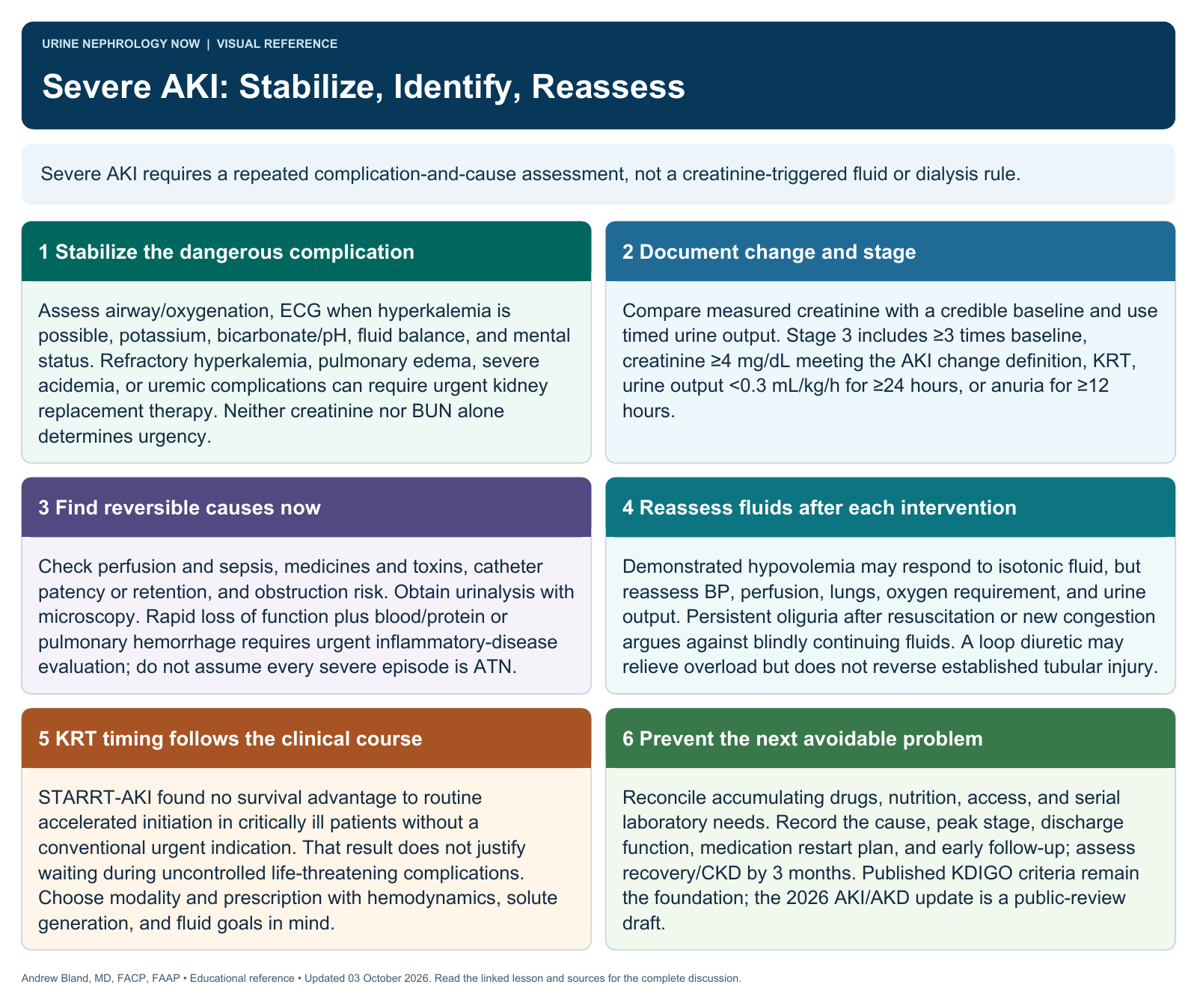
Browse the visual reference library · Download lesson Markdown
Identify immediate threats
Assess airway, breathing, circulation, mental status, perfusion, and urine output. Obtain urgent chemistry and ECG when hyperkalemia is possible. Pulmonary edema, severe electrolyte disturbance, refractory acidosis, or uremic complications requires early nephrology and critical-care involvement; do not wait for a creatinine threshold.
Establish the timeline
Compare with prior creatinine and urine output, including recent admissions and medicines. Assess obstruction, infection, hypotension, surgery, toxins, and muscle injury. Urinalysis and sediment can refine the differential, but casts and urinary indices are clues that require clinical correlation.
Match fluids to physiology
Examine volume status and perfusion repeatedly. Give fluids when indicated for hypovolemia, with reassessment of response and congestion. Oliguria after substantial fluid administration does not prove that more fluid is needed; venous congestion and cardiac dysfunction can also impair kidney function.
Reduce ongoing injury
Review nephrotoxins, adjust drug dosing to changing kidney function and any replacement therapy, and treat the underlying illness. Stop an offending exposure when clinically appropriate. Suspected glomerular disease, thrombotic microangiopathy, or rapidly progressive injury may need urgent specialist investigation and targeted therapy.
Decide on replacement therapy
Kidney replacement therapy treats complications and supports recovery; it is not triggered by a universal creatinine or urea number. STARRT-AKI did not support routine accelerated initiation in its selected critically ill population without conventional urgent indications. That finding does not justify delay when urgent indications exist.
Reassess and communicate
Track urine output, chemistry, fluid balance, symptoms, and treatment response. Specify the next laboratory review and escalation triggers. KDIGO 2026 AKI/AKD material is a public-review draft; identify it as draft when teaching its proposed framework, alongside the published definitions used in trial evidence.
Apply the framework
Does oliguria despite several liters of fluid establish prerenal AKI?
Show the reasoning
No. Reassess perfusion, congestion, cardiac function, obstruction, exposures, and intrinsic injury. Further fluid depends on evidence of need and response.
References and evidence
These sources support the teaching framework. Trial populations, endpoints, and limitations should be checked before applying a result to an individual patient.
- STARRT-AKI Investigators, Canadian Critical Care Trials Group, Australian and New Zealand Intensive Care Society Clinical Trials Group et al.. Timing of Initiation of Renal-Replacement Therapy in Acute Kidney Injury. N Engl J Med. 2020;383(3):240-251. PubMed 32668114
- Kidney Disease: Improving Global Outcomes (KDIGO) CKD Work Group. KDIGO 2024 Clinical Practice Guideline for the Evaluation and Management of Chronic Kidney Disease. Kidney Int. 2024;105(4S):S117-S314. PubMed 38490803
- KDIGO acute kidney injury guideline program: 2026 AKI/AKD public-review draft status.