Visual summary
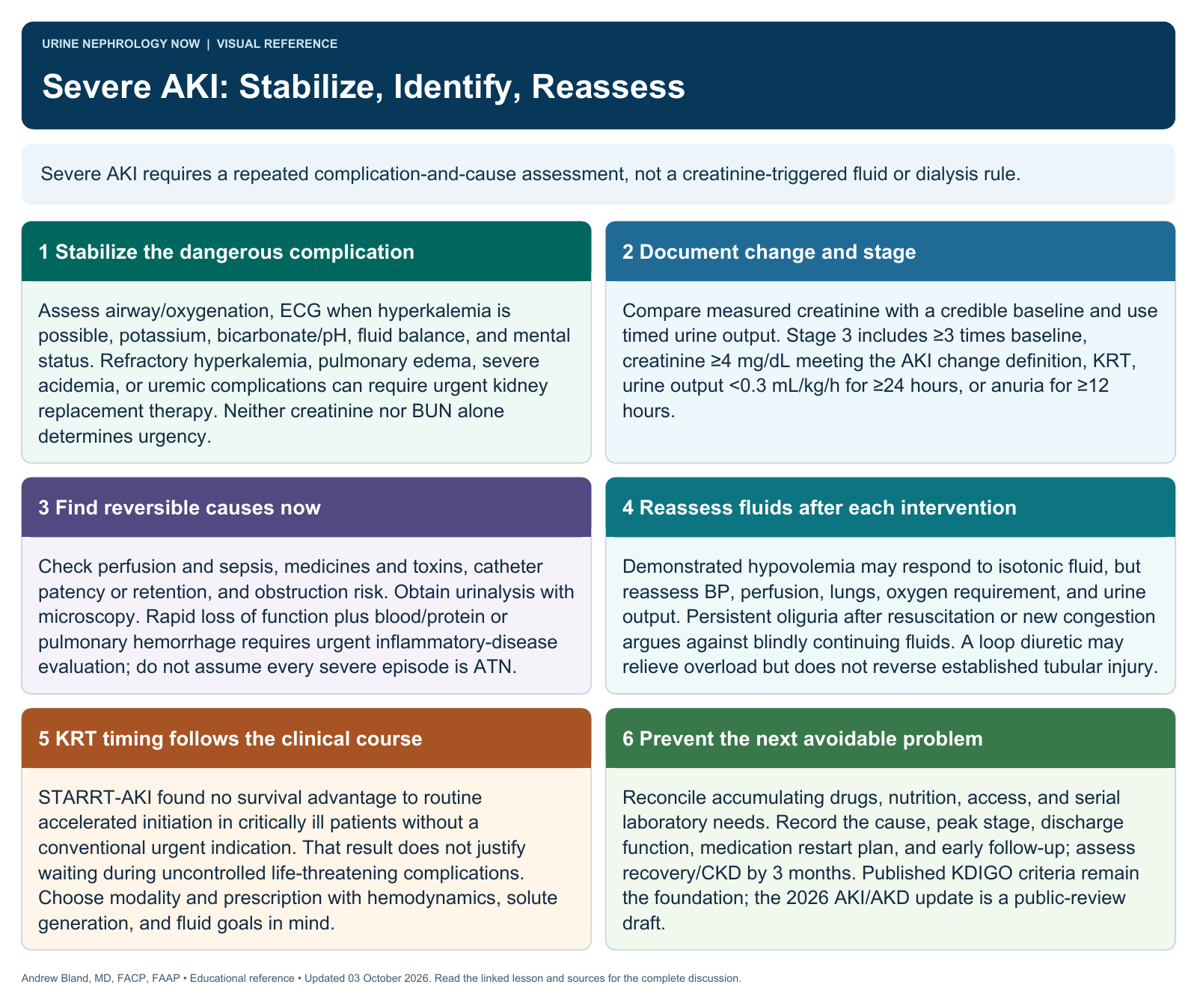
Severe AKI requires a repeated complication-and-cause assessment, not a creatinine-triggered fluid or dialysis rule.
Text version
Stabilize the dangerous complication
Assess airway/oxygenation, ECG when hyperkalemia is possible, potassium, bicarbonate/pH, fluid balance, and mental status. Refractory hyperkalemia, pulmonary edema, severe acidemia, or uremic complications can require urgent kidney replacement therapy. Neither creatinine nor BUN alone determines urgency.
Document change and stage
Compare measured creatinine with a credible baseline and use timed urine output. Stage 3 includes ≥3 times baseline, creatinine ≥4 mg/dL meeting the AKI change definition, KRT, urine output <0.3 mL/kg/h for ≥24 hours, or anuria for ≥12 hours.
Find reversible causes now
Check perfusion and sepsis, medicines and toxins, catheter patency or retention, and obstruction risk. Obtain urinalysis with microscopy. Rapid loss of function plus blood/protein or pulmonary hemorrhage requires urgent inflammatory-disease evaluation; do not assume every severe episode is ATN.
Reassess fluids after each intervention
Demonstrated hypovolemia may respond to isotonic fluid, but reassess BP, perfusion, lungs, oxygen requirement, and urine output. Persistent oliguria after resuscitation or new congestion argues against blindly continuing fluids. A loop diuretic may relieve overload but does not reverse established tubular injury.
KRT timing follows the clinical course
STARRT-AKI found no survival advantage to routine accelerated initiation in critically ill patients without a conventional urgent indication. That result does not justify waiting during uncontrolled life-threatening complications. Choose modality and prescription with hemodynamics, solute generation, and fluid goals in mind.
Prevent the next avoidable problem
Reconcile accumulating drugs, nutrition, access, and serial laboratory needs. Record the cause, peak stage, discharge function, medication restart plan, and early follow-up; assess recovery/CKD by 3 months. Published KDIGO criteria remain the foundation; the 2026 AKI/AKD update is a public-review draft.