Visual summary
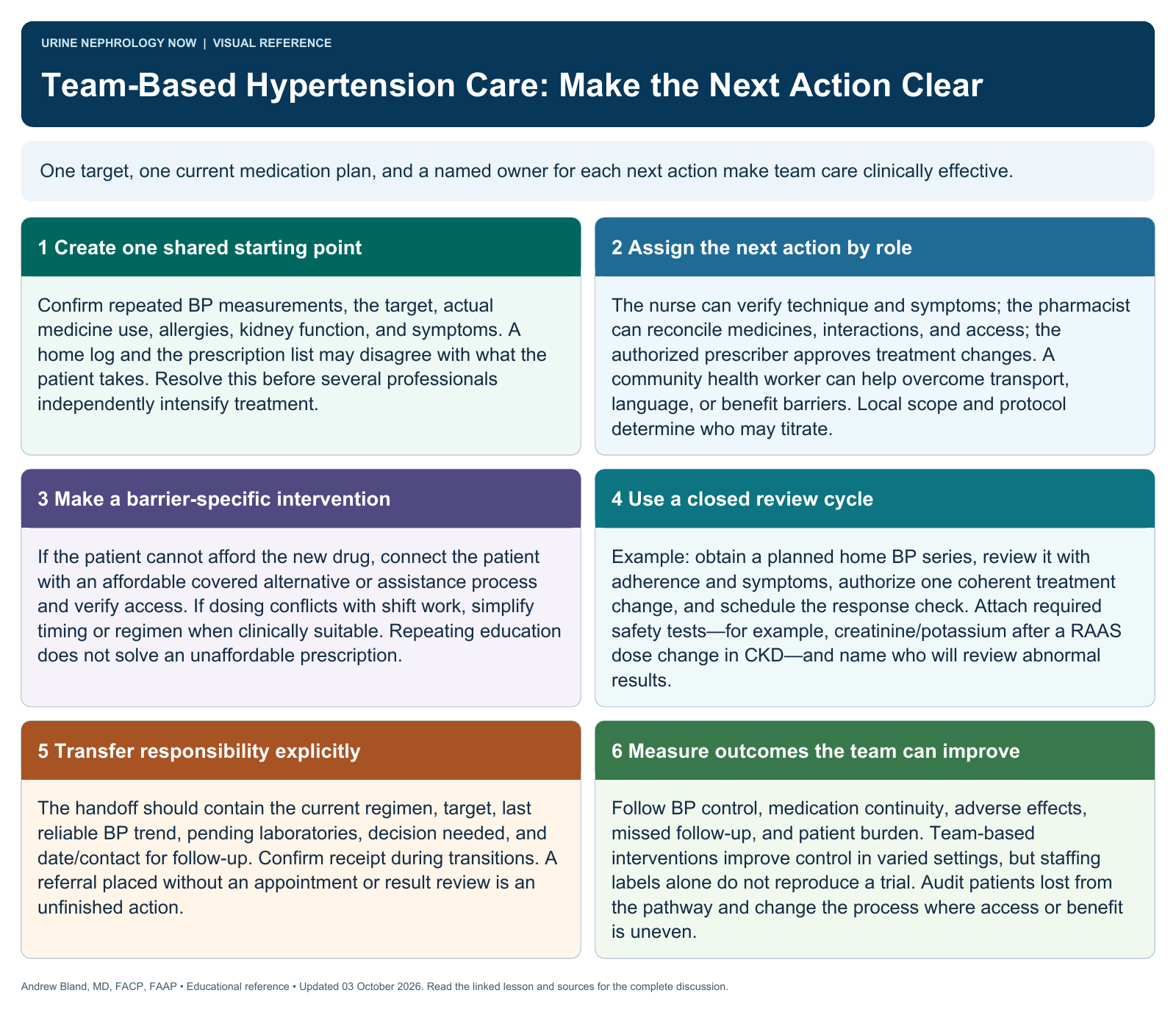
One target, one current medication plan, and a named owner for each next action make team care clinically effective.
Text version
Create one shared starting point
Confirm repeated BP measurements, the target, actual medicine use, allergies, kidney function, and symptoms. A home log and the prescription list may disagree with what the patient takes. Resolve this before several professionals independently intensify treatment.
Assign the next action by role
The nurse can verify technique and symptoms; the pharmacist can reconcile medicines, interactions, and access; the authorized prescriber approves treatment changes. A community health worker can help overcome transport, language, or benefit barriers. Local scope and protocol determine who may titrate.
Make a barrier-specific intervention
If the patient cannot afford the new drug, connect the patient with an affordable covered alternative or assistance process and verify access. If dosing conflicts with shift work, simplify timing or regimen when clinically suitable. Repeating education does not solve an unaffordable prescription.
Use a closed review cycle
Example: obtain a planned home BP series, review it with adherence and symptoms, authorize one coherent treatment change, and schedule the response check. Attach required safety tests—for example, creatinine/potassium after a RAAS dose change in CKD—and name who will review abnormal results.
Transfer responsibility explicitly
The handoff should contain the current regimen, target, last reliable BP trend, pending laboratories, decision needed, and date/contact for follow-up. Confirm receipt during transitions. A referral placed without an appointment or result review is an unfinished action.
Measure outcomes the team can improve
Follow BP control, medication continuity, adverse effects, missed follow-up, and patient burden. Team-based interventions improve control in varied settings, but staffing labels alone do not reproduce a trial. Audit patients lost from the pathway and change the process where access or benefit is uneven.