Visual summary
The access life plan changes with health and goals. Success includes usable treatment with acceptable burden, not just creation of a particular access type.
Text version
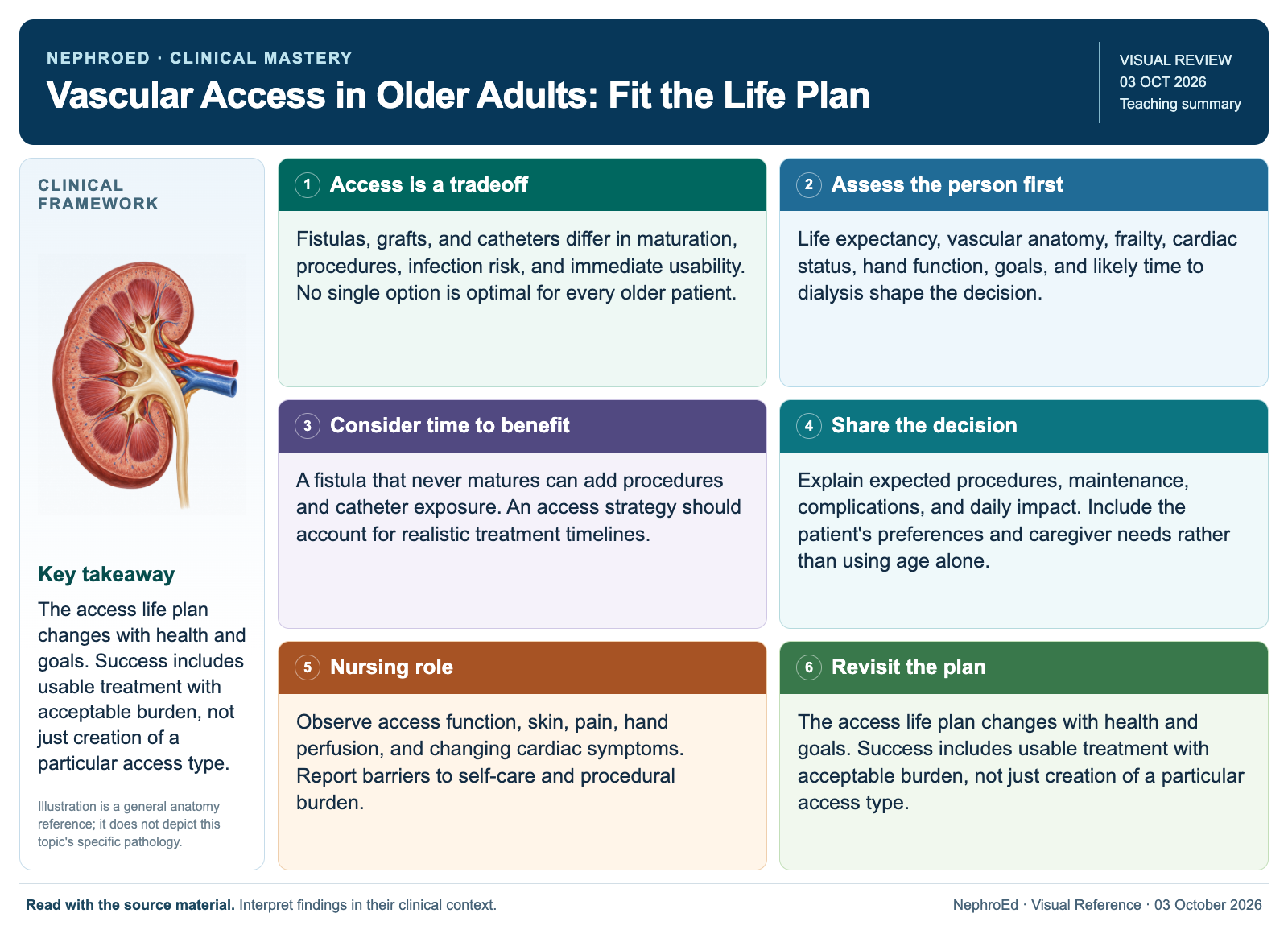
Access is a tradeoff
Fistulas, grafts, and catheters differ in maturation, procedures, infection risk, and immediate usability. No single option is optimal for every older patient.
Assess the person first
Life expectancy, vascular anatomy, frailty, cardiac status, hand function, goals, and likely time to dialysis shape the decision.
Consider time to benefit
A fistula that never matures can add procedures and catheter exposure. An access strategy should account for realistic treatment timelines.
Share the decision
Explain expected procedures, maintenance, complications, and daily impact. Include the patient's preferences and caregiver needs rather than using age alone.
Nursing role
Observe access function, skin, pain, hand perfusion, and changing cardiac symptoms. Report barriers to self-care and procedural burden.
Revisit the plan
The access life plan changes with health and goals. Success includes usable treatment with acceptable burden, not just creation of a particular access type.
Continue learning
This graphic summarizes a topic. The full educational pages provide the broader discussion and references.