Visual summary
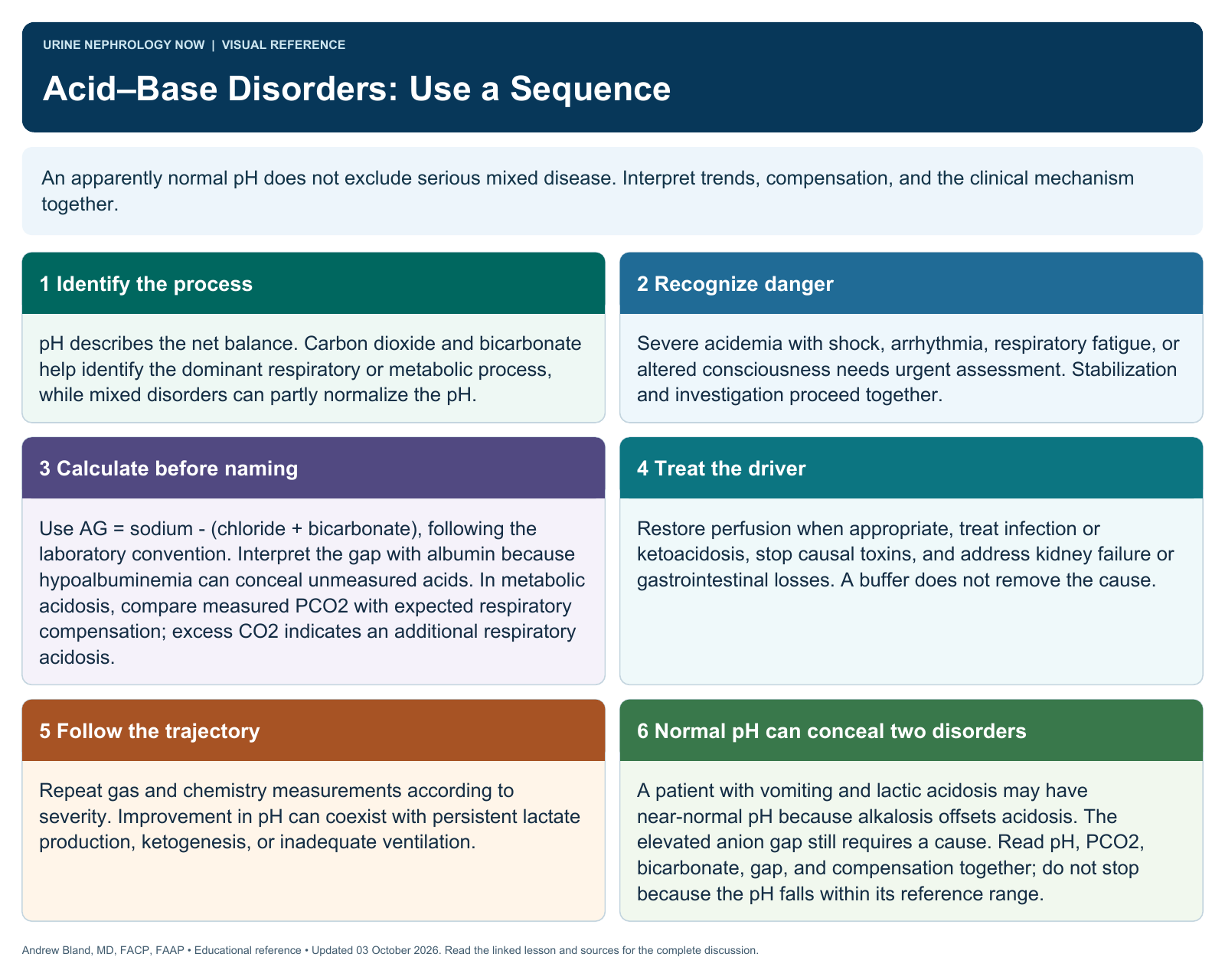
An apparently normal pH does not exclude serious mixed disease. Interpret trends, compensation, and the clinical mechanism together.
Text version
Identify the process
pH describes the net balance. Carbon dioxide and bicarbonate help identify the dominant respiratory or metabolic process, while mixed disorders can partly normalize the pH.
Recognize danger
Severe acidemia with shock, arrhythmia, respiratory fatigue, or altered consciousness needs urgent assessment. Stabilization and investigation proceed together.
Calculate before naming
Use AG = sodium − (chloride + bicarbonate), following the laboratory convention. Interpret the gap with albumin because hypoalbuminemia can conceal unmeasured acids. In metabolic acidosis, compare measured PCO2 with expected respiratory compensation; excess CO2 indicates an additional respiratory acidosis.
Treat the driver
Restore perfusion when appropriate, treat infection or ketoacidosis, stop causal toxins, and address kidney failure or gastrointestinal losses. A buffer does not remove the cause.
Follow the trajectory
Repeat gas and chemistry measurements according to severity. Improvement in pH can coexist with persistent lactate production, ketogenesis, or inadequate ventilation.
Normal pH can conceal two disorders
A patient with vomiting and lactic acidosis may have near-normal pH because alkalosis offsets acidosis. The elevated anion gap still requires a cause. Read pH, PCO2, bicarbonate, gap, and compensation together; do not stop because the pH falls within its reference range.