Visual summary
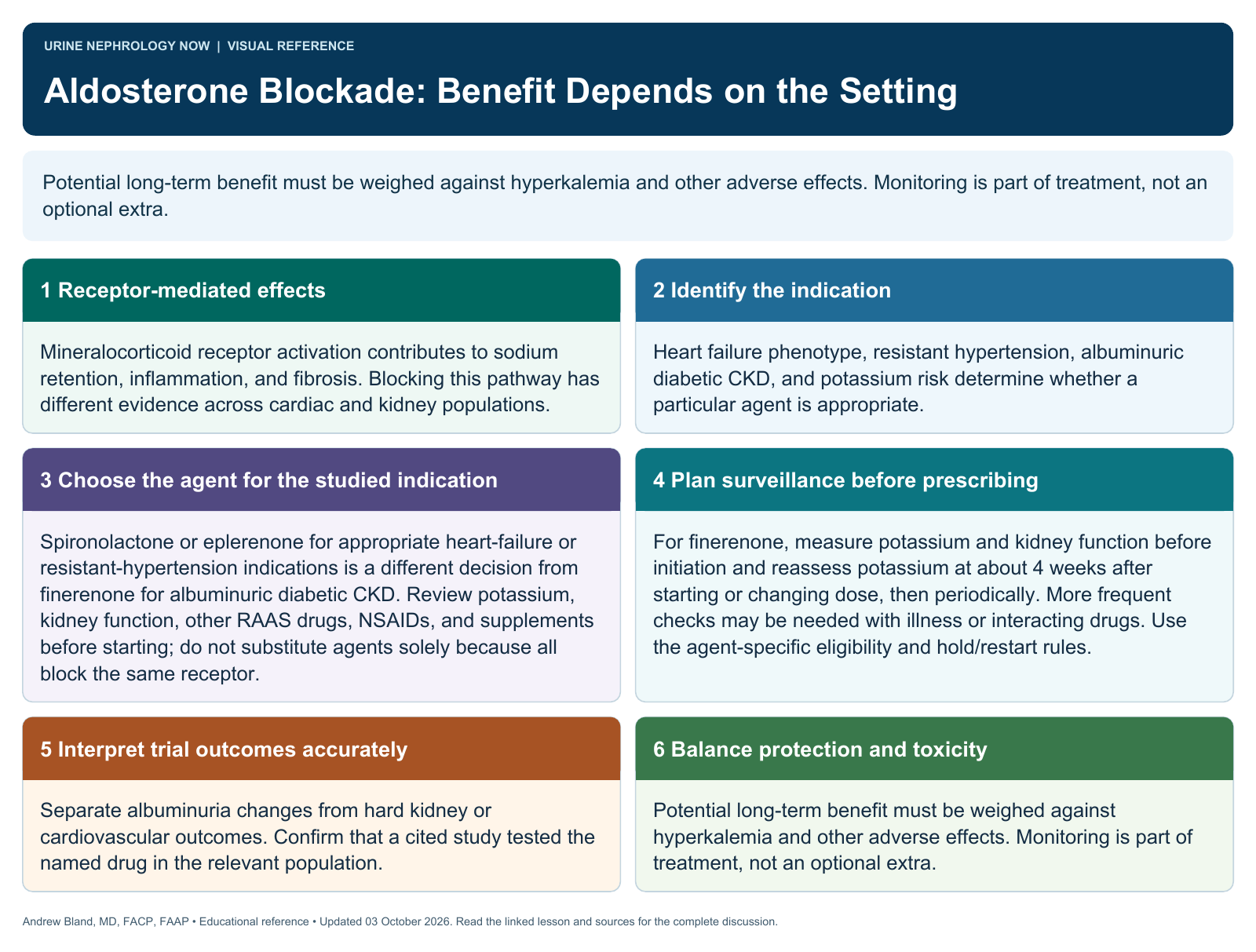
Potential long-term benefit must be weighed against hyperkalemia and other adverse effects. Monitoring is part of treatment, not an optional extra.
Text version
Receptor-mediated effects
Mineralocorticoid receptor activation contributes to sodium retention, inflammation, and fibrosis. Blocking this pathway has different evidence across cardiac and kidney populations.
Identify the indication
Heart failure phenotype, resistant hypertension, albuminuric diabetic CKD, and potassium risk determine whether a particular agent is appropriate.
Assess before treatment
Review kidney function, potassium, volume status, interacting medicines, and the agent's trial population and labeling. Steroidal and nonsteroidal agents are not interchangeable.
Plan monitoring
Check potassium and kidney function after initiation and relevant changes. Adjust the regimen to illness, dehydration, interacting drugs, and evolving renal function.
Interpret trial outcomes accurately
Separate albuminuria changes from hard kidney or cardiovascular outcomes. Confirm that a cited study tested the named drug in the relevant population.
Balance protection and toxicity
Potential long-term benefit must be weighed against hyperkalemia and other adverse effects. Monitoring is part of treatment, not an optional extra.
Continue learning
This graphic summarizes a topic. The full educational pages provide the broader discussion and references.