Visual summary
Improved laboratory values do not automatically imply survival benefit. Trial population, severity, kidney injury, and cointerventions determine applicability.
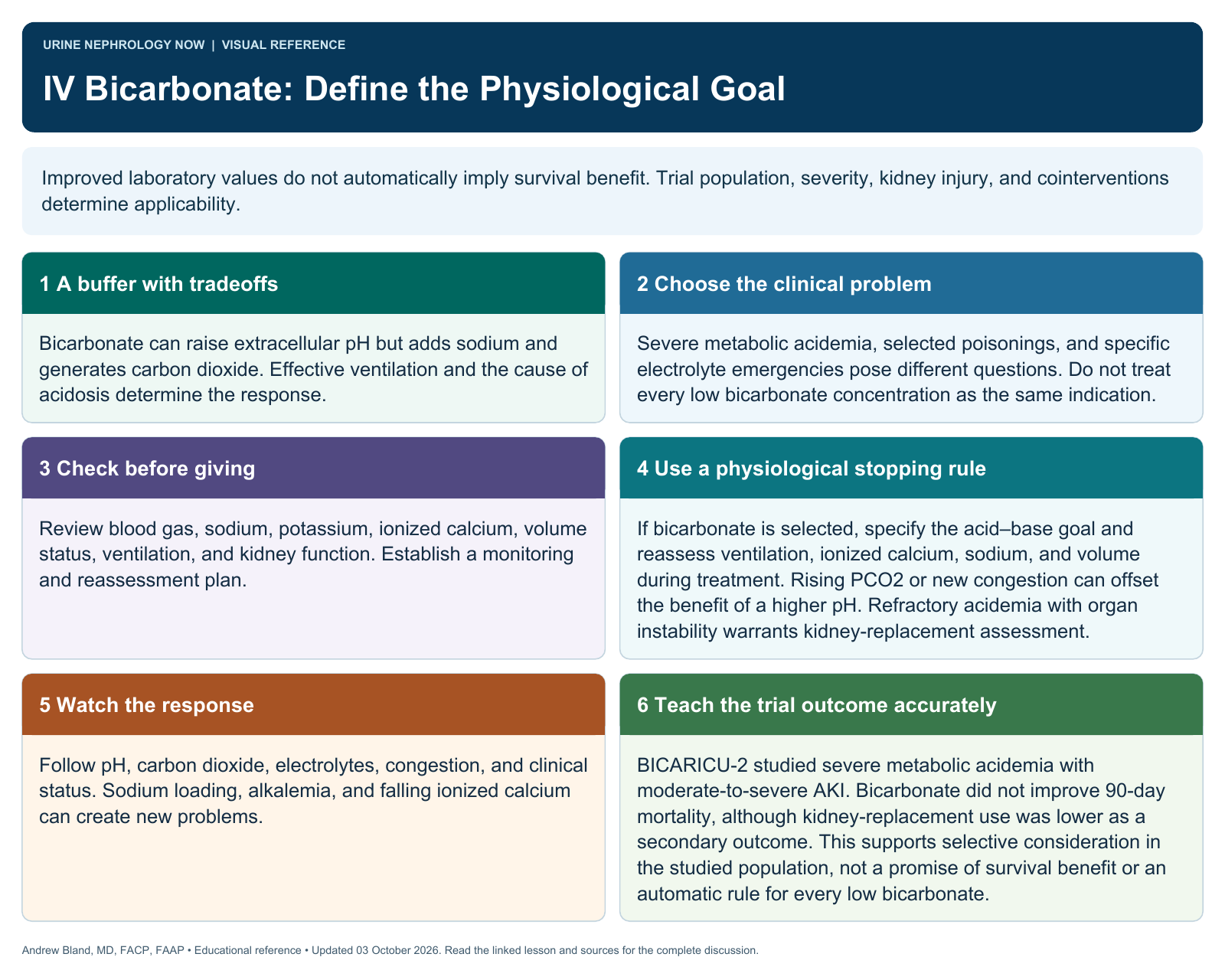
Text version
A buffer with tradeoffs
Bicarbonate can raise extracellular pH but adds sodium and generates carbon dioxide. Effective ventilation and the cause of acidosis determine the response.
Choose the clinical problem
Severe metabolic acidemia, selected poisonings, and specific electrolyte emergencies pose different questions. Do not treat every low bicarbonate concentration as the same indication.
Check before giving
Review blood gas, sodium, potassium, ionized calcium, volume status, ventilation, and kidney function. Establish a monitoring and reassessment plan.
Use a physiological stopping rule
If bicarbonate is selected, specify the acid–base goal and reassess ventilation, ionized calcium, sodium, and volume during treatment. Rising PCO2 or new congestion can offset the benefit of a higher pH. Refractory acidemia with organ instability warrants kidney-replacement assessment.
Watch the response
Follow pH, carbon dioxide, electrolytes, congestion, and clinical status. Sodium loading, alkalemia, and falling ionized calcium can create new problems.
Teach the trial outcome accurately
BICARICU-2 studied severe metabolic acidemia with moderate-to-severe AKI. Bicarbonate did not improve 90-day mortality, although kidney-replacement use was lower as a secondary outcome. This supports selective consideration in the studied population, not a promise of survival benefit or an automatic rule for every low bicarbonate.