Visual summary
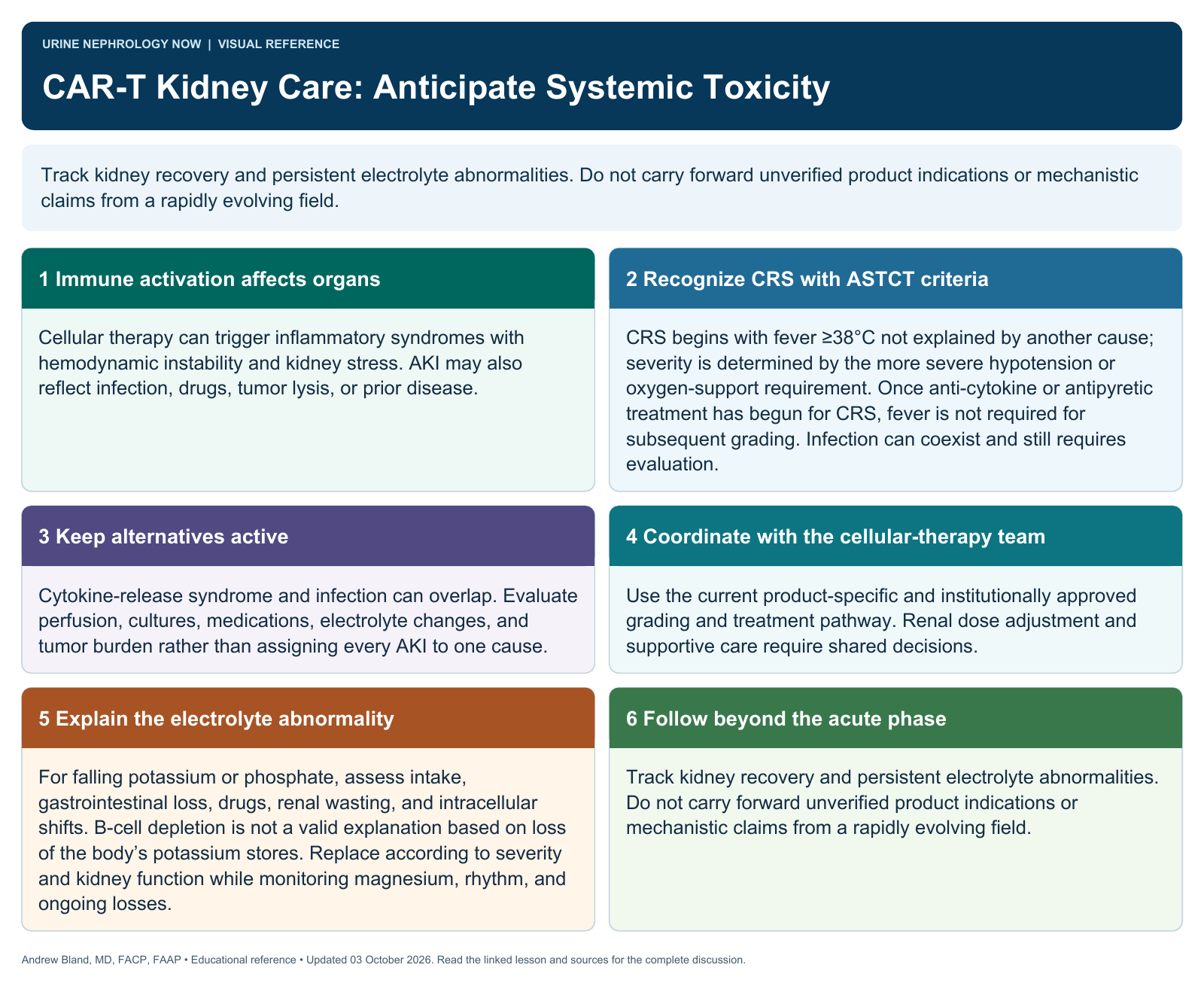
Track kidney recovery and persistent electrolyte abnormalities. Do not carry forward unverified product indications or mechanistic claims from a rapidly evolving field.
Text version
Immune activation affects organs
Cellular therapy can trigger inflammatory syndromes with hemodynamic instability and kidney stress. AKI may also reflect infection, drugs, tumor lysis, or prior disease.
Recognize CRS with ASTCT criteria
CRS begins with fever ≥38°C not explained by another cause; severity is determined by the more severe hypotension or oxygen-support requirement. Once anti-cytokine or antipyretic treatment has begun for CRS, fever is not required for subsequent grading. Infection can coexist and still requires evaluation.
Keep alternatives active
Cytokine-release syndrome and infection can overlap. Evaluate perfusion, cultures, medications, electrolyte changes, and tumor burden rather than assigning every AKI to one cause.
Coordinate with the cellular-therapy team
Use the current product-specific and institutionally approved grading and treatment pathway. Renal dose adjustment and supportive care require shared decisions.
Explain the electrolyte abnormality
For falling potassium or phosphate, assess intake, gastrointestinal loss, drugs, renal wasting, and intracellular shifts. B-cell depletion is not a valid explanation based on loss of the body’s potassium stores. Replace according to severity and kidney function while monitoring magnesium, rhythm, and ongoing losses.
Follow beyond the acute phase
Track kidney recovery and persistent electrolyte abnormalities. Do not carry forward unverified product indications or mechanistic claims from a rapidly evolving field.