Visual summary
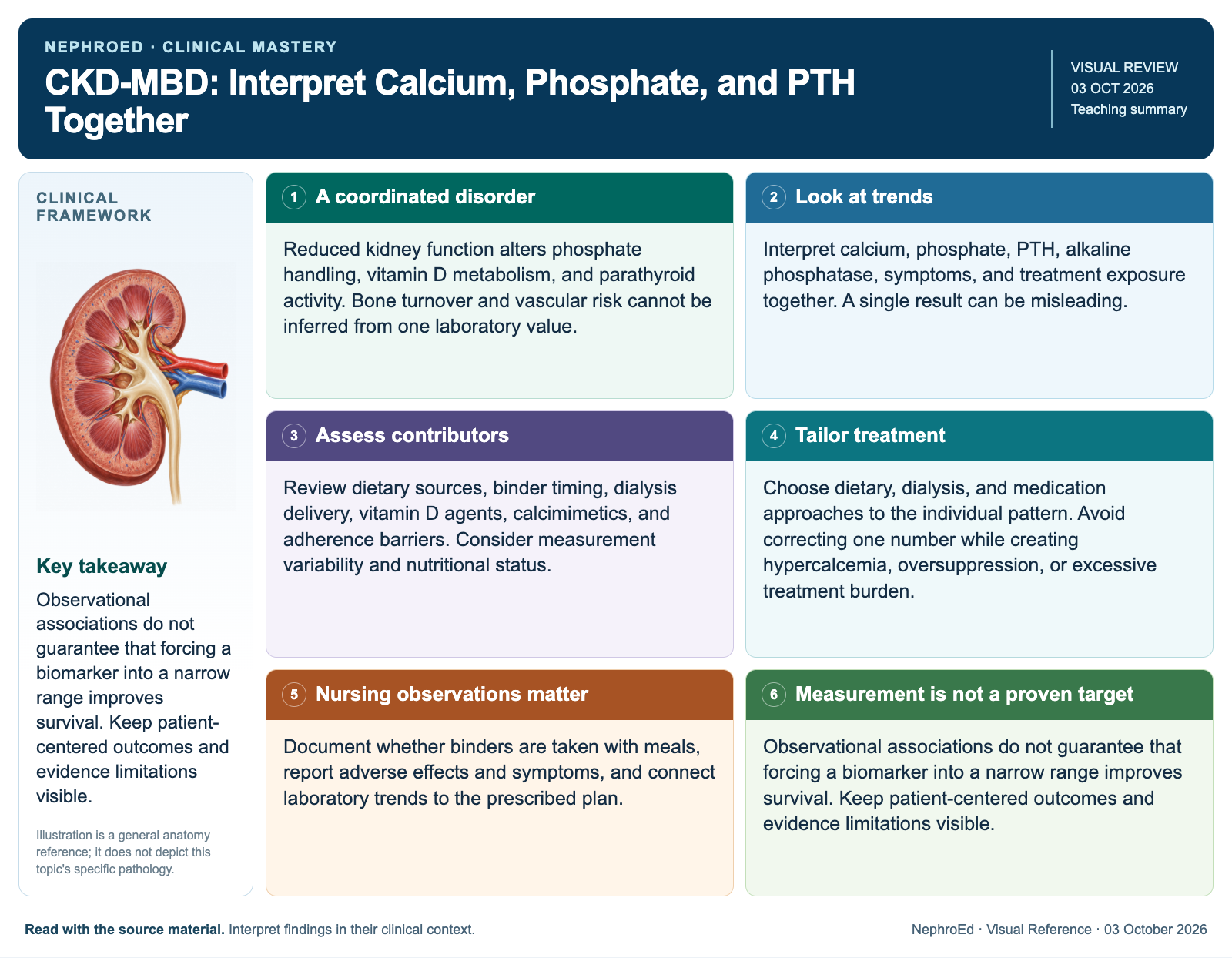
Observational associations do not guarantee that forcing a biomarker into a narrow range improves survival. Keep patient-centered outcomes and evidence limitations visible.
Text version
A coordinated disorder
Reduced kidney function alters phosphate handling, vitamin D metabolism, and parathyroid activity. Bone turnover and vascular risk cannot be inferred from one laboratory value.
Look at trends
Interpret calcium, phosphate, PTH, alkaline phosphatase, symptoms, and treatment exposure together. A single result can be misleading.
Assess contributors
Review dietary sources, binder timing, dialysis delivery, vitamin D agents, calcimimetics, and adherence barriers. Consider measurement variability and nutritional status.
Tailor treatment
Choose dietary, dialysis, and medication approaches to the individual pattern. Avoid correcting one number while creating hypercalcemia, oversuppression, or excessive treatment burden.
Nursing observations matter
Document whether binders are taken with meals, report adverse effects and symptoms, and connect laboratory trends to the prescribed plan.
Measurement is not a proven target
Observational associations do not guarantee that forcing a biomarker into a narrow range improves survival. Keep patient-centered outcomes and evidence limitations visible.
Continue learning
This graphic summarizes a topic. The full educational pages provide the broader discussion and references.