Visual summary
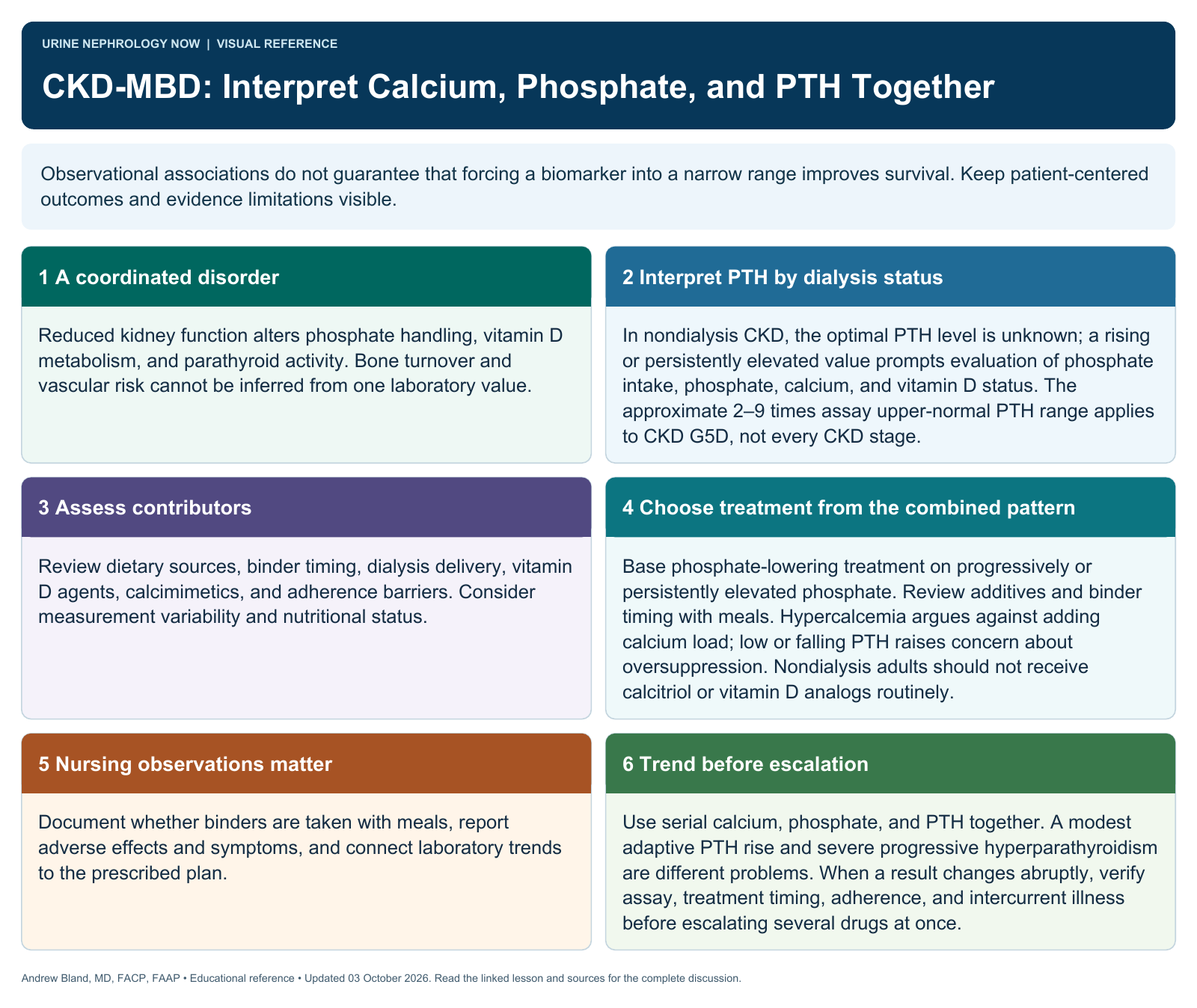
Observational associations do not guarantee that forcing a biomarker into a narrow range improves survival. Keep patient-centered outcomes and evidence limitations visible.
Text version
A coordinated disorder
Reduced kidney function alters phosphate handling, vitamin D metabolism, and parathyroid activity. Bone turnover and vascular risk cannot be inferred from one laboratory value.
Interpret PTH by dialysis status
In nondialysis CKD, the optimal PTH level is unknown; a rising or persistently elevated value prompts evaluation of phosphate intake, phosphate, calcium, and vitamin D status. The approximate 2–9 times assay upper-normal PTH range applies to CKD G5D, not every CKD stage.
Assess contributors
Review dietary sources, binder timing, dialysis delivery, vitamin D agents, calcimimetics, and adherence barriers. Consider measurement variability and nutritional status.
Choose treatment from the combined pattern
Base phosphate-lowering treatment on progressively or persistently elevated phosphate. Review additives and binder timing with meals. Hypercalcemia argues against adding calcium load; low or falling PTH raises concern about oversuppression. Nondialysis adults should not receive calcitriol or vitamin D analogs routinely.
Nursing observations matter
Document whether binders are taken with meals, report adverse effects and symptoms, and connect laboratory trends to the prescribed plan.
Trend before escalation
Use serial calcium, phosphate, and PTH together. A modest adaptive PTH rise and severe progressive hyperparathyroidism are different problems. When a result changes abruptly, verify assay, treatment timing, adherence, and intercurrent illness before escalating several drugs at once.