Visual summary
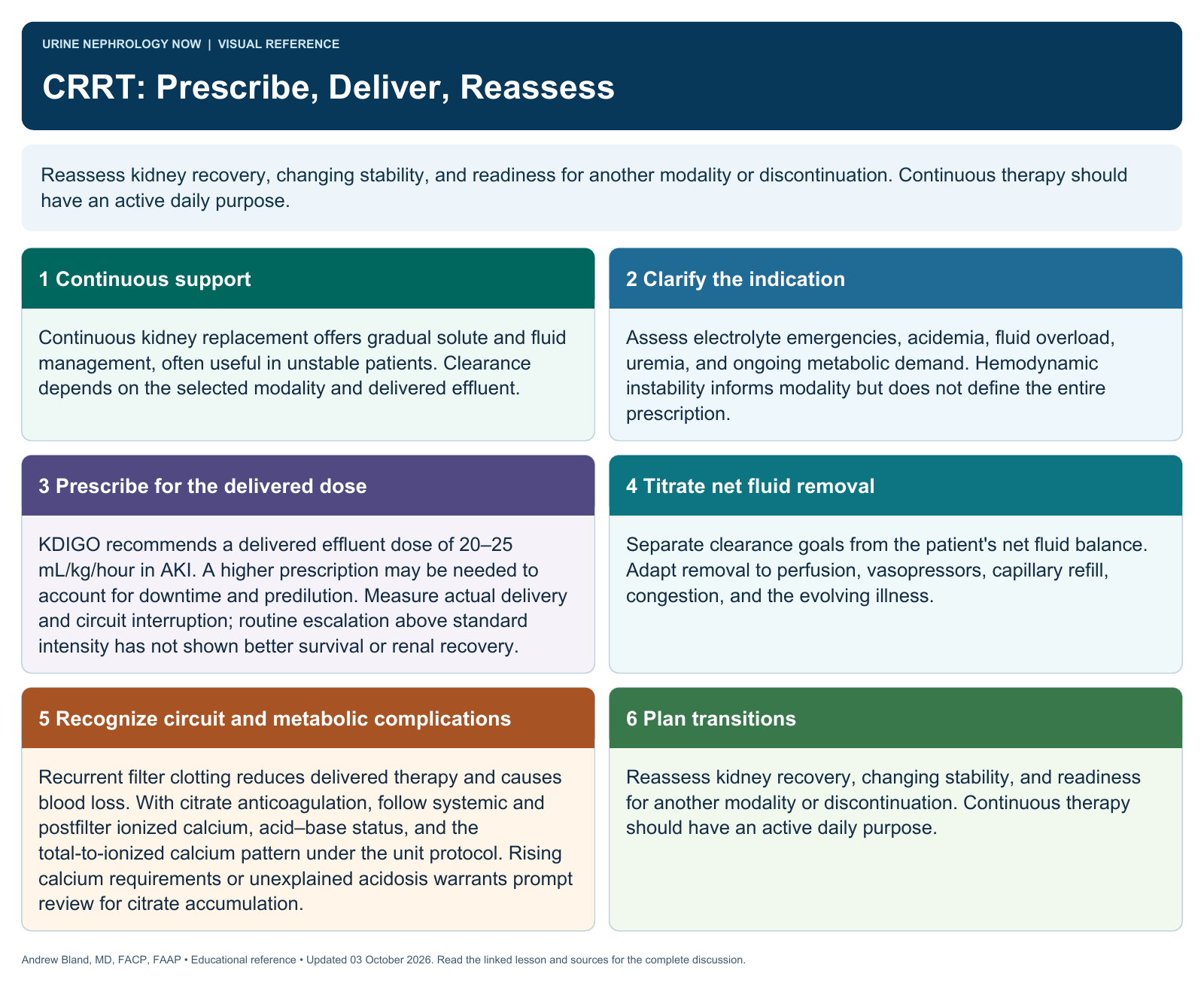
Reassess kidney recovery, changing stability, and readiness for another modality or discontinuation. Continuous therapy should have an active daily purpose.
Text version
Continuous support
Continuous kidney replacement offers gradual solute and fluid management, often useful in unstable patients. Clearance depends on the selected modality and delivered effluent.
Clarify the indication
Assess electrolyte emergencies, acidemia, fluid overload, uremia, and ongoing metabolic demand. Hemodynamic instability informs modality but does not define the entire prescription.
Prescribe for the delivered dose
KDIGO recommends a delivered effluent dose of 20–25 mL/kg/hour in AKI. A higher prescription may be needed to account for downtime and predilution. Measure actual delivery and circuit interruption; routine escalation above standard intensity has not shown better survival or renal recovery.
Titrate net fluid removal
Separate clearance goals from the patient's net fluid balance. Adapt removal to perfusion, vasopressors, capillary refill, congestion, and the evolving illness.
Recognize circuit and metabolic complications
Recurrent filter clotting reduces delivered therapy and causes blood loss. With citrate anticoagulation, follow systemic and postfilter ionized calcium, acid–base status, and the total-to-ionized calcium pattern under the unit protocol. Rising calcium requirements or unexplained acidosis warrants prompt review for citrate accumulation.
Plan transitions
Reassess kidney recovery, changing stability, and readiness for another modality or discontinuation. Continuous therapy should have an active daily purpose.