Visual summary
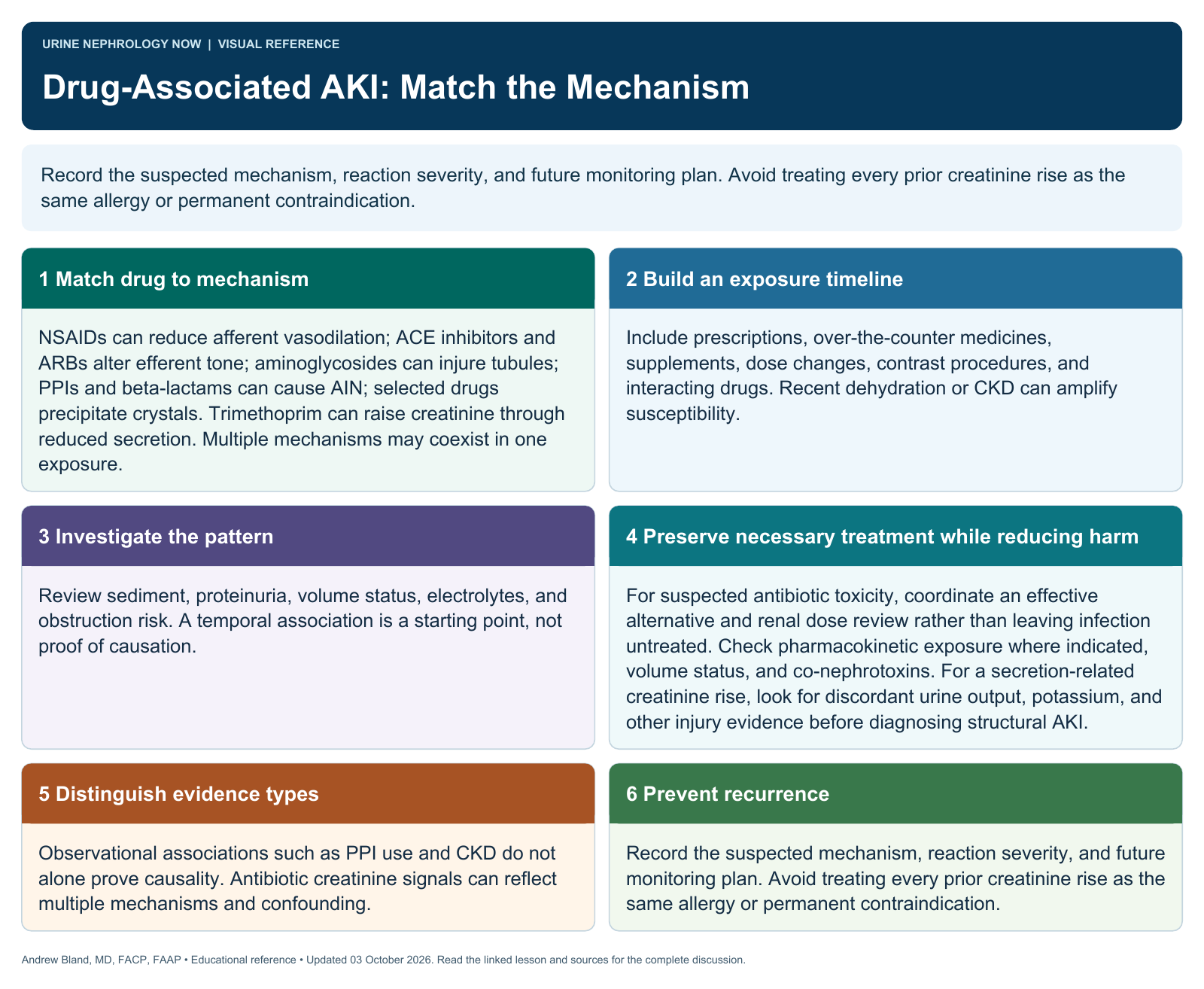
Record the suspected mechanism, reaction severity, and future monitoring plan. Avoid treating every prior creatinine rise as the same allergy or permanent contraindication.
Text version
More than direct toxicity
Drugs may alter renal hemodynamics, injure tubules, provoke interstitial inflammation, form crystals, or affect microvasculature. Some raise creatinine without reducing filtration.
Build an exposure timeline
Include prescriptions, over-the-counter medicines, supplements, dose changes, contrast procedures, and interacting drugs. Recent dehydration or CKD can amplify susceptibility.
Investigate the pattern
Review sediment, proteinuria, volume status, electrolytes, and obstruction risk. A temporal association is a starting point, not proof of causation.
Balance stopping and treating
Withdraw or modify the likely culprit when possible while preserving essential infection or cancer treatment. Coordinate alternatives and renal dose adjustment.
Distinguish evidence types
Observational associations such as PPI use and CKD do not alone prove causality. Antibiotic creatinine signals can reflect multiple mechanisms and confounding.
Prevent recurrence
Record the suspected mechanism, reaction severity, and future monitoring plan. Avoid treating every prior creatinine rise as the same allergy or permanent contraindication.
Continue learning
This graphic summarizes a topic. The full educational pages provide the broader discussion and references.