Visual summary
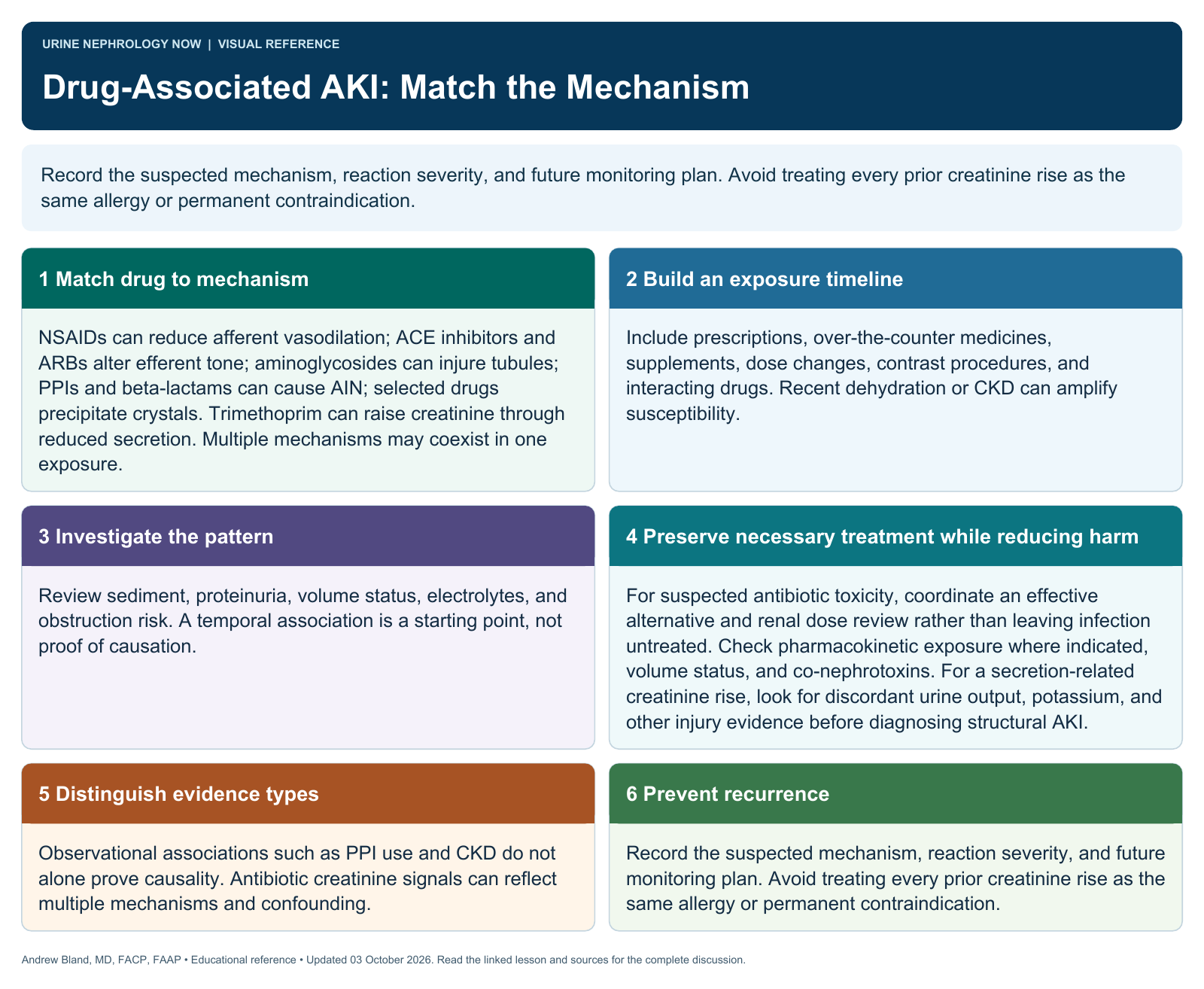
Record the suspected mechanism, reaction severity, and future monitoring plan. Avoid treating every prior creatinine rise as the same allergy or permanent contraindication.
Text version
Match drug to mechanism
NSAIDs can reduce afferent vasodilation; ACE inhibitors and ARBs alter efferent tone; aminoglycosides can injure tubules; PPIs and beta-lactams can cause AIN; selected drugs precipitate crystals. Trimethoprim can raise creatinine through reduced secretion. Multiple mechanisms may coexist in one exposure.
Build an exposure timeline
Include prescriptions, over-the-counter medicines, supplements, dose changes, contrast procedures, and interacting drugs. Recent dehydration or CKD can amplify susceptibility.
Investigate the pattern
Review sediment, proteinuria, volume status, electrolytes, and obstruction risk. A temporal association is a starting point, not proof of causation.
Preserve necessary treatment while reducing harm
For suspected antibiotic toxicity, coordinate an effective alternative and renal dose review rather than leaving infection untreated. Check pharmacokinetic exposure where indicated, volume status, and co-nephrotoxins. For a secretion-related creatinine rise, look for discordant urine output, potassium, and other injury evidence before diagnosing structural AKI.
Distinguish evidence types
Observational associations such as PPI use and CKD do not alone prove causality. Antibiotic creatinine signals can reflect multiple mechanisms and confounding.
Prevent recurrence
Record the suspected mechanism, reaction severity, and future monitoring plan. Avoid treating every prior creatinine rise as the same allergy or permanent contraindication.