Visual summary
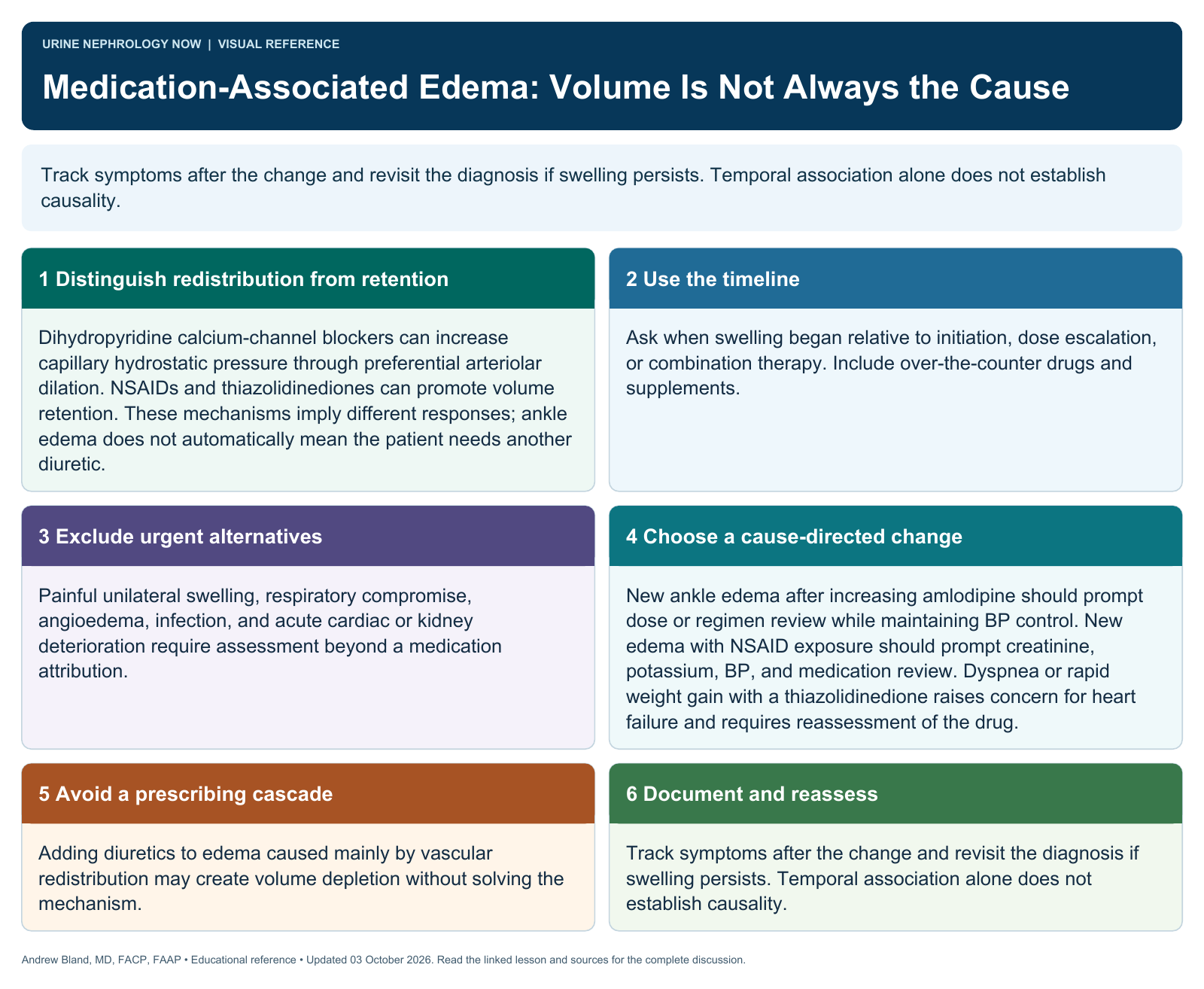
Track symptoms after the change and revisit the diagnosis if swelling persists. Temporal association alone does not establish causality.
Text version
Distinguish redistribution from retention
Dihydropyridine calcium-channel blockers can increase capillary hydrostatic pressure through preferential arteriolar dilation. NSAIDs and thiazolidinediones can promote volume retention. These mechanisms imply different responses; ankle edema does not automatically mean the patient needs another diuretic.
Use the timeline
Ask when swelling began relative to initiation, dose escalation, or combination therapy. Include over-the-counter drugs and supplements.
Exclude urgent alternatives
Painful unilateral swelling, respiratory compromise, angioedema, infection, and acute cardiac or kidney deterioration require assessment beyond a medication attribution.
Choose a cause-directed change
New ankle edema after increasing amlodipine should prompt dose or regimen review while maintaining BP control. New edema with NSAID exposure should prompt creatinine, potassium, BP, and medication review. Dyspnea or rapid weight gain with a thiazolidinedione raises concern for heart failure and requires reassessment of the drug.
Avoid a prescribing cascade
Adding diuretics to edema caused mainly by vascular redistribution may create volume depletion without solving the mechanism.
Document and reassess
Track symptoms after the change and revisit the diagnosis if swelling persists. Temporal association alone does not establish causality.
Supporting evidence
- Drug-induced peripheral oedema: An aetiology-based review.
- Comparative peripheral edema for dihydropyridines calcium channel blockers treatment: A systematic review and network meta-analysis.
- PubMed 35303569
- Etiology of Drug-Induced Edema: A Review of Dihydropyridine, Thiazolidinedione, and Other Medications Causing Edema.