Visual summary
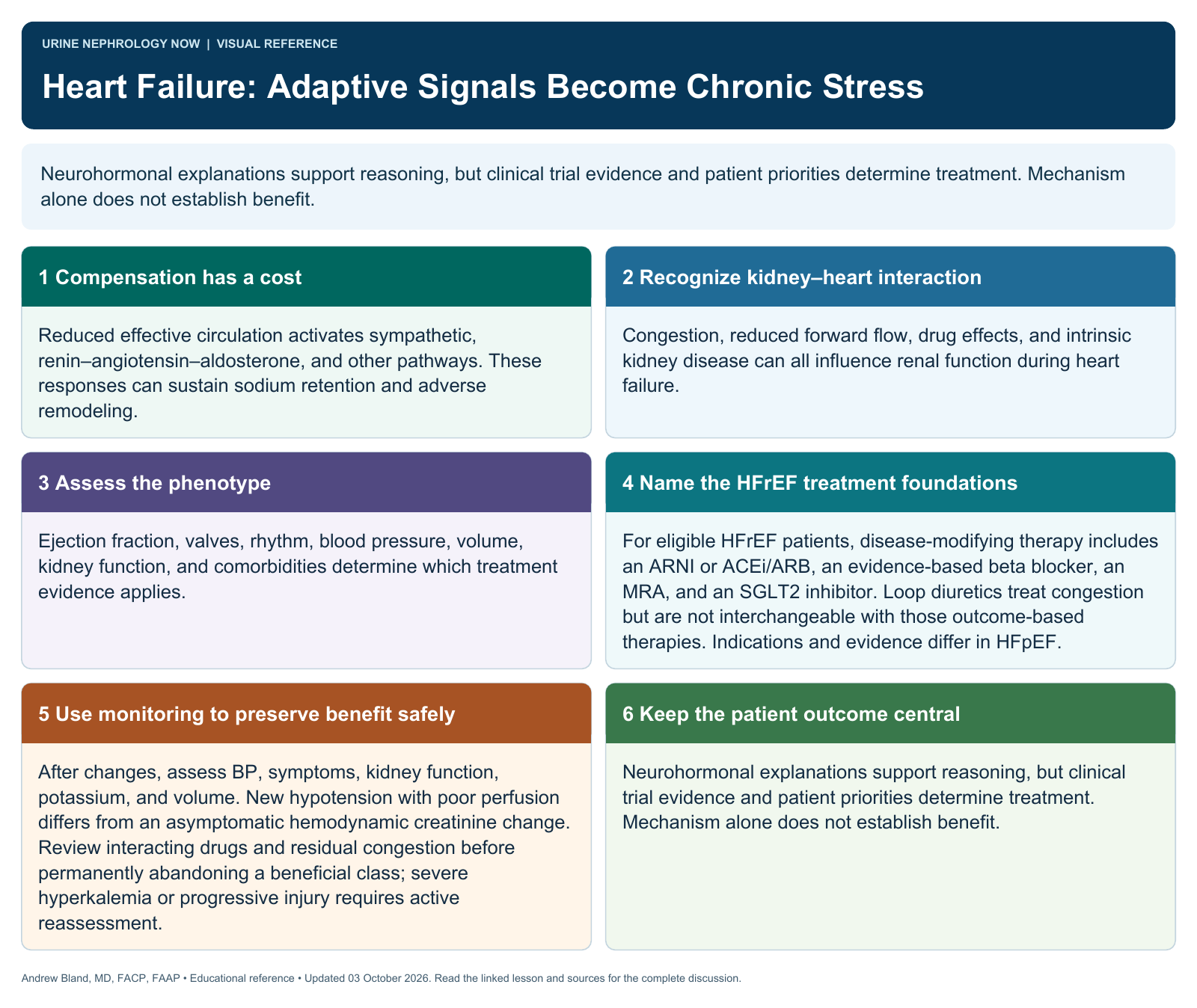
Neurohormonal explanations support reasoning, but clinical trial evidence and patient priorities determine treatment. Mechanism alone does not establish benefit.
Text version
Compensation has a cost
Reduced effective circulation activates sympathetic, renin–angiotensin–aldosterone, and other pathways. These responses can sustain sodium retention and adverse remodeling.
Recognize kidney–heart interaction
Congestion, reduced forward flow, drug effects, and intrinsic kidney disease can all influence renal function during heart failure.
Assess the phenotype
Ejection fraction, valves, rhythm, blood pressure, volume, kidney function, and comorbidities determine which treatment evidence applies.
Name the HFrEF treatment foundations
For eligible HFrEF patients, disease-modifying therapy includes an ARNI or ACEi/ARB, an evidence-based beta blocker, an MRA, and an SGLT2 inhibitor. Loop diuretics treat congestion but are not interchangeable with those outcome-based therapies. Indications and evidence differ in HFpEF.
Use monitoring to preserve benefit safely
After changes, assess BP, symptoms, kidney function, potassium, and volume. New hypotension with poor perfusion differs from an asymptomatic hemodynamic creatinine change. Review interacting drugs and residual congestion before permanently abandoning a beneficial class; severe hyperkalemia or progressive injury requires active reassessment.
Keep the patient outcome central
Neurohormonal explanations support reasoning, but clinical trial evidence and patient priorities determine treatment. Mechanism alone does not establish benefit.