Optimizing treatment across the disease spectrum through phenotype, trial evidence, and safe implementation
Andrew Bland, MD, FACP, FAAP · Urine Nephrology Now · Corrected edition: October 3, 2026
This edition supersedes the July 24, 2025 teaching report. It retains the original focus on RAAS inhibition, MRAs, natriuretic peptides, treatment timing, and clinical monitoring, while correcting unsupported comparative rankings and biomarker thresholds. Educational material; individual care requires the treating team's assessment and current prescribing information.
Visual reference
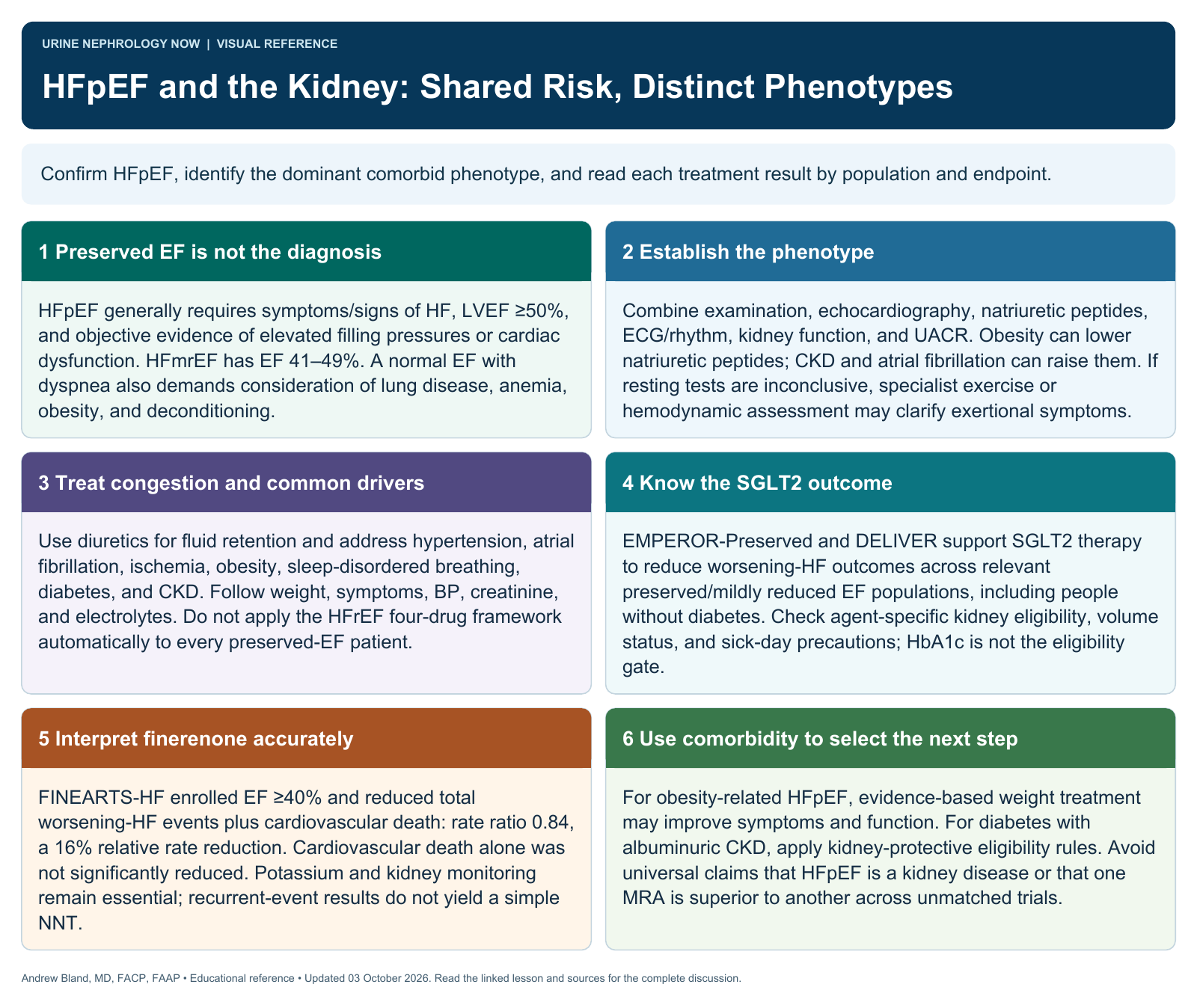
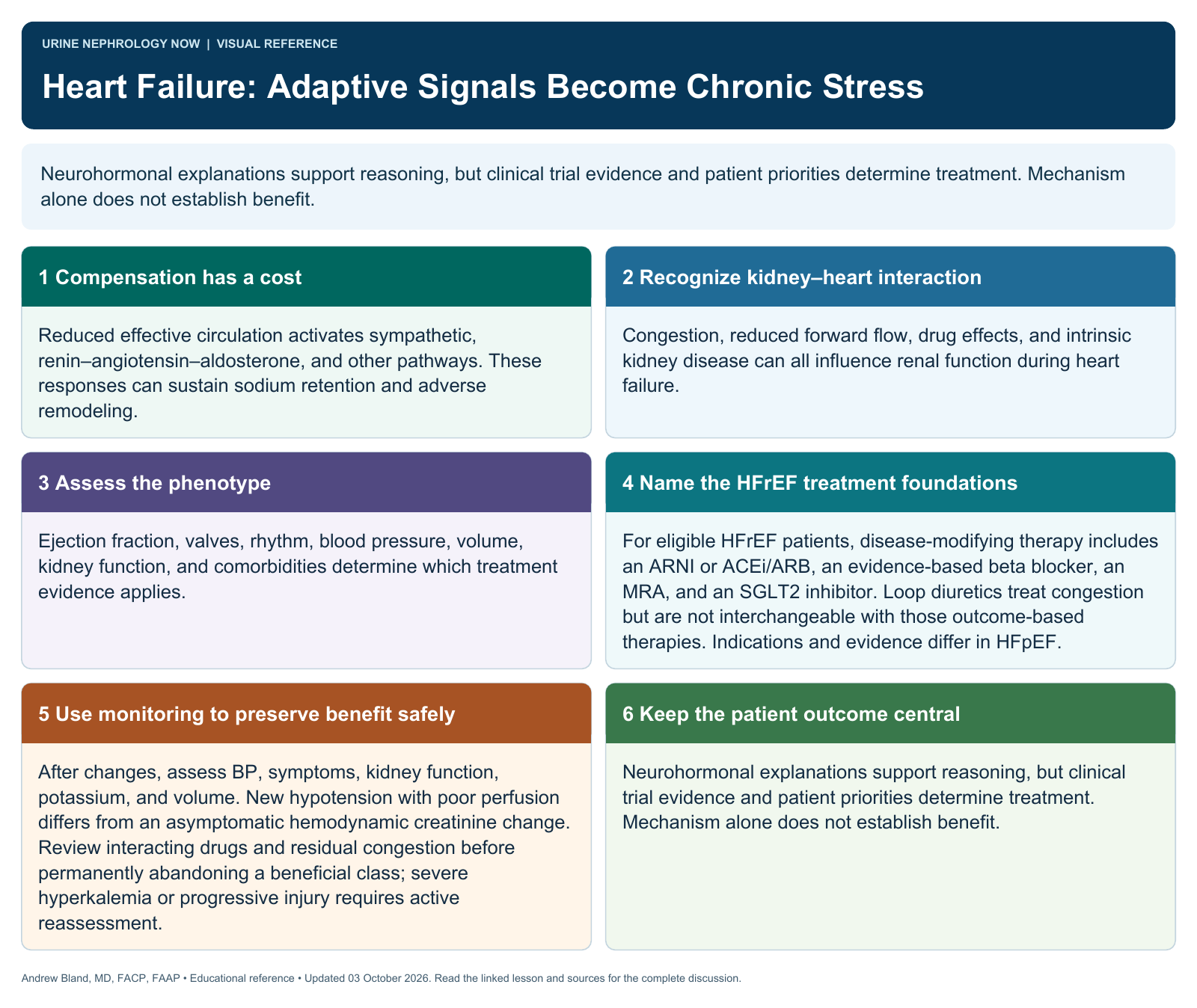
Browse the visual reference library · Download lesson Markdown
1. From compensation to chronic maladaptation
Reduced effective perfusion and increased filling pressures activate sympathetic, renin–angiotensin–aldosterone, and vasopressin pathways. These responses can initially defend circulation, yet persistent activation contributes to vasoconstriction, sodium retention, arrhythmia, inflammation, and remodeling. Natriuretic peptide pathways provide counter-regulatory signals, including vasodilation and natriuresis. The balance is dynamic and influenced by kidney function, tissue responses, and comorbid disease.
This physiology explains plausible drug targets, but clinical benefit must be demonstrated in an appropriate population. A stronger laboratory effect, receptor affinity, or biochemical selectivity does not automatically mean greater survival benefit. Nor does one pathway become the only important target at a particular NYHA class. Patients often need several complementary treatments and a plan to deliver them safely.
The major phenotype distinction is between HFrEF, mildly reduced EF, and HFpEF, with recognition of prior EF and changes over time. Clinical HF is more than an imaging percentage: symptoms, signs, structure, filling pressures, and alternative diagnoses matter. CKD adds prognostic information and affects drug eligibility and monitoring, but does not supply a universal preference for one drug class at an arbitrary eGFR boundary. HF guideline.
2. Reading comparative evidence correctly
When comparing therapies, first write down the study population, comparator, background treatment, outcome definition, and follow-up. A placebo comparison from an earlier treatment era cannot be directly ranked against an active-comparator trial conducted decades later. Relative risks also depend on the measure used: a hazard ratio, recurrent-event rate ratio, and risk ratio answer different questions.
Absolute event proportions are helpful when accompanied by the same endpoint and time horizon. For a suitable fixed-period binary outcome, an absolute risk difference can be calculated from the two event risks, with attention to censoring and uncertainty. A reciprocal risk difference is not automatically appropriate for a recurrent-event analysis. Avoid moving an NNT between populations or claiming that separate drug-class benefits can simply be added.
| Evidence question | Appropriate inference | Inference to avoid |
|---|---|---|
| One drug versus another in a randomized trial | Comparative effect for the enrolled population and specified endpoint | Universal superiority in every indication. |
| Similar drugs in separate placebo trials | Each has evidence in its own trial setting | A head-to-head safety or efficacy ranking. |
| Subgroup analysis | A potentially relevant signal, considering interaction tests and uncertainty | Proof that one subgroup has no benefit because its confidence interval crosses one. |
| Biomarker trial | Effect on the measured marker over the studied interval | Unmeasured mortality, dialysis, or hospitalization benefit. |
| Mechanistic experiment | Biological plausibility or pathway effect | A validated prescribing threshold. |
These distinctions are especially important when teaching ACE inhibitors versus ARBs, steroidal versus nonsteroidal MRAs, and the possible importance of natriuretic-peptide resistance. An attractive physiological explanation does not repair a missing clinical comparison.
3. ACE inhibitors, ARBs, and ARNIs
ACE inhibitors reduce angiotensin II generation and influence bradykinin metabolism; ARBs block the angiotensin II type 1 receptor; sacubitril/valsartan combines neprilysin inhibition with an ARB. These differences help explain adverse effects and possible mechanisms. They do not establish an all-purpose ARNI > ACE inhibitor > ARB hierarchy across hypertension, CKD, HFrEF, and HFpEF.
PARADIGM-HF provides a direct HFrEF comparison. Sacubitril/valsartan reduced the primary cardiovascular-death or HF-hospitalization outcome relative to enalapril. The observed primary event proportions were 21.8% versus 26.5% over median 27-month follow-up, with HR 0.80. All-cause death occurred in 17.0% versus 19.8%, with HR 0.84. The different absolute effects belong to different outcomes and should not be combined. Run-in requirements and trial selection also matter when applying the findings. PARADIGM-HF.
PIONEER-HF compared sacubitril/valsartan with enalapril after hemodynamic stabilization during an HFrEF hospitalization. Its primary endpoint was time-averaged proportional NT-proBNP change; the reduction was greater with sacubitril/valsartan. This supports an opportunity to initiate therapy during a suitable admission, not treatment during unstable shock or omission of transition precautions. PIONEER-HF.
PARAGON-HF, involving EF at least 45%, did not significantly reduce its primary composite of total HF hospitalizations and cardiovascular death in the overall trial. Subgroup patterns require careful interpretation and do not make the HFrEF result universally applicable. UK HARP-III found similar kidney-function and albuminuria effects between sacubitril/valsartan and irbesartan over 12 months in CKD. PARAGON-HF, UK HARP-III.
| Study | Comparison | Primary question | Main teaching point |
|---|---|---|---|
| PARADIGM-HF | Sacubitril/valsartan versus enalapril | CV death or HF hospitalization in reduced EF | A direct beneficial HFrEF comparison. |
| PIONEER-HF | Sacubitril/valsartan versus enalapril after stabilization | NT-proBNP change during early follow-up | In-hospital initiation is possible in selected stable patients. |
| PARAGON-HF | Sacubitril/valsartan versus valsartan in higher EF | Total HF hospitalizations plus CV death | Overall primary result was not statistically significant. |
| UK HARP-III | Sacubitril/valsartan versus irbesartan in CKD | Kidney function at 12 months | HF superiority does not imply superior measured GFR preservation. |
Safe switching is part of efficacy in practice. There must be at least 36 hours between an ACE inhibitor and sacubitril/valsartan in either direction. The previous ARB is stopped because the combination already contains valsartan. Review hypotension, potassium, kidney function, angioedema history, pregnancy-related contraindications, and interactions. Do not prescribe an unsupported extended washout simply because CKD is present. Prescribing information.
4. Steroidal MRAs: established evidence and limits
RALES tested spironolactone in severe systolic HF and demonstrated a mortality benefit. EMPHASIS-HF tested eplerenone in systolic HF with milder symptoms and reduced the composite of cardiovascular death or HF hospitalization. Differences in symptoms, EF, background therapy, and follow-up are important; the trials do not identify a single universal absolute benefit for all patients receiving an MRA. RALES, EMPHASIS-HF.
TOPCAT studied spironolactone in HF with preserved EF. Its overall primary composite result was not statistically significant, although HF hospitalization was reduced. Regional patterns and concerns about differences in enrolled populations complicate interpretation. A secondary outcome or regional analysis should not be presented as the overall primary result. TOPCAT.
Hyperkalemia and kidney-function changes are central safety considerations. Spironolactone can also produce endocrine adverse effects. Drug selection should consider the actual indication, eligibility, adverse-effect profile, cost, interactions, and monitoring capacity. Do not switch every patient with HFrEF to a different MRA solely because it is newer or labeled nonsteroidal.
5. Finerenone: distinguish three evidence settings
The first setting is CKD with type 2 diabetes. FIDELIO-DKD demonstrated benefit for its prespecified kidney composite, and FIGARO-DKD demonstrated benefit for its cardiovascular composite, on background RAAS blockade in selected patients. Their entry criteria and primary outcomes differ. A kidney outcome trial is not a direct substitute for a trial of mortality in HFrEF. FIDELIO-DKD, FIGARO-DKD.
The second setting is HF with mildly reduced or preserved EF. FINEARTS-HF randomized 6001 participants with LVEF at least 40%. The primary outcome counted first and recurrent worsening-HF events together with cardiovascular death. Finerenone reduced that event rate: rate ratio 0.84, 95% CI 0.74–0.95. This is a 16% relative rate reduction, not 29%. Cardiovascular death alone was not significantly reduced. Hyperkalemia increased and hypokalemia decreased. FINEARTS-HF.
The third setting is combination therapy in CKD with type 2 diabetes. CONFIDENCE compared finerenone, empagliflozin, and their combination on background RAAS inhibition. Its primary assessment was UACR change at day 180. Combination therapy lowered albuminuria more, but the trial did not establish a new reduction in dialysis or mortality from starting the two together. CONFIDENCE.
| Evidence setting | Relevant endpoint | What remains uncertain from that study alone |
|---|---|---|
| FIDELIO-DKD | Prespecified kidney composite | Superiority to spironolactone/eplerenone for HFrEF. |
| FIGARO-DKD | CV death, MI, stroke, or HF hospitalization composite | Equal benefit for every individual component or every CKD phenotype. |
| FINEARTS-HF | Total worsening-HF events plus CV death | A significant mortality benefit considered separately, or superiority to another MRA. |
| CONFIDENCE | Albuminuria change at 180 days | Long-term clinical-outcome advantage of simultaneous combination initiation. |
The 2024 Lancet individual-patient analysis included four trials, not three: RALES, EMPHASIS-HF, TOPCAT, and FINEARTS-HF. Across 13,846 participants, the investigators evaluated a first-event composite and additional outcomes. The findings support benefit across studied EF ranges with differences in mortality evidence. Because drug identity and phenotype were linked to the included trials, this was not a randomized comparison of steroidal against nonsteroidal MRAs. Individual-patient analysis.
An evidence table should therefore show trial names, populations, and outcomes rather than assign an unexplained confidence score. In particular, subgroup boundaries around eGFR 30, 45, or 60 should not be converted into a categorical class preference without indication-specific evidence and prescribing constraints.
6. The natriuretic peptide system: physiology versus a clinical rule
ANP and BNP participate in volume and pressure regulation through receptor-linked cGMP signaling. Advanced disease may involve changes in secretion, processing, receptor signaling, clearance, and downstream responses. The term “natriuretic peptide resistance” describes physiological concepts but is not a routinely validated bedside diagnosis defined by NYHA class, CKD stage, or one circulating concentration.
A high NT-proBNP value reflects a combination of production, clearance, and clinical circumstances. It does not prove that the kidney has become irreversibly resistant to BNP. Neither NT-proBNP above 1000 or 3000 pg/mL nor an asserted cGMP:BNP ratio below 0.15 is an established prescribing threshold for an ARNI. Similarly, a low post-diuretic urine sodium is a response marker, not a direct receptor assay.
The rationale for timely indicated treatment is the demonstrated clinical evidence and the risk of leaving disease untreated, not a proven opportunity to prevent an irreversible peptide-resistance stage. Patients with advanced symptoms still require evidence-based assessment and treatment; a mechanistic label should not be used to withhold care.
Natriuretic peptides can be elevated despite congestion because a circulating hormone concentration is not the same as effective physiological response. Other pathways, renal disease, drug delivery, and hemodynamics contribute. Avoid turning this observation into the unsupported claim that vasopressin and aldosterone always remain fully effective while BNP becomes uniformly ineffective at a particular stage.
7. BNP and NT-proBNP in monitoring
Interpret biomarkers alongside symptoms, examination, rhythm, body size, kidney function, recent treatment, and prior values. Obesity may lower concentrations; atrial fibrillation and CKD may raise them. A low value in one context and a high value in another carry different diagnostic implications. Use the appropriate diagnostic framework rather than one cutoff for every patient.
Neprilysin inhibition changes BNP handling, which can complicate serial interpretation after treatment begins. NT-proBNP is not a neprilysin substrate and is often useful for following wall-stress-related change. Nevertheless, neither marker replaces assessment of congestion, perfusion, blood pressure, or electrolytes. Daily measurement should have an explicit question and a plausible effect on care.
GUIDE-IT randomized high-risk HFrEF patients to an NT-proBNP-guided strategy or usual care and was stopped for futility. A target concentration did not improve the primary clinical outcome beyond the comparison care. This does not erase the diagnostic or prognostic value of NT-proBNP; it limits the claim that chasing a number necessarily improves outcomes. GUIDE-IT.
Spot urine sodium after a loop diuretic addresses a different question: whether the administered treatment is producing an adequate natriuretic response. Timing, dose, prior diuretics, urine flow, and kidney function affect interpretation. PUSH-AHF improved natriuresis with its response-guided algorithm but did not demonstrate a significant benefit on the 180-day mortality/HF-rehospitalization endpoint. Use this distinction when teaching a protocol. PUSH-AHF.
8. Timing, sequencing, and complementary treatment
HFrEF therapy is usually built from complementary evidence-based classes, with prompt introduction and titration as tolerated. There is no need to finish months of titration of one class before considering the others, but the pace must respect stability and follow-up capacity. Hypotension, bradycardia, congestion, potassium, kidney function, adverse effects, and cost influence sequencing.
Evidence-based beta-blockers address sympathetic activation and are foundational in HFrEF. SGLT2 inhibitors have independent evidence from DAPA-HF and EMPEROR-Reduced, and higher-EF evidence from EMPEROR-Preserved and DELIVER. This broadens the treatment framework beyond a contest among RAAS drugs. The HFrEF package should not be imposed identically on HFpEF, where comorbidity and phenotype-specific choices are especially important. DAPA-HF, EMPEROR-Reduced, EMPEROR-Preserved, DELIVER.
STRONG-HF tested a package of rapid titration and frequent follow-up after acute HF admission. The primary composite of HF readmission or all-cause death was improved at 180 days; more overall adverse events occurred with intensive care, while serious adverse events were similar. The lesson is organized, monitored implementation—not maximum dosing without reassessment. STRONG-HF.
For a patient with symptomatic low blood pressure, first establish whether this represents poor perfusion, excessive diuresis, another medication, or a tolerated baseline. For recurrent hyperkalemia, review reversible causes and the indications for each potassium-affecting therapy. For worsening kidney function, assess trajectory, volume/perfusion, and competing kidney disease. These reviews can preserve beneficial therapy while addressing the actual safety problem.
9. CKD, frailty, and acute illness
Reduced kidney function increases the need for careful prescribing but does not make every hemodynamic eGFR change evidence of nephrotoxicity. Conversely, significant AKI should not be dismissed because a drug is beneficial long term. Monitor changes after initiation and dose adjustment, with closer follow-up when baseline potassium is high, kidney function is unstable, or several interacting treatments are combined.
Trial exclusions and product contraindications are different. A subgroup underrepresented in a trial creates uncertainty; it does not automatically establish an absolute contraindication. Use the current product information and relevant guidance, and make uncertainty explicit in advanced CKD or dialysis rather than extrapolating from a small or absent evidence base.
Frailty, falls, cognition, caregiver support, nutrition, and treatment burden can change priorities and the feasible monitoring plan. A medication list that is theoretically complete but impossible to obtain or take is not an effective regimen. Simplify where possible, confirm understanding, and discuss expected benefits in relation to the person's goals.
During vomiting, poor intake, infection, or a procedure, medicine decisions must be individualized. A dehydrated patient and a congested patient may need different diuretic instructions. MRAs are not automatically safe to continue during AKI or hyperkalemia. SGLT2 inhibitors require illness and fasting precautions appropriate to ketoacidosis risk. Any temporary hold should specify who reassesses the patient and when indicated therapy will be restarted.
10. An evidence-to-action table
| Decision | Evidence basis | Practical boundary |
|---|---|---|
| Sacubitril/valsartan in eligible HFrEF | Direct randomized comparison with enalapril | Respect stability, transition precautions, tolerability, and indication. |
| Spironolactone/eplerenone in eligible HFrEF | RALES and EMPHASIS-HF | Monitor potassium and kidney function; do not import one trial's absolute effect into all patients. |
| Finerenone in the appropriate CKD/T2D or higher-EF HF setting | Separate trials with distinct endpoints | Avoid assumed head-to-head superiority or unproven mortality claims. |
| SGLT2 inhibition for eligible HF/CKD | Multiple indication-specific outcome trials | Match eligibility, safety precautions, and product guidance. |
| Early post-discharge optimization | A monitored implementation trial | Follow-up is part of the intervention. |
| Biomarker-supported assessment | Diagnostic/prognostic evidence; selected treatment-strategy trials | A prognostic marker is not automatically a validated treatment target. |
This table replaces arbitrary numeric confidence rankings. Confidence depends on the specific outcome, directness, precision, study design, and applicability—not just the prestige of a trial or the plausibility of a mechanism.
11. Applied discussion cases
Synthetic case A: A patient with stable HFrEF, CKD, and ACE-inhibitor treatment is being considered for sacubitril/valsartan. The team should confirm indication and tolerability, review potassium and kidney function, clarify angioedema history, write the stop/start schedule with the 36-hour interval, and arrange follow-up. CKD does not justify an invented week-long washout or simultaneous ACE inhibitor and ARNI use.
Synthetic case B: A patient with HFpEF, type 2 diabetes, albuminuria, and borderline potassium asks whether finerenone is “better” than spironolactone. Explain which trials support each relevant indication, then discuss potassium, kidney function, other medications, cost, and monitoring. FINEARTS-HF supports benefit versus placebo for its recurrent-event composite; it does not directly answer which MRA is superior for this individual.
Synthetic case C: A patient improves clinically during decongestion but NT-proBNP remains high. Reassess the clinical course and relevant confounders instead of diagnosing irreversible peptide resistance or escalating treatment solely to normalize the value. The biomarker may remain prognostically useful while the immediate therapeutic decision depends on congestion, perfusion, renal function, and electrolytes.
A useful teaching explanation names the intervention, the patient population, the comparator, and the endpoint before quoting an effect. It then connects that evidence to an achievable monitoring and follow-up plan.
Full references
1. Heidenreich PA, Bozkurt B, Aguilar D, et al. 2022 AHA/ACC/HFSA Guideline for the Management of Heart Failure: A Report of the American College of Cardiology/American Heart Association Joint Committee on Clinical Practice Guidelines. Circulation. 2022;145(18):e895-e1032. PubMed 35363499
2. McMurray JJ, Packer M, Desai AS, et al. Angiotensin-neprilysin inhibition versus enalapril in heart failure. N Engl J Med. 2014;371(11):993-1004. PubMed 25176015
3. Velazquez EJ, Morrow DA, DeVore AD, et al. Angiotensin-Neprilysin Inhibition in Acute Decompensated Heart Failure. N Engl J Med. 2019;380(6):539-548. PubMed 30415601
4. Solomon SD, McMurray JJV, Anand IS, et al. Angiotensin-Neprilysin Inhibition in Heart Failure with Preserved Ejection Fraction. N Engl J Med. 2019;381(17):1609-1620. PubMed 31475794
5. Haynes R, Judge PK, Staplin N, et al. Effects of Sacubitril/Valsartan Versus Irbesartan in Patients With Chronic Kidney Disease. Circulation. 2018;138(15):1505-1514. PubMed 30002098
6. Pitt B, Zannad F, Remme WJ, et al. The effect of spironolactone on morbidity and mortality in patients with severe heart failure. Randomized Aldactone Evaluation Study Investigators. N Engl J Med. 1999;341(10):709-17. PubMed 10471456
7. Zannad F, McMurray JJ, Krum H, et al. Eplerenone in patients with systolic heart failure and mild symptoms. N Engl J Med. 2011;364(1):11-21. PubMed 21073363
8. Pitt B, Pfeffer MA, Assmann SF, et al. Spironolactone for heart failure with preserved ejection fraction. N Engl J Med. 2014;370(15):1383-92. PubMed 24716680
9. Bakris GL, Agarwal R, Anker SD, et al. Effect of Finerenone on Chronic Kidney Disease Outcomes in Type 2 Diabetes. N Engl J Med. 2020;383(23):2219-2229. PubMed 33264825
10. Pitt B, Filippatos G, Agarwal R, et al. Cardiovascular Events with Finerenone in Kidney Disease and Type 2 Diabetes. N Engl J Med. 2021;385(24):2252-2263. PubMed 34449181
11. Solomon SD, McMurray JJV, Vaduganathan M, et al. Finerenone in Heart Failure with Mildly Reduced or Preserved Ejection Fraction. N Engl J Med. 2024;391(16):1475-1485. PubMed 39225278
12. Agarwal R, Green JB, Heerspink HJL, et al. Finerenone with Empagliflozin in Chronic Kidney Disease and Type 2 Diabetes. N Engl J Med. 2025;393(6):533-543. PubMed 40470996
13. Jhund PS, Talebi A, Henderson AD, et al. Mineralocorticoid receptor antagonists in heart failure: an individual patient level meta-analysis. Lancet. 2024;404(10458):1119-1131. PubMed 39232490
14. Felker GM, Anstrom KJ, Adams KF, et al. Effect of Natriuretic Peptide-Guided Therapy on Hospitalization or Cardiovascular Mortality in High-Risk Patients With Heart Failure and Reduced Ejection Fraction: A Randomized Clinical Trial. JAMA. 2017;318(8):713-720. PubMed 28829876
15. Ter Maaten JM, Beldhuis IE, van der Meer P, et al. Natriuresis-guided diuretic therapy in acute heart failure: a pragmatic randomized trial. Nat Med. 2023;29(10):2625-2632. PubMed 37640861
16. McMurray JJV, Solomon SD, Inzucchi SE, et al. Dapagliflozin in Patients with Heart Failure and Reduced Ejection Fraction. N Engl J Med. 2019;381(21):1995-2008. PubMed 31535829
17. Packer M, Anker SD, Butler J, et al. Cardiovascular and Renal Outcomes with Empagliflozin in Heart Failure. N Engl J Med. 2020;383(15):1413-1424. PubMed 32865377
18. Anker SD, Butler J, Filippatos G, et al. Empagliflozin in Heart Failure with a Preserved Ejection Fraction. N Engl J Med. 2021;385(16):1451-1461. PubMed 34449189
19. Solomon SD, McMurray JJV, Claggett B, et al. Dapagliflozin in Heart Failure with Mildly Reduced or Preserved Ejection Fraction. N Engl J Med. 2022;387(12):1089-1098. PubMed 36027570
20. Mebazaa A, Davison B, Chioncel O, et al. Safety, tolerability and efficacy of up-titration of guideline-directed medical therapies for acute heart failure (STRONG-HF): a multinational, open-label, randomised, trial. Lancet. 2022;400(10367):1938-1952. PubMed 36356631