Visual summary
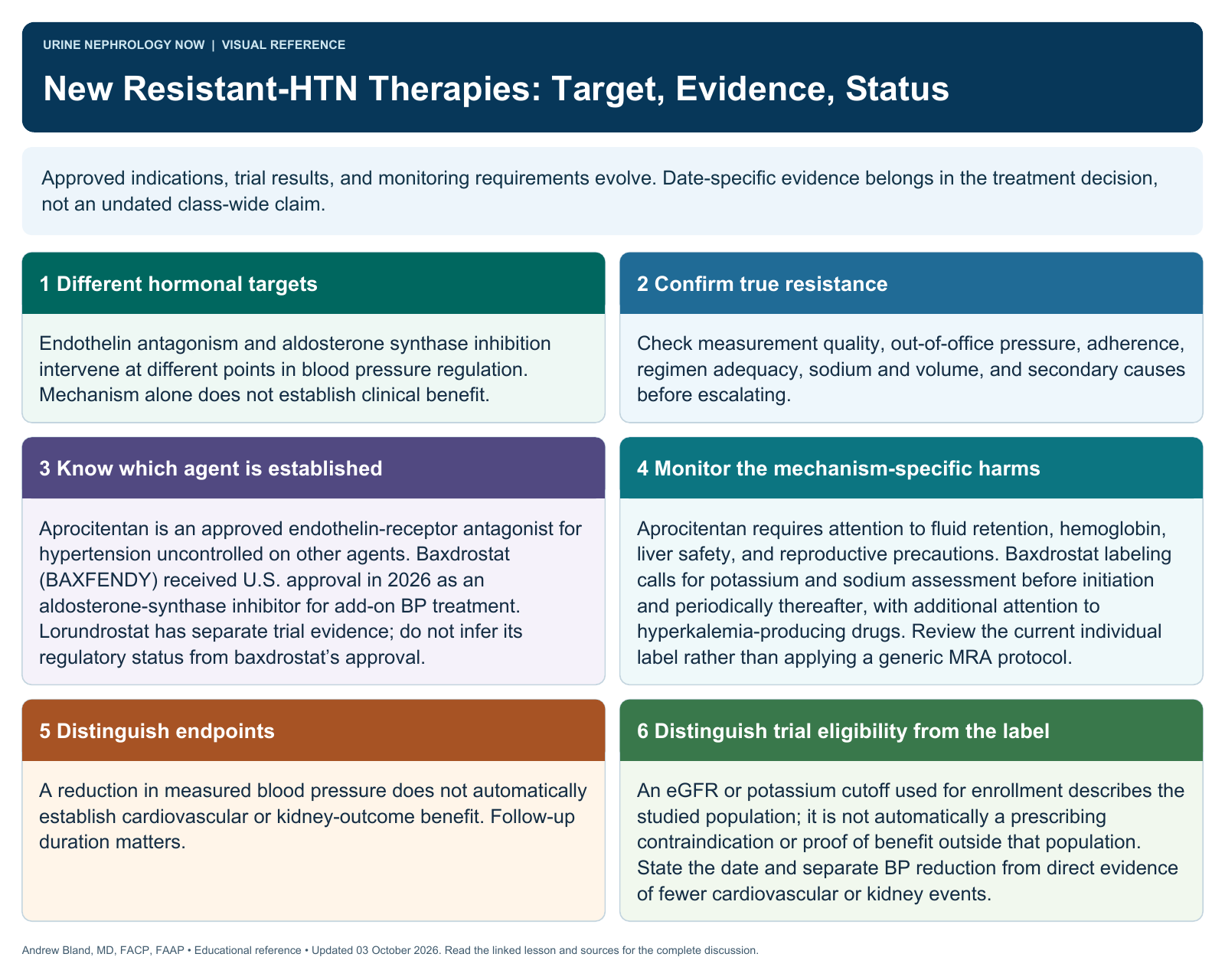
Approved indications, trial results, and monitoring requirements evolve. Date-specific evidence belongs in the treatment decision, not an undated class-wide claim.
Text version
Different hormonal targets
Endothelin antagonism and aldosterone synthase inhibition intervene at different points in blood pressure regulation. Mechanism alone does not establish clinical benefit.
Confirm true resistance
Check measurement quality, out-of-office pressure, adherence, regimen adequacy, sodium and volume, and secondary causes before escalating.
Compare the evidence
Aprocitentan, baxdrostat, and lorundrostat have distinct trials, populations, adverse effects, and regulatory status. Verify each agent separately.
Anticipate mechanism-related harms
Fluid retention, electrolyte changes, kidney effects, and endocrine consequences require attention according to the specific drug.
Distinguish endpoints
A reduction in measured blood pressure does not automatically establish cardiovascular or kidney-outcome benefit. Follow-up duration matters.
Check status at the point of use
Approved indications, trial results, and monitoring requirements evolve. Date-specific evidence belongs in the treatment decision, not an undated class-wide claim.
Continue learning
This graphic summarizes a topic. The full educational pages provide the broader discussion and references.