Visual summary
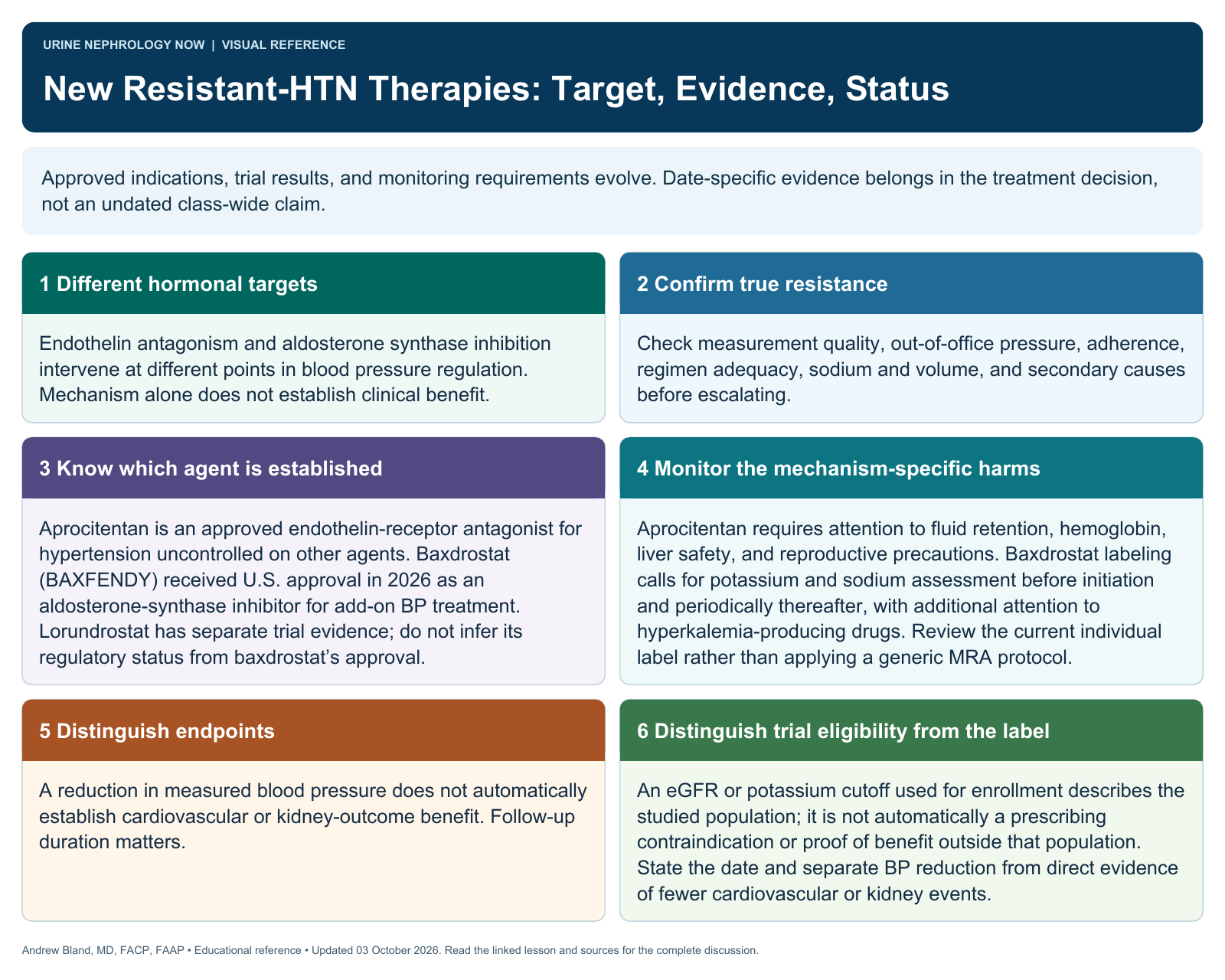
Approved indications, trial results, and monitoring requirements evolve. Date-specific evidence belongs in the treatment decision, not an undated class-wide claim.
Text version
Different hormonal targets
Endothelin antagonism and aldosterone synthase inhibition intervene at different points in blood pressure regulation. Mechanism alone does not establish clinical benefit.
Confirm true resistance
Check measurement quality, out-of-office pressure, adherence, regimen adequacy, sodium and volume, and secondary causes before escalating.
Know which agent is established
Aprocitentan is an approved endothelin-receptor antagonist for hypertension uncontrolled on other agents. Baxdrostat (BAXFENDY) received U.S. approval in 2026 as an aldosterone-synthase inhibitor for add-on BP treatment. Lorundrostat has separate trial evidence; do not infer its regulatory status from baxdrostat’s approval.
Monitor the mechanism-specific harms
Aprocitentan requires attention to fluid retention, hemoglobin, liver safety, and reproductive precautions. Baxdrostat labeling calls for potassium and sodium assessment before initiation and periodically thereafter, with additional attention to hyperkalemia-producing drugs. Review the current individual label rather than applying a generic MRA protocol.
Distinguish endpoints
A reduction in measured blood pressure does not automatically establish cardiovascular or kidney-outcome benefit. Follow-up duration matters.
Distinguish trial eligibility from the label
An eGFR or potassium cutoff used for enrollment describes the studied population; it is not automatically a prescribing contraindication or proof of benefit outside that population. State the date and separate BP reduction from direct evidence of fewer cardiovascular or kidney events.