Visual summary
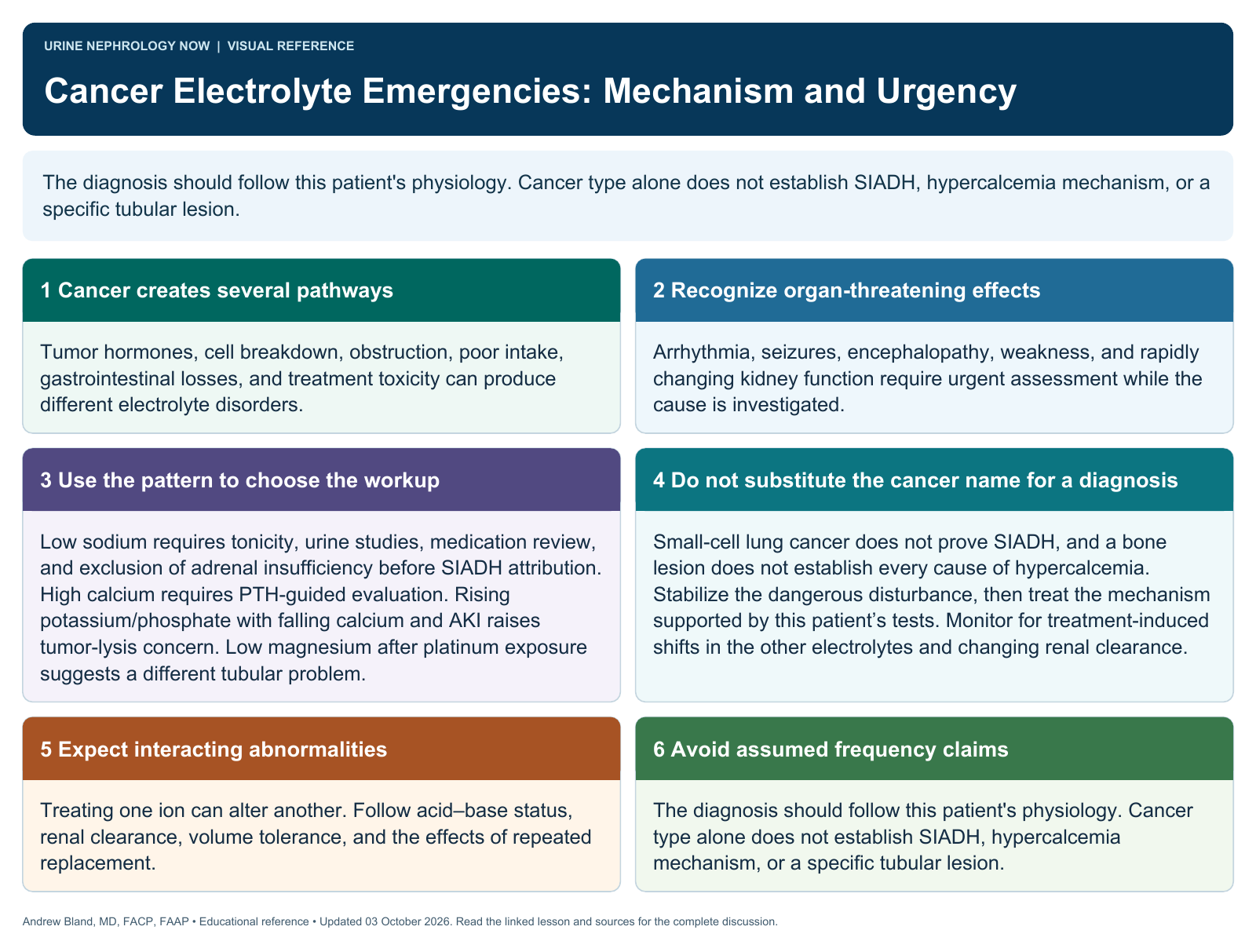
The diagnosis should follow this patient's physiology. Cancer type alone does not establish SIADH, hypercalcemia mechanism, or a specific tubular lesion.
Text version
Cancer creates several pathways
Tumor hormones, cell breakdown, obstruction, poor intake, gastrointestinal losses, and treatment toxicity can produce different electrolyte disorders.
Recognize organ-threatening effects
Arrhythmia, seizures, encephalopathy, weakness, and rapidly changing kidney function require urgent assessment while the cause is investigated.
Use the pattern
Consider calcium with PTH, sodium with tonicity and urine studies, and potassium/phosphate changes with possible cell lysis. Magnesium loss can accompany platinum therapy.
Treat two problems together
Stabilize the electrolyte disturbance and address the tumor, treatment toxicity, endocrine mechanism, or ongoing loss that sustains it.
Expect interacting abnormalities
Treating one ion can alter another. Follow acid–base status, renal clearance, volume tolerance, and the effects of repeated replacement.
Avoid assumed frequency claims
The diagnosis should follow this patient's physiology. Cancer type alone does not establish SIADH, hypercalcemia mechanism, or a specific tubular lesion.
Continue learning
This graphic summarizes a topic. The full educational pages provide the broader discussion and references.