Visual summary
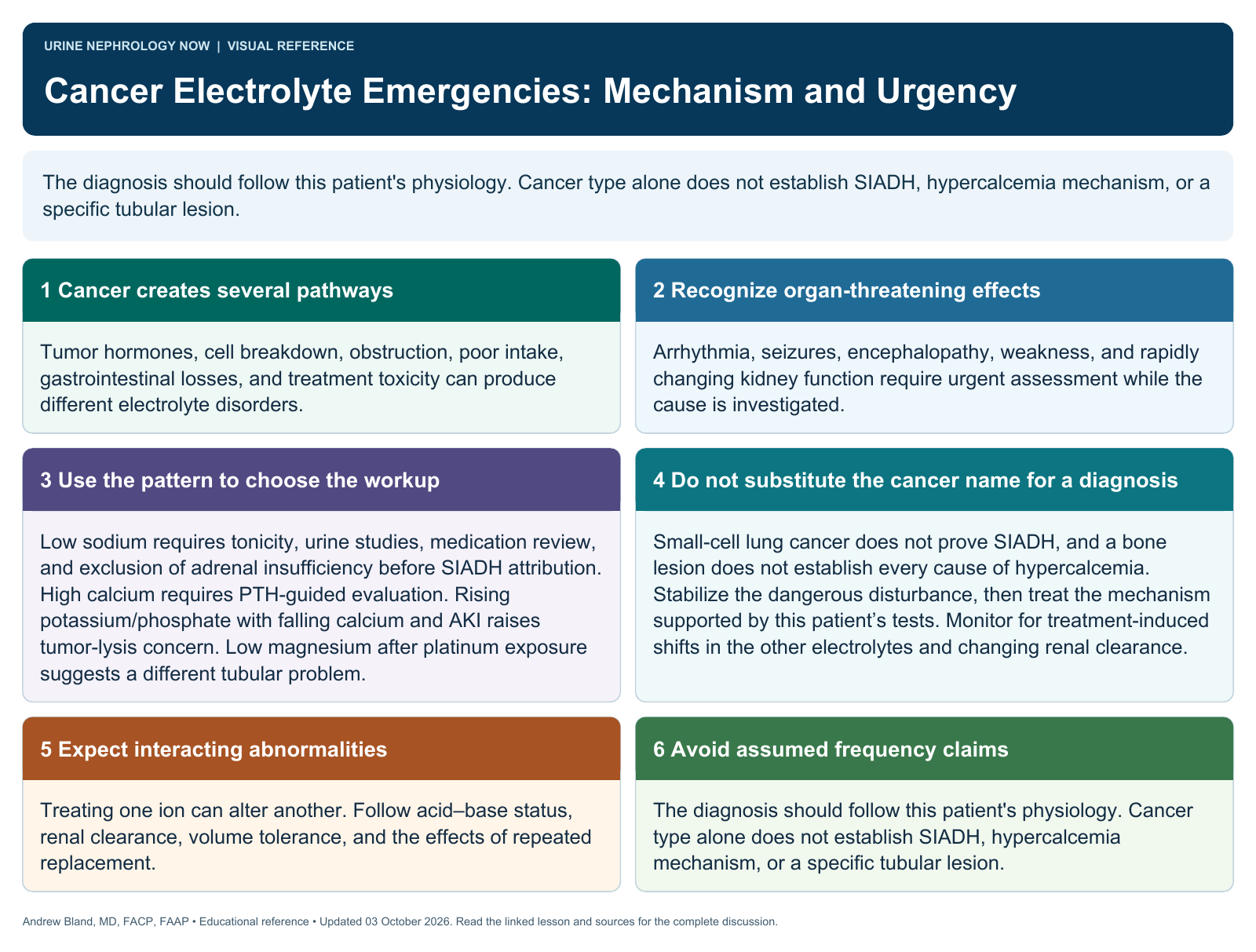
The diagnosis should follow this patient's physiology. Cancer type alone does not establish SIADH, hypercalcemia mechanism, or a specific tubular lesion.
Text version
Cancer creates several pathways
Tumor hormones, cell breakdown, obstruction, poor intake, gastrointestinal losses, and treatment toxicity can produce different electrolyte disorders.
Recognize organ-threatening effects
Arrhythmia, seizures, encephalopathy, weakness, and rapidly changing kidney function require urgent assessment while the cause is investigated.
Use the pattern to choose the workup
Low sodium requires tonicity, urine studies, medication review, and exclusion of adrenal insufficiency before SIADH attribution. High calcium requires PTH-guided evaluation. Rising potassium/phosphate with falling calcium and AKI raises tumor-lysis concern. Low magnesium after platinum exposure suggests a different tubular problem.
Do not substitute the cancer name for a diagnosis
Small-cell lung cancer does not prove SIADH, and a bone lesion does not establish every cause of hypercalcemia. Stabilize the dangerous disturbance, then treat the mechanism supported by this patient’s tests. Monitor for treatment-induced shifts in the other electrolytes and changing renal clearance.
Expect interacting abnormalities
Treating one ion can alter another. Follow acid–base status, renal clearance, volume tolerance, and the effects of repeated replacement.
Avoid assumed frequency claims
The diagnosis should follow this patient's physiology. Cancer type alone does not establish SIADH, hypercalcemia mechanism, or a specific tubular lesion.