Visual summary
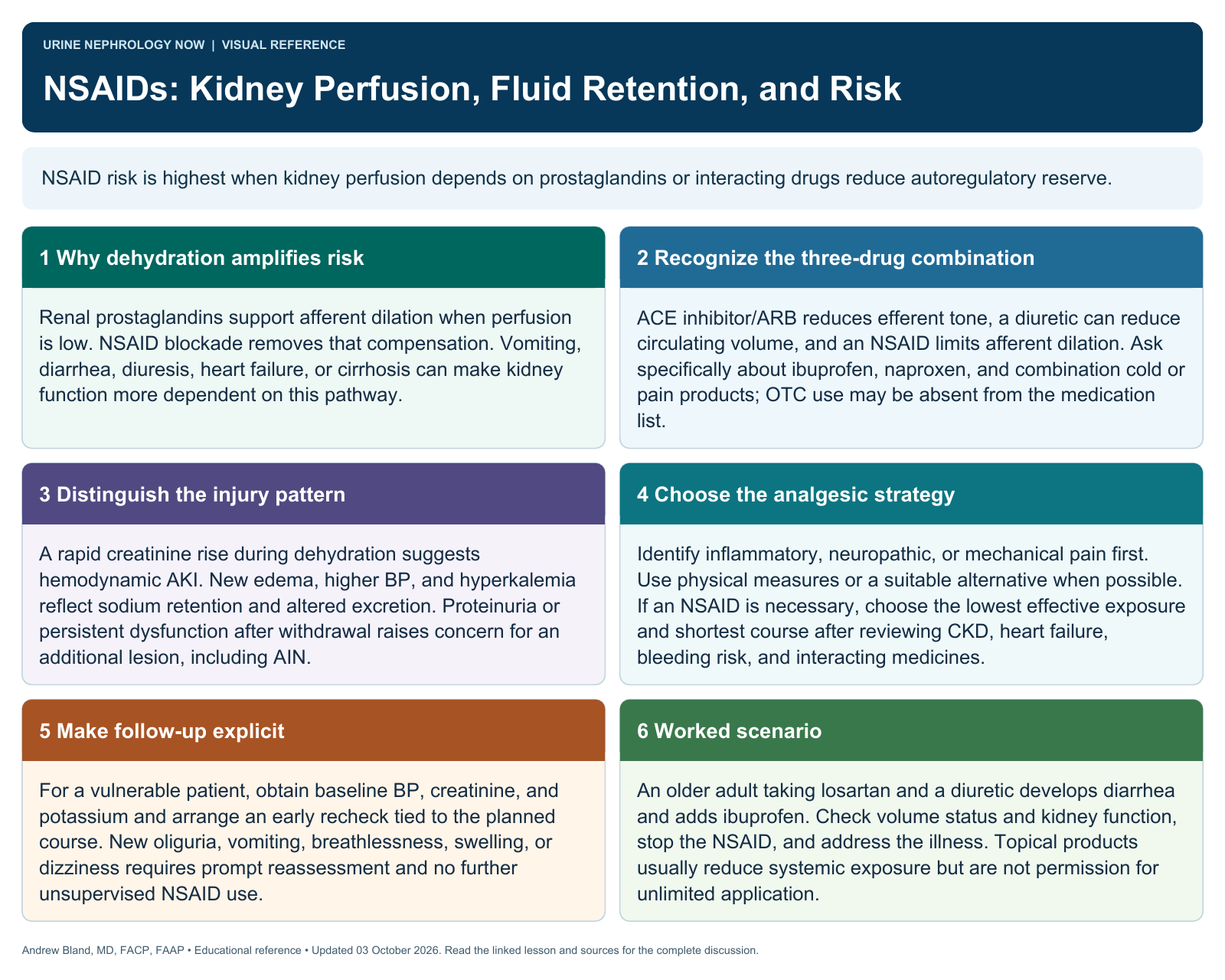
NSAID risk follows physiology and exposure; the combination of impaired perfusion and interacting drugs deserves particular attention.
Text version
Afferent protection is reduced
NSAIDs inhibit prostaglandin synthesis and can reduce compensatory afferent arteriolar dilation. The effect becomes more consequential when renal perfusion depends on that compensation, such as during volume depletion.
More than a creatinine rise
Potential problems include hemodynamic AKI, sodium retention, edema, hypertension, hyperkalemia, and interstitial nephritis. Gastrointestinal and cardiovascular harms also matter when weighing pain relief against medication risk.
Identify vulnerable combinations
Review CKD, heart failure, cirrhosis, recent AKI, dehydration, and concurrent RAAS blockade or diuretics. The NSAID–diuretic–RAAS combination is a recognizable setting for impaired renal autoregulation.
Choose a pain strategy
Clarify the pain mechanism and consider non-drug measures or appropriate alternatives. If an NSAID is used, individualize formulation, dose, duration, and follow-up rather than assuming any regimen is universally safe.
Watch the trajectory
Monitor blood pressure, volume status, creatinine, and potassium when clinical risk warrants it. A new dehydrating illness or escalating diuretic requirement should trigger reassessment of ongoing NSAID exposure.
Topical does not mean risk-free
Topical products generally reduce systemic exposure, but actual absorption depends on product and use. Avoid categorical promises of safety, fixed drug rankings, or interpreting observational associations as proof of comparative superiority.
Continue learning
This graphic summarizes a topic. The full educational pages provide the broader discussion and references.