Visual summary
NSAID risk is highest when kidney perfusion depends on prostaglandins or interacting drugs reduce autoregulatory reserve.
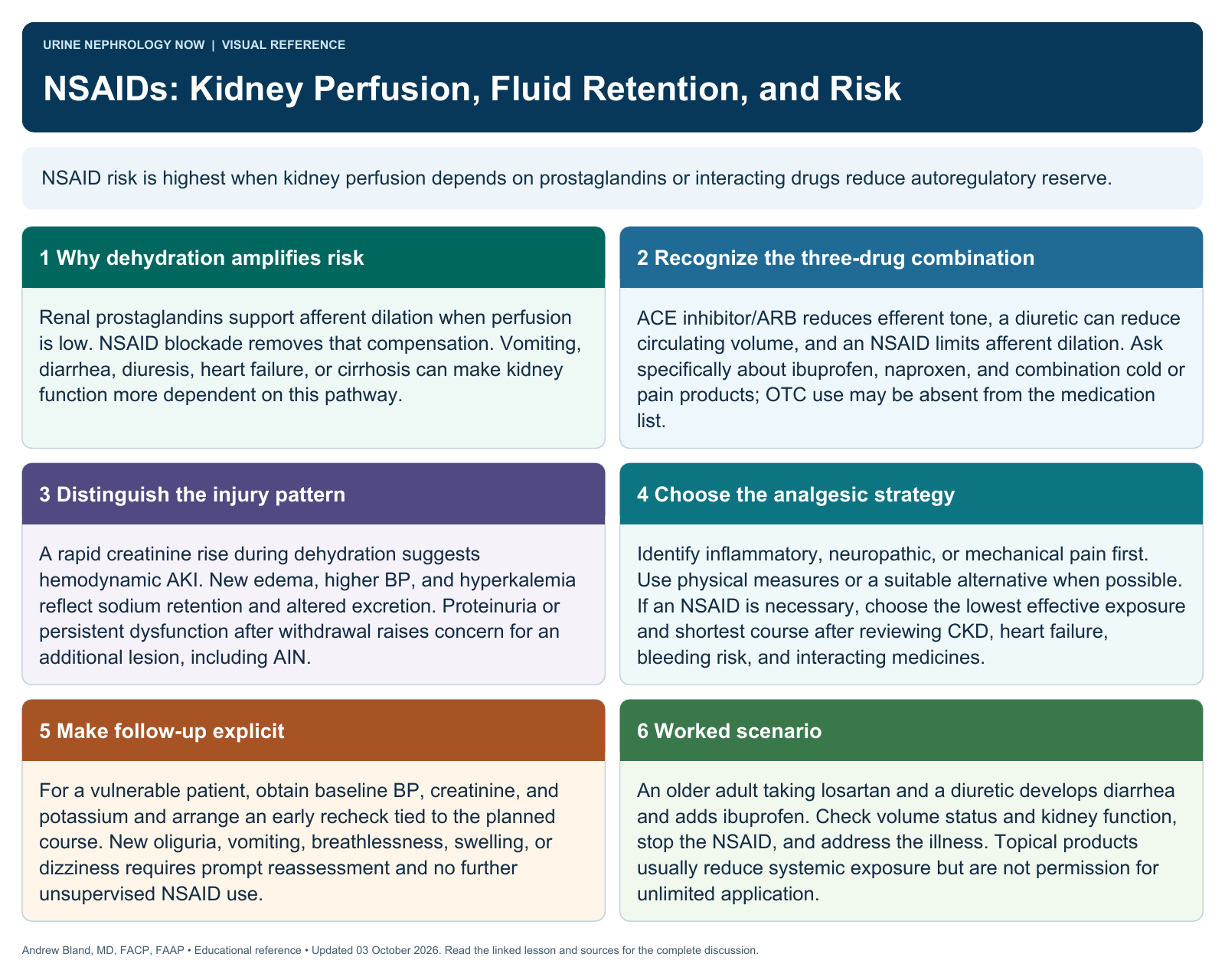
Text version
Why dehydration amplifies risk
Renal prostaglandins support afferent dilation when perfusion is low. NSAID blockade removes that compensation. Vomiting, diarrhea, diuresis, heart failure, or cirrhosis can make kidney function more dependent on this pathway.
Recognize the three-drug combination
ACE inhibitor/ARB reduces efferent tone, a diuretic can reduce circulating volume, and an NSAID limits afferent dilation. Ask specifically about ibuprofen, naproxen, and combination cold or pain products; OTC use may be absent from the medication list.
Distinguish the injury pattern
A rapid creatinine rise during dehydration suggests hemodynamic AKI. New edema, higher BP, and hyperkalemia reflect sodium retention and altered excretion. Proteinuria or persistent dysfunction after withdrawal raises concern for an additional lesion, including AIN.
Choose the analgesic strategy
Identify inflammatory, neuropathic, or mechanical pain first. Use physical measures or a suitable alternative when possible. If an NSAID is necessary, choose the lowest effective exposure and shortest course after reviewing CKD, heart failure, bleeding risk, and interacting medicines.
Make follow-up explicit
For a vulnerable patient, obtain baseline BP, creatinine, and potassium and arrange an early recheck tied to the planned course. New oliguria, vomiting, breathlessness, swelling, or dizziness requires prompt reassessment and no further unsupervised NSAID use.
Worked scenario
An older adult taking losartan and a diuretic develops diarrhea and adds ibuprofen. Check volume status and kidney function, stop the NSAID, and address the illness. Topical products usually reduce systemic exposure but are not permission for unlimited application.