Visual summary
When the goal does not fit safely, review time and treatment planning rather than simply increasing the rate.
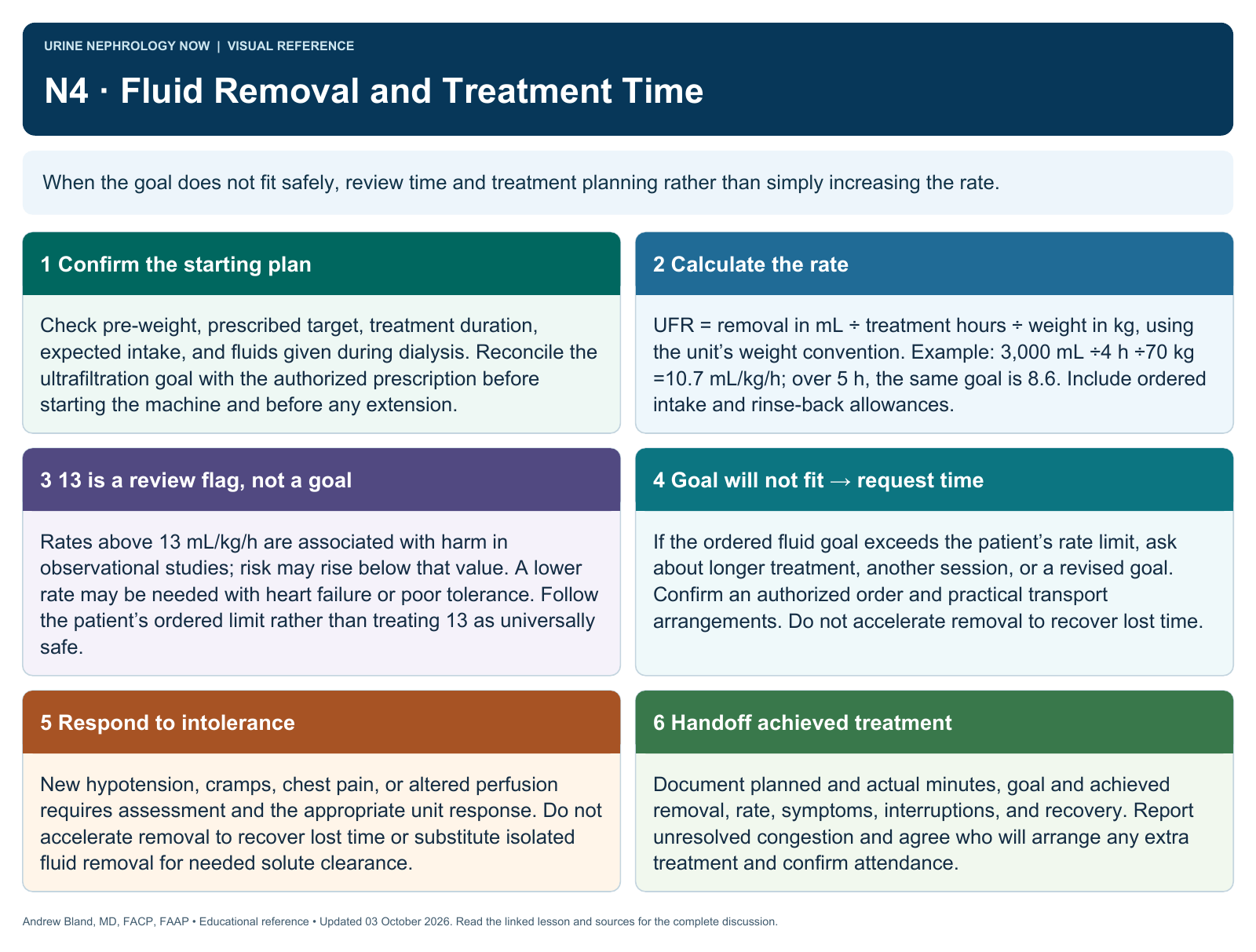
Text version
Confirm the starting plan
Check pre-weight, prescribed target, treatment duration, expected intake, and fluids given during dialysis. Reconcile the ultrafiltration goal with the authorized prescription before starting the machine and before any extension.
Calculate and interpret
Weight-normalized ultrafiltration rate equals planned fluid removal in milliliters divided by treatment hours and the specified body weight in kilograms. Use the unit calculation convention and check the inputs.
A threshold is not a guarantee
Higher removal rates are associated with adverse outcomes, but observational cutoffs do not define a universally safe rate. Cardiac reserve, residual urine, symptoms, and patient size influence tolerance.
Escalate a difficult goal
If the required removal cannot be delivered within the prescribed time and tolerated rate, request review for longer treatment, an additional session, or an adjusted plan. Include the patient’s practical constraints.
Respond to intolerance
New hypotension, cramps, chest pain, or altered perfusion requires assessment and the appropriate unit response. Do not accelerate removal to recover lost time or substitute isolated fluid removal for needed solute clearance.
Handoff achieved treatment
Document planned and actual minutes, goal and achieved removal, rate, symptoms, interruptions, and recovery. Report unresolved congestion and agree who will arrange any extra treatment and confirm attendance.
Continue learning
This graphic summarizes a topic. The full educational pages provide the broader discussion and references.